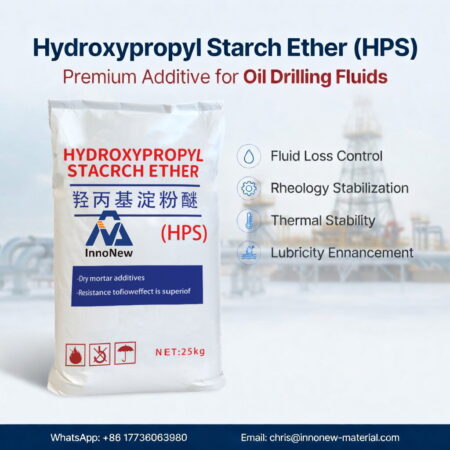
Hydroxypropyl Starch Ether (HPS) in Oil Drilling Fluids
Engineered Polymer for High-Performance Drilling Operations
Why HPS Matters in Modern Drilling Systems
In oil and gas drilling, fluid performance directly impacts:
- Wellbore stability
- Drilling efficiency
- Operational cost
Key challenges include:
- Excessive fluid loss into formations
- Poor rheology control under high shear
- Thermal degradation of additives
👉 Hydroxypropyl Starch Ether (HPS) is engineered to address these challenges by delivering stable filtration control and rheology optimization under demanding drilling conditions.
Core Functions of HPS in Drilling Fluids
1. Fluid Loss Control
- Forms a thin, low-permeability filter cake
- Reduces filtrate invasion into formations
- Enhances wellbore integrity
2. Rheology Stabilization
- Maintains optimal viscosity under shear
- Improves cuttings suspension capacity
- Prevents sedimentation
3. Thermal Stability
- Modified starch structure improves resistance to degradation
- Suitable for medium-temperature drilling environments
4. Lubricity Enhancement
- Improves drilling fluid flow behavior
- Reduces friction during drilling operations
Mechanism of Action
HPS functions through polymer hydration and network formation:
✔ Hydration & Swelling
- Rapid dispersion in water-based drilling fluids
- Forms a structured polymer network
✔ Filter Cake Formation
- Fine particles + polymer matrix
- Reduces permeability of formation interface
✔ Rheological Modification
- Introduces controlled viscosity
- Enhances yield point and gel strength
Performance Benchmark vs Traditional Additives
| Property | Native Starch | HPS |
|---|---|---|
| Fluid Loss Control | Medium | High |
| Thermal Stability | Low | Medium-High |
| Rheology Stability | Low | High |
| Application Consistency | Variable | Stable |
✔ Conclusion: HPS is an upgraded starch derivative designed for drilling-grade performance
Application Scope in Oilfield Systems
HPS is widely used in:
- Water-Based Drilling Fluids (WBM)
- Workover & Completion Fluids
- Low-Solid Drilling Systems
- Horizontal & Directional Drilling
Formulation Strategy
Recommended System Design
- HPS → Fluid loss + rheology
- PAC / CMC → additional filtration control
- Bentonite → base viscosity
Typical Dosage
- HPS: 0.2% – 0.5% (by weight of fluid)
Competitive Advantage
Why Choose Our HPS for Oil Drilling?
- Consistent molecular modification → stable performance
- Optimized for drilling fluid compatibility
- Reliable filtration control under field conditions
- Cost-effective alternative to high-end polymers
✔ Designed for oilfield efficiency and cost optimization
Common Field Problems & HPS Solutions
| Problem | Solution with HPS |
|---|---|
| High fluid loss | Builds effective filter cake |
| Poor cuttings suspension | Improves rheology |
| Fluid instability | Stabilizes viscosity |
| Cost pressure | Reduces additive consumption |
FAQ
1. What is HPS used for in oil drilling?
It controls fluid loss and stabilizes drilling fluid rheology.
2. Is HPS suitable for high-temperature wells?
It is suitable for medium-temperature conditions; modification level affects performance.
3. How does HPS compare with PAC or CMC?
HPS offers cost-effective fluid loss control but is often used in combination.
4. What is the typical dosage?
Usually 0.2%–0.5%, depending on drilling fluid formulation.
5. Can HPS be used in all drilling fluids?
Primarily used in water-based systems.
Call to Action
Looking for a reliable drilling fluid additive?
We provide:
- Oilfield formulation support
- Free sample testing
- Customized polymer solutions
📩 Email: chris@innonew-material.com
📱 WhatsApp: +86 17736063980