
RDP for ETICS / EIFS Systems (External Wall Insulation Solutions)
What is RDP in ETICS/EIFS?
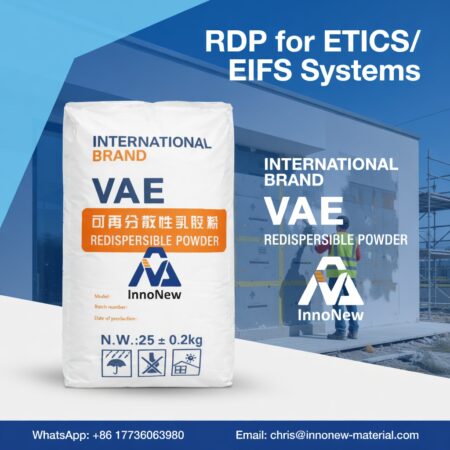
InnoNew® Redispersible Polymer Powder (RDP/VAE) is a critical functional additive in External Thermal Insulation Composite Systems (ETICS/EIFS). It enhances the performance of dry-mix mortars used in:
- Insulation board adhesive mortar
- Base coat (reinforced mortar)
- Skim coat / finishing layer
When dispersed in water, InnoNew® RDP forms a polymer film, significantly improving bonding strength, flexibility, and durability of insulation systems.
Why RDP is Essential for ETICS / EIFS
Modern ETICS systems require materials that can withstand:
- Thermal expansion & contraction
- Environmental stress (rain, UV, freeze-thaw)
- Substrate movement
InnoNew® Redispersible Polymer Powder RDP provides:
✔ High adhesion strength (EPS / XPS / mineral wool)
✔ Crack resistance & flexibility
✔ Water resistance & durability
✔ Impact resistance improvement
✔ Workability & open time optimization
Key Applications of RDP in ETICS
1. Insulation Board Adhesive Mortar
- Strong bonding to wall substrates
- Excellent adhesion to EPS/XPS boards
- Reduced delamination risk
2. Base Coat (Reinforcement Layer)
- Improved tensile strength
- Crack resistance with fiberglass mesh
- Enhanced flexibility under stress
3. Finishing / Skim Coat
- Smooth application
- Surface durability
- Resistance to weathering
Technical Advantages of Our RDP
| Property | Performance Benefit |
|---|---|
| Film Formation | Strong cohesive matrix |
| Flexibility | Prevents cracking |
| Adhesion | Superior bonding strength |
| Water Resistance | Long-term durability |
| Redispersibility | Stable performance in dry mix |
Recommended Formulation Synergy (Critical for Performance)
To achieve TOP-level ETICS performance, RDP should be used together with:
👉 Hydroxypropyl Methyl Cellulose (HPMC)
- Water retention
- Workability improvement
- Open time control
➡ For optimal formulation, pair RDP with our HPMC, learn more about HPMC.
👉 Polycarboxylate Superplasticizer (PCE)
- Improved flowability
- Reduced water demand
- Better mechanical strength
➡ Check PCE Superplasticizer specification and dosage guide
Typical Dosage in ETICS Mortar
| Application | RDP Dosage |
|---|---|
| Adhesive Mortar | 1.5% – 3.0% |
| Base Coat | 2.0% – 4.0% |
| Skim Coat | 1.0% – 2.5% |
Compatible Insulation Materials
- EPS (Expanded Polystyrene)
- XPS (Extruded Polystyrene)
- Mineral Wool
- Rock Wool Panels
Performance Compared to Non-RDP Systems
| Feature | Without RDP | With RDP |
|---|---|---|
| Adhesion | Low | High |
| Flexibility | Brittle | Flexible |
| Crack Resistance | Poor | Excellent |
| Durability | Limited | Long-lasting |
Our RDP Advantages (Supplier Strength)
- Stable polymer quality (consistent batch performance)
- Optimized for ETICS climate conditions
- Excellent compatibility with cement systems
- Global export experience (EU / Asia / Middle East markets)
- Technical support for formulation optimization
FAQ
1. What type of RDP is best for ETICS?
Vinyl acetate-ethylene (VAE) based RDP is most widely used due to its balance of adhesion, flexibility, and cost-performance.
2. How does RDP improve crack resistance?
RDP forms a flexible polymer film that absorbs stress and prevents brittle cracking in cement-based mortars.
3. Can RDP replace HPMC in ETICS?
No. RDP improves mechanical performance, while HPMC controls water retention and workability. Both are essential.
4. What happens if RDP dosage is too low?
- Weak adhesion
- Increased cracking
- Poor durability
5. Is RDP suitable for all climates?
Yes, but formulation adjustments (dosage + additives) are required for extreme hot or cold climates.
Call to Action (High Conversion Design)
👉 Looking for high-performance RDP for ETICS/EIFS systems?
We provide:
- Customized formulation support
- Stable supply chain
- Competitive factory pricing
📩 Contact us now for free samples & technical guidance