
RDP for Repair Mortars & Interface Treatment (Concrete Repair Solutions)
What is RDP in Repair & Interface Mortars?
Redispersible Polymer Powder (RDP) is a key performance additive used in:
- Concrete repair mortars
- Interface treatment mortars (bonding slurry / bonding coat)
- Surface modification layers
RDP enhances cement-based systems by forming a flexible polymer film, significantly improving adhesion to old substrates and ensuring long-term durability in repair applications.
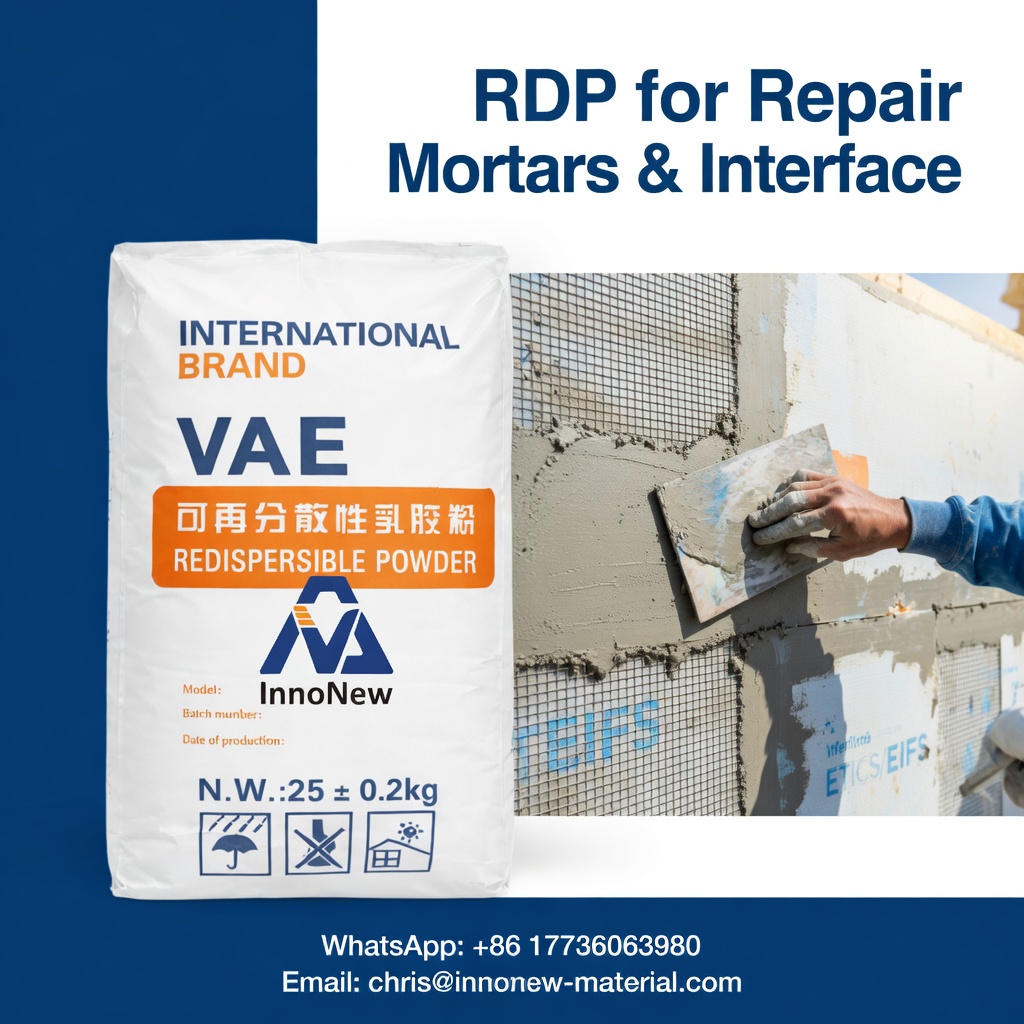
Why RDP is Critical in Concrete Repair Systems
Concrete repair requires materials that can:
- Bond strongly to old concrete substrates
- Resist cracking due to shrinkage and stress
- Maintain durability under harsh environments
RDP enables:
✔ High bond strength to old concrete
✔ Shrinkage crack reduction
✔ Improved flexibility under load
✔ Enhanced water resistance & durability
✔ Better workability for thin-layer applications
Core Applications of RDP in Repair Systems
1. Concrete Repair Mortar (Structural & Non-Structural)
- Restores damaged concrete surfaces
- Improves cohesion and mechanical strength
- Reduces delamination risk
2. Interface Treatment Mortar (Bonding Slurry)
- Creates strong bond between old and new concrete
- Essential for overlays and patch repair
- Improves substrate wetting and adhesion
3. Thin Layer Repair & Skim Coating
- Smooth surface restoration
- Crack-resistant finishing layer
- Excellent adhesion to difficult substrates
Technical Performance Advantages
| Property | Benefit in Repair Systems |
|---|---|
| Adhesion | Strong bond to aged concrete |
| Flexibility | Absorbs stress & prevents cracking |
| Film Formation | Enhances cohesion |
| Water Resistance | Protects repaired structure |
| Workability | Easy application for contractors |
Advanced System Synergy (Critical SEO + Technical Section)
To achieve high-performance repair mortars, RDP must work synergistically with:
👉 Hydroxypropyl Methyl Cellulose (HPMC)
- Improves water retention
- Enhances workability
- Prevents rapid drying
➡ RDP + HPMC → TOP performance, for detailed viscosity grades and substitution parameters matching this RDP grade, refer to the HPMC technical datasheet.
👉 Polycarboxylate Superplasticizer (PCE)
- Reduces water demand
- Improves flow and density
- Enhances mechanical strength
➡ Explore PCE Technical specification and dosage guide
👉 Polyvinyl Alcohol (PVA)
- Enhances adhesion and film strength
- Improves crack resistance
- Used in high-performance bonding systems
➡ View PVA technical data and application guide
Typical Dosage in Repair & Interface Mortars
| Application | RDP Dosage |
|---|---|
| Repair Mortar | 2.0% – 5.0% |
| Bonding Slurry | 3.0% – 6.0% |
| Thin Layer Skim Coat | 1.5% – 3.0% |
Compatible Substrates
- Old concrete
- Cement mortar surfaces
- Precast elements
- Brick & masonry
- Fiber-reinforced substrates
Performance Comparison (With vs Without RDP)
| Feature | Without RDP | With RDP |
|---|---|---|
| Bond Strength | Weak | Excellent |
| Crack Resistance | Low | High |
| Durability | Limited | Long-term |
| Workability | Poor | Smooth & stable |
Formulation Insight (High-Level Technical Value)
Typical repair mortar system includes:
- Cement
- Sand / aggregates
- RDP (core modifier)
- HPMC (water retention)
- PCE (flowability)
- Optional PVA (high bonding reinforcement)
👉 This combination ensures:
- Optimal adhesion
- Reduced shrinkage
- Improved mechanical performance
Our RDP Advantages (Supplier Strength & Conversion Section)
- Stable VAE-based polymer quality
- Optimized for repair and bonding systems
- Excellent compatibility with multi-additive formulations
- Proven performance in global infrastructure projects
- Technical support for formulation adjustment
FAQ
1. Why is RDP essential in repair mortars?
RDP improves adhesion and flexibility, which are critical to prevent failure between old and new concrete.
2. Can RDP be used in bonding slurry?
Yes. It significantly enhances interface bonding strength and reduces delamination.
3. How does RDP reduce cracking?
It forms a flexible polymer network that absorbs stress and reduces shrinkage cracks.
4. Is RDP compatible with PVA?
Yes. In high-performance systems, RDP and PVA can be combined to further enhance bonding and toughness.
5. What happens if no polymer is used in repair mortar?
- Poor adhesion
- High cracking risk
- Short service life
Call to Action (Conversion Focused)
👉 Need high-performance RDP for concrete repair and interface treatment systems?
We offer:
- Customized formulation support
- Free sample testing
- Stable global supply
- Competitive factory pricing
📩 Contact us today to upgrade your repair mortar performance.