
TIPA vs TEA in Cement Additives – Complete Guide
When selecting the right additive for cement production, the comparison between Triisopropanolamine (TIPA) and Triethanolamine (TEA) is one of the most searched topics in the industry.
Both are widely used as cement grinding aids, but they differ significantly in performance, strength development, and application results. Understanding the difference between TIPA vs TEA in cement additives is essential for optimizing cement quality and production efficiency.
What is Triisopropanolamine TIPA?
Triisopropanolamine (TIPA) is a high-performance alkanolamine mainly used in:
- Cement grinding aids
- Concrete admixtures
- Strength enhancement
It is especially effective in improving late compressive strength (7–28 days).
What is Triethanolamine TEA?
Triethanolamine (TEA) is a traditional cement additive widely used for:
- Grinding aid
- Early strength improvement
- Particle dispersion
TIPA vs TEA – Key Differences
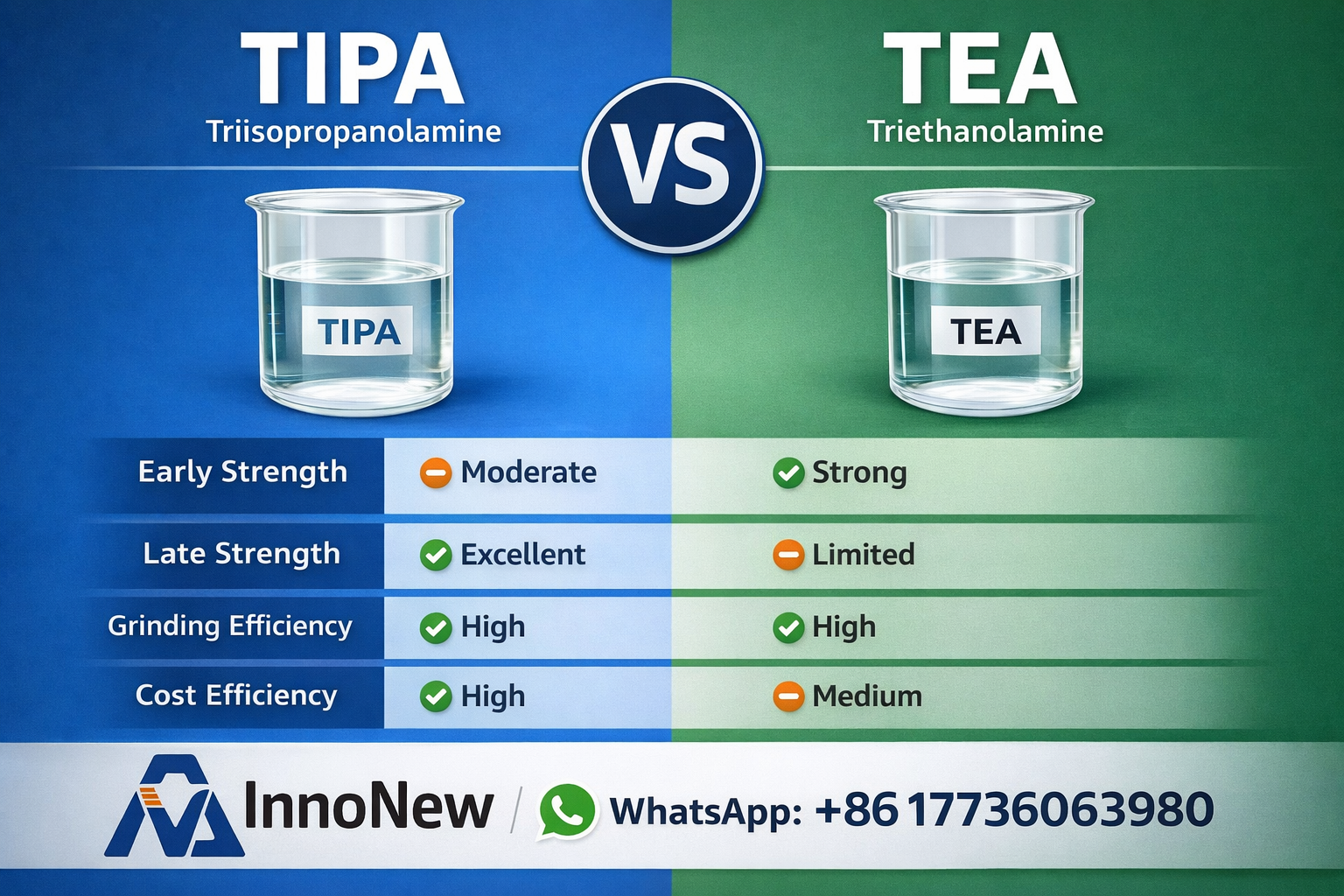
1. Strength Development: TIPA vs TEA
- TIPA significantly improves late compressive strength, making it ideal for high-performance cement.
- TEA mainly improves early strength, but may negatively affect later strength if overdosed.
For long-term strength → TIPA is better than TEA
2. Grinding Performance
Both TIPA and TEA improve grinding efficiency by reducing particle agglomeration.
However:
- TIPA provides more stable performance
- TEA may cause over-grinding in some formulations
3. Cost Performance
While TEA may appear cheaper, TIPA offers:
- Better strength performance
- Lower cement consumption
- Higher overall ROI
This makes TIPA a more cost-effective cement additive
When to Use TIPA vs TEA
Use TIPA when:
- High late strength is required
- Producing high-performance cement
- Reducing clinker factor
Use TEA when:
- Early strength is the priority
- Short curing time is required
- Cost is the main concern
Applications of TIPA and TEA in Cement Industry
- Cement grinding plants
- Ready-mix concrete production
- Precast concrete manufacturing
- Infrastructure projects
Why More Manufacturers Choose TIPA Today
With increasing demand for high-performance cement, more manufacturers are shifting from TEA to TIPA due to:
- Better strength performance
- Improved efficiency
- Lower long-term cost
Your Reliable TIPA Supplier
Hebei InnoNew Material Technology Co., Ltd. is a professional triisopropanolamine manufacturer, providing high-quality TIPA for global cement and construction industries.
We offer:
- Stable TIPA 85% / 98%
- Competitive pricing
- Technical support
FAQ:
Q1: What is the difference between TIPA and TEA?
TIPA improves late strength, while TEA mainly enhances early strength.
Q2: Which is better for cement grinding aid, TIPA or TEA?
TIPA is better for long-term performance, while TEA is suitable for early strength.
Q3: Can TIPA replace TEA?
Yes, in many applications TIPA is used as a TEA alternative for better overall performance.
Q4: Is TIPA more expensive than TEA?
TIPA may have a higher price, but offers better cost-performance ratio.
Q5: Can TIPA be used with PCE?
Yes, TIPA works well with PCE superplasticizer.
Upgrade Your Cement Performance with TIPA
Looking for a better alternative to TEA?
Contact Hebei InnoNew Material Technology Co., Ltd. now:
- Free samples
- Technical consultation
- Competitive pricing