
Advanced Market Structure, Concrete Technology Systems & Integrated Material Engineering Solutions
1. Brazil Construction Chemicals Market:
Brazil is one of the most complex and high-potential construction markets in Latin America, characterized by a dual structure system:
- Large-scale infrastructure and industrial construction
- Highly fragmented residential and SME-level construction sector
This duality creates a hybrid demand model for construction chemicals:
- High-performance chemical systems for infrastructure projects
- Cost-sensitive formulations for residential and commercial applications
As a result, Brazil is not a “product market”, but a system-driven chemical market.
2. Key Technical Drivers of Construction Chemical Demand
2.1 Concrete Performance Requirements Under Tropical Climate
Brazil’s climate introduces multiple engineering constraints:
- High ambient temperature accelerates cement hydration
- Rapid evaporation reduces open time
- Slump loss occurs within short transport cycles
- Pumping instability in urban construction zones
Technical implication:
Concrete in Brazil requires kinetically controlled hydration systems, not simple water adjustment.
This is the primary reason why PCE-based superplasticizer systems dominate modern formulations.
2.2 Aggregates Variability and Mix Design Instability
Brazilian sand and aggregate sources often show:
- High fines variability
- Irregular grading curves
- Clay contamination in some regions
This leads to:
- Inconsistent workability
- Higher water demand
- Strength fluctuation risk
Chemical solution requirement:
- High dispersion efficiency admixtures (PCE)
- Stabilized viscosity systems (HPMC / modified cellulose)
- Air control systems (defoamer)
2.3 Industrialization of Construction Process
Brazil is gradually shifting toward:
- Precast concrete industrialization
- Standardized dry mix mortar systems
- Mechanized application (spray / pumping systems)
This shift increases demand for:
- Polymer-modified mortar systems
- High-performance water retention agents
- Adhesion-enhancing polymer powders
3. Core Construction Chemical Engineering Systems
3.1 Polycarboxylate Ether (PCE) Superplasticizer System
PCE Superplasticizer is not just a water reducer—it is a cement dispersion control polymer system.
Technical functions:
- Steric hindrance dispersion of cement particles
- Controlled hydration kinetics
- Water reduction: 25–40%
- Rheology optimization for pumping systems
Engineering impact:
- Enables low water-cement ratio concrete (<0.40)
- Improves early and final strength development
- Stabilizes slump retention in hot environments
Applications:
- Ready-mix concrete plants
- Pumped concrete for high-rise buildings
- Precast structural elements
- Infrastructure-grade concrete systems
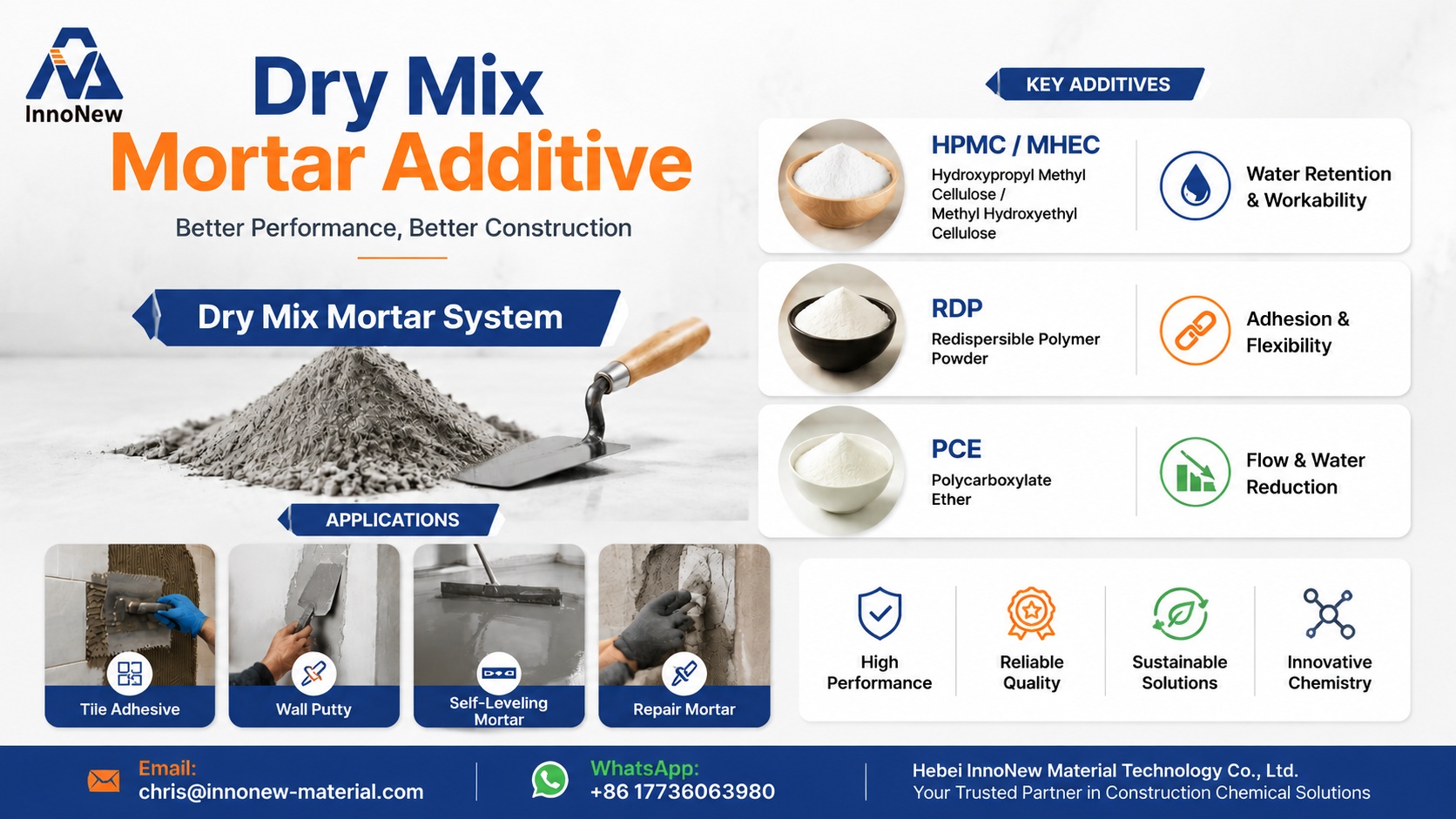
3.2 Cellulose Ether System (HPMC / MHEC)
Cellulose ether acts as a water retention and rheology stabilization polymer in dry mix mortar.
Technical mechanism:
- Formation of hydration water retention film
- Control of capillary water migration
- Adjustment of mortar viscosity curve
Performance functions:
- Water retention stabilization
- Anti-sag behavior in vertical applications
- Extended open time for tile installation
Applications:
- Tile adhesive systems (C1 / C2 class)
- Gypsum-based plaster systems
- Wall putty and skim coat systems
- Self-leveling compounds
3.3 Redispersible Polymer Powder (RDP)
RDP Powder is a post-emulsion polymer film formation system.
Technical mechanism:
Upon hydration:
- Polymer particles re-emulsify
- Form continuous polymer film network
- Enhance interface bonding strength
Engineering effects:
- Adhesion strength increase (cement-substrate interface)
- Crack resistance improvement (flexibility modulus control)
- Freeze-thaw and durability enhancement
3.4 Defoamer System in Cementitious Materials
Foam formation in concrete/mortar is caused by:
- Mixing turbulence
- Surfactant contamination in raw materials
- Pumping pressure variation
Technical role of defoamer:
- Reduce entrapped air voids (<2–3% target range)
- Improve density uniformity
- Enhance surface finish quality
- Reduce permeability in hardened concrete
3.5 PVA (Polyvinyl Alcohol) Functional Applications
PVA 2488 in construction chemistry is used as a binder and film-forming modifier.
Functional roles:
- Improves cohesion in polymer systems
- Enhances film integrity in coatings
- Acts as secondary binder in specialty formulations
4. Application System Engineering in Brazil
4.1 Ready-Mix Concrete System (RMC)
Brazil RMC systems require:
Performance targets:
- Stable slump retention (60–120 min)
- Pumpability over long distance transport
- Strength consistency under variable temperature
System formulation logic:
- PCE → dispersion & flow control
- Retarder → hydration delay control
- Defoamer → air system stabilization
4.2 Precast Concrete Industrial System
Precast plants in Brazil prioritize:
- High early strength (demolding efficiency)
- Dimensional stability
- Fast production cycles
Chemical dependency:
- High-performance PCE systems
- Early strength optimization additives
- Low void structural control (defoamer systems)
4.3 Dry Mix Mortar Industrial System
This is the fastest growing segment in Brazil construction chemistry.
System architecture:
| Function | Material |
|---|---|
| Water retention | HPMC / MHEC |
| Adhesion | RDP |
| Rheology control | PCE (partial use) |
| Air stability | Defoamer |
Application systems:
- Tile adhesive (C1 / C2 systems)
- Exterior wall systems
- Self-leveling floors
- Repair mortars
5. Market Constraints & Technical Challenges
Brazil construction chemical industry faces structural challenges:
- Raw material inconsistency (cement, sand quality variability)
- High temperature instability in field applications
- Limited local production of high-end polymer additives
- Cost sensitivity in public infrastructure projects
Result:
Market heavily depends on imported, stable-performance chemical systems.
6. Strategic Opportunity for Suppliers
Brazil is transitioning from material-based procurement to system-based procurement.
High-value opportunities include:
- Integrated concrete admixture systems (PCE + retarder + defoamer)
- Dry mix mortar formulation systems (HPMC + RDP + additives)
- Technical formulation support (value-added service model)
Competitive advantage factor:
Not price—but system stability + technical formulation support.
7. Conclusion
The Brazil construction chemicals market is evolving into a system-engineered materials industry.
Future demand will be driven by:
- High-performance concrete systems
- Industrial dry mix mortar adoption
- Polymer-based modification technologies
- Integrated chemical formulation solutions
Suppliers who provide engineering-based chemical systems rather than standalone materials will dominate long-term market positioning.
FAQ
1. What are construction chemicals used for in Brazil?
Construction chemicals in Brazil are used to improve concrete performance, enhance mortar adhesion, control water retention, and optimize workability in ready-mix, precast, and dry mix mortar systems.
2. Why is PCE superplasticizer important in Brazilian concrete?
Because Brazil has high temperature and variable aggregates, PCE is essential for maintaining slump retention, improving pumpability, and reducing water demand in concrete systems.
3. What is the role of HPMC in tile adhesive systems?
HPMC provides water retention, improves open time, and prevents sagging in vertical tile applications, especially in hot climates like Brazil.
4. Why is RDP used in dry mix mortar?
RDP enhances adhesion strength, improves flexibility, and reduces cracking by forming a polymer film after hydration.
5. What problems does defoamer solve in concrete?
Defoamer reduces entrapped air, improves concrete density, enhances surface finish, and prevents void formation during mixing and pumping.
6. What are the main challenges in Brazil construction industry?
Key challenges include inconsistent raw materials, high temperature effects on concrete performance, and limited access to high-performance chemical systems.
7. Is Brazil a growing market for dry mix mortar?
Yes, Brazil is rapidly adopting industrial dry mix mortar systems such as tile adhesives, self-leveling compounds, and gypsum-based products.
8. What is the future trend of construction chemicals in Brazil?
The market is shifting toward integrated system solutions combining multiple additives rather than single-component materials.