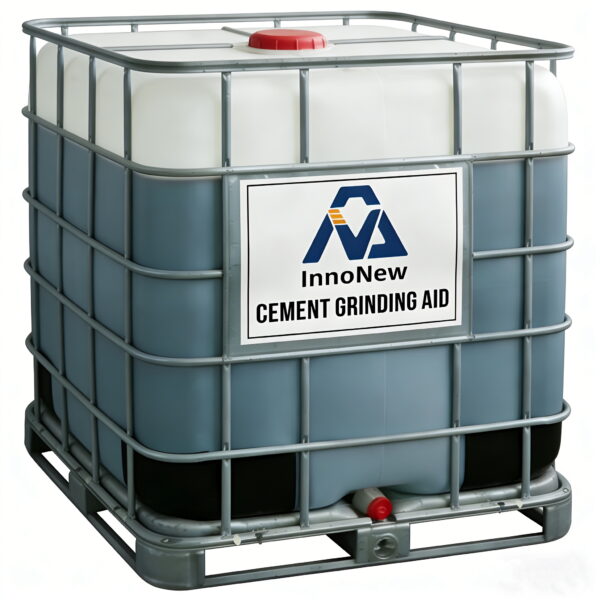
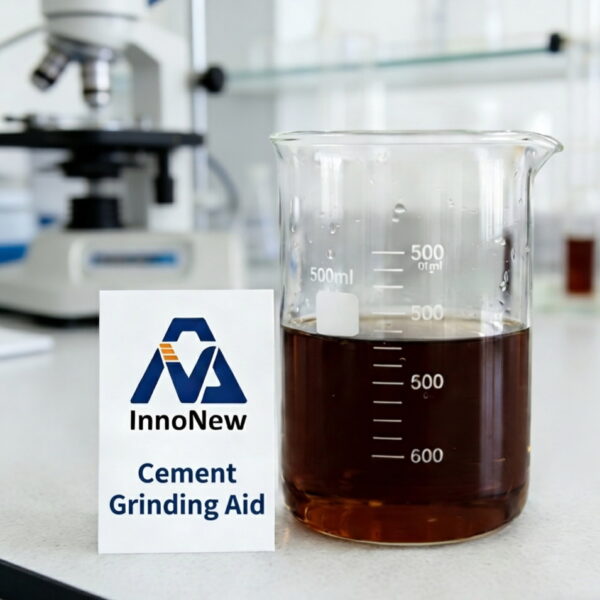
Cement Grinding Aid & Production Optimization Solution
Optimize Cement Production, Reduce Costs, and Enhance Quality
InnoNew® Cement Grinding Aid is more than a traditional additive—it is a comprehensive solution for modern cement plants aiming to improve production efficiency, reduce energy consumption, lower clinker factor, and enhance cement performance.
Developed with advanced dispersion technology, our solution minimizes particle agglomeration, improves separator efficiency, and optimizes particle size distribution. The result: higher mill throughput, reduced production costs, enhanced cement flowability, and improved strength development.
Compatible with Ball Mills, Vertical Roller Mills (VRM), and Closed-Circuit Grinding Systems, InnoNew Cement Grinding Aid delivers measurable economic benefits and supports sustainability initiatives.
Why Cement Grinding Aid Matters for Modern Plants
Cement grinding can consume up to 70% of total plant electricity. During grinding, freshly fractured clinker particles develop strong electrostatic forces, leading to:
- Particle agglomeration
- Coating on grinding media
- Reduced separator efficiency
InnoNew Cement Grinding Aid addresses these challenges by neutralizing surface charges, improving particle dispersion, and maintaining optimal mill conditions. This mechanism reduces internal coating, enhances powder flowability, and increases grinding efficiency.
Differentiation: Unlike generic grinding aids, our solution is designed to optimize production economics, not just improve fineness.
Key Benefits
1. Increase Mill Throughput
- Typical output increase: 10–25%
- Enhanced separator efficiency
- Reduced mill vibration and coating
- Stable grinding performance
2. Reduce Energy Consumption
- Lower specific grinding energy (kWh/t)
- Faster achievement of target Blaine fineness
- Reduced over-grinding and unnecessary power loss
3. Improve Cement Quality
- Optimized particle size distribution
- Better flowability and silo discharge
- Reduced pack-set tendency
- Improved workability for concrete production
4. Enhance Cement Strength
- Higher early strength (1–3 days)
- Improved long-term strength (28 days+)
- Efficient hydration and strength development
5. Lower Production Costs
- Reduced grinding cost per ton
- Enable higher limestone usage and lower clinker factor
- Increased profitability in blended cement production
How It Works – Production Optimization Approach
1. Agglomeration Control
Grinding aid molecules adsorb onto particle surfaces, reducing attractive forces and preventing re-agglomeration.
Impact: Higher separator efficiency, better particle dispersion, and increased mill output.
2. Mill Coating Reduction
Prevents cement particles from adhering to grinding media and mill liners.
Impact: Reduced power consumption and more stable grinding conditions.
3. Particle Size Optimization
Promotes uniform particle size distribution for:
- Better cement reactivity
- Faster strength gain
- Reduced over-grinding
Unique Differentiation: We optimize particle distribution tailored to your cement type and mill system, not a one-size-fits-all formula.
Typical Performance Improvement
| Parameter | Without InnoNew | With InnoNew |
|---|---|---|
| Mill Output | Baseline | +10–25% |
| Power Consumption | Baseline | -5–15% |
| Cement Flowability | Standard | Significantly Improved |
| Separator Efficiency | Standard | Improved |
| Early Strength | Standard | Improved |
| Late Strength | Standard | Improved |
| Silo Discharge | Moderate | Excellent |
Actual results vary depending on clinker chemistry, mill type, and production conditions.
Application by Cement Type
| Cement Type | Optimization Target |
|---|---|
| OPC 42.5R | Higher Throughput |
| OPC 52.5N | Early Strength Optimization |
| PPC | Increased Limestone Usage |
| PSC | Slag Activation Efficiency |
| Composite Cement | Production Cost Reduction |
| Low Carbon Cement | CO₂ Emission Reduction |
Industrial Case Study (Anonymous)
5000 TPD Cement Plant – Closed Circuit Ball Mill – OPC 42.5R
| Metric | Before | After |
|---|---|---|
| Output | 102 tph | 114 tph (+11.8%) |
| Power | 34.8 kWh/t | 31.2 kWh/t (-10.3%) |
| Clinker Factor | 80% | 75% (-5%) |
Result: Significant cost savings, improved mill efficiency, lower energy consumption, and reduced carbon emissions.
Typical Dosage
| Application | Recommended Dosage |
|---|---|
| Standard OPC | 200–600 g/t |
| PPC Cement | 300–800 g/t |
| High Limestone Cement | 400–1000 g/t |
Optimal dosage determined via plant trials.
Sustainability Benefits
InnoNew Cement Grinding Aid contributes to lower energy consumption, reduced CO₂ emissions, and clinker factor optimization, supporting global cement decarbonization initiatives and ESG targets.
Technical Specifications
| Property | Specification |
|---|---|
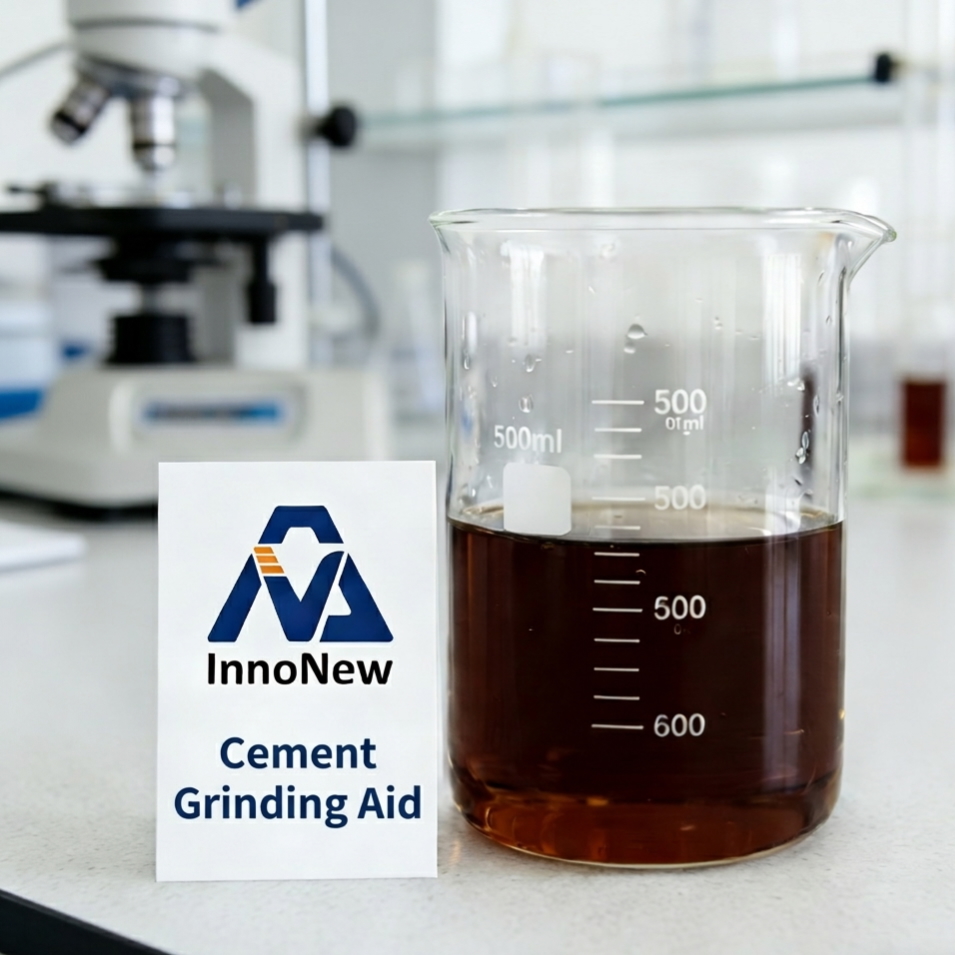
| Appearance | Brown Liquid |
| Density | 1.05–1.15 g/cm³ |
| pH | 8–11 |
| Solubility | Completely soluble |
| Chloride Content | Chloride-free |
| Shelf Life | 12 months |
Packaging Options
- 200 kg Drum
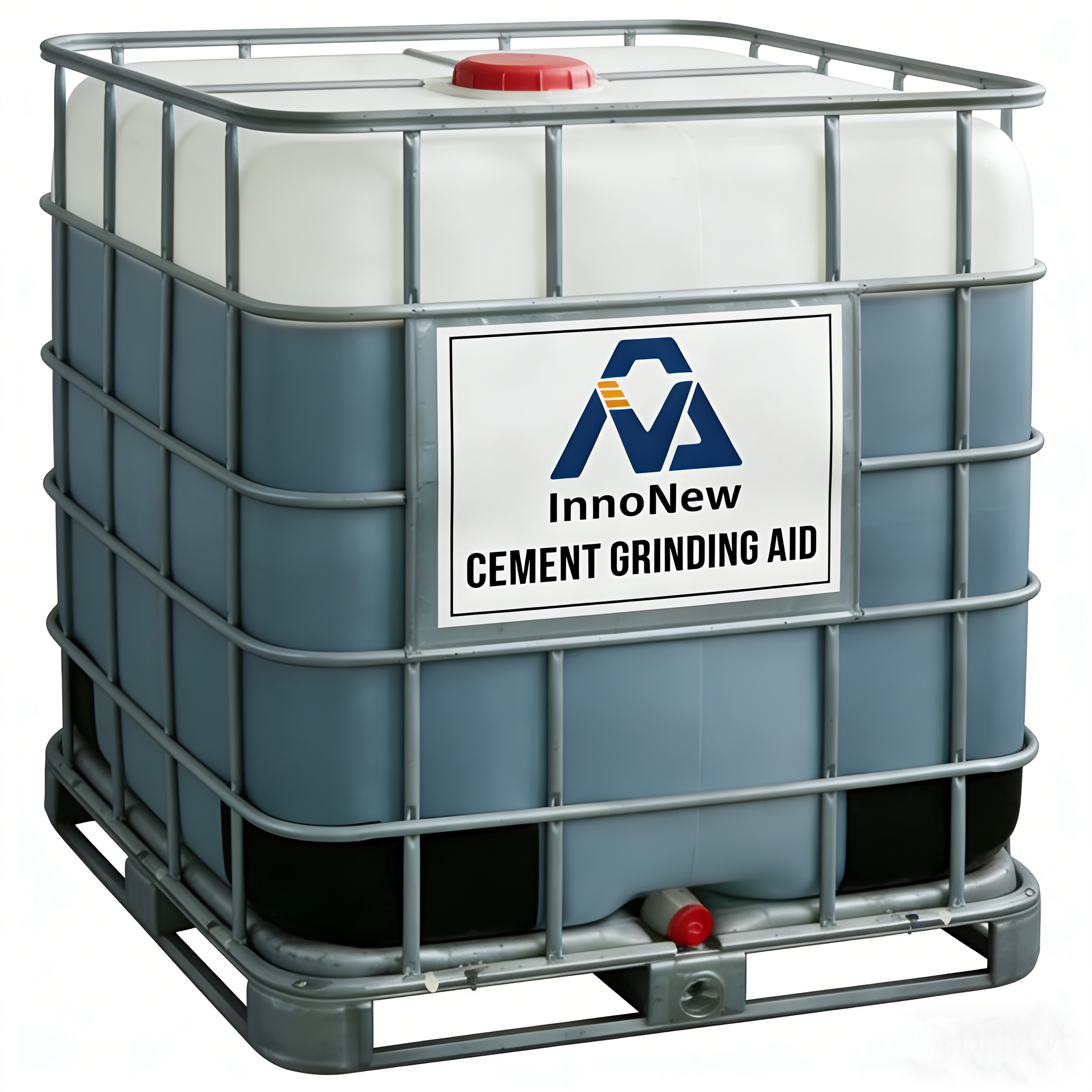
- 1000 kg IBC Tank
- Flexitank
- Bulk Tanker
Why Choose Hebei InnoNew Material Technology Co., Ltd.
- Customized Formulations: Tailored to clinker chemistry, cement type, and mill configuration
- Trial-Based Optimization: Industrial trial guidance and dosage adjustment
- Low-Carbon Cement Support: Enable higher SCM usage and lower CO₂ emissions
- Global Export Capability: Middle East, Southeast Asia, Africa, South America
FAQ
1. What is a cement grinding aid?
A chemical additive that improves grinding efficiency, reduces power consumption, and enhances cement performance.
2. How much grinding aid should be added?
Typically 200–1000 g/t depending on cement type and production objectives.
3. Can grinding aid improve cement strength?
Yes. Certain formulations improve both early and late compressive strength.
4. Is it suitable for VRM systems?
Yes. It improves particle dispersion and grinding efficiency in VRM and combined systems.
5. Does it reduce production cost?
Yes. By increasing output and reducing power consumption, it lowers cost per ton significantly.