
PVA 0588 vs PVA 1788: What’s the Difference and Which One Should You Choose?
Introduction
Polyvinyl Alcohol (PVA) is widely used in adhesives, textile sizing, paper coating, and construction materials. Among various grades, PVA 0588 and PVA 1788 are two of the most commonly used—but they serve very different purposes.
If you are selecting raw materials for wood glue, paper processing, or textile applications, understanding the difference between these two grades is critical for both performance and cost optimization.
This guide will break down the technical differences, application scenarios, and selection strategy to help you make the right decision.
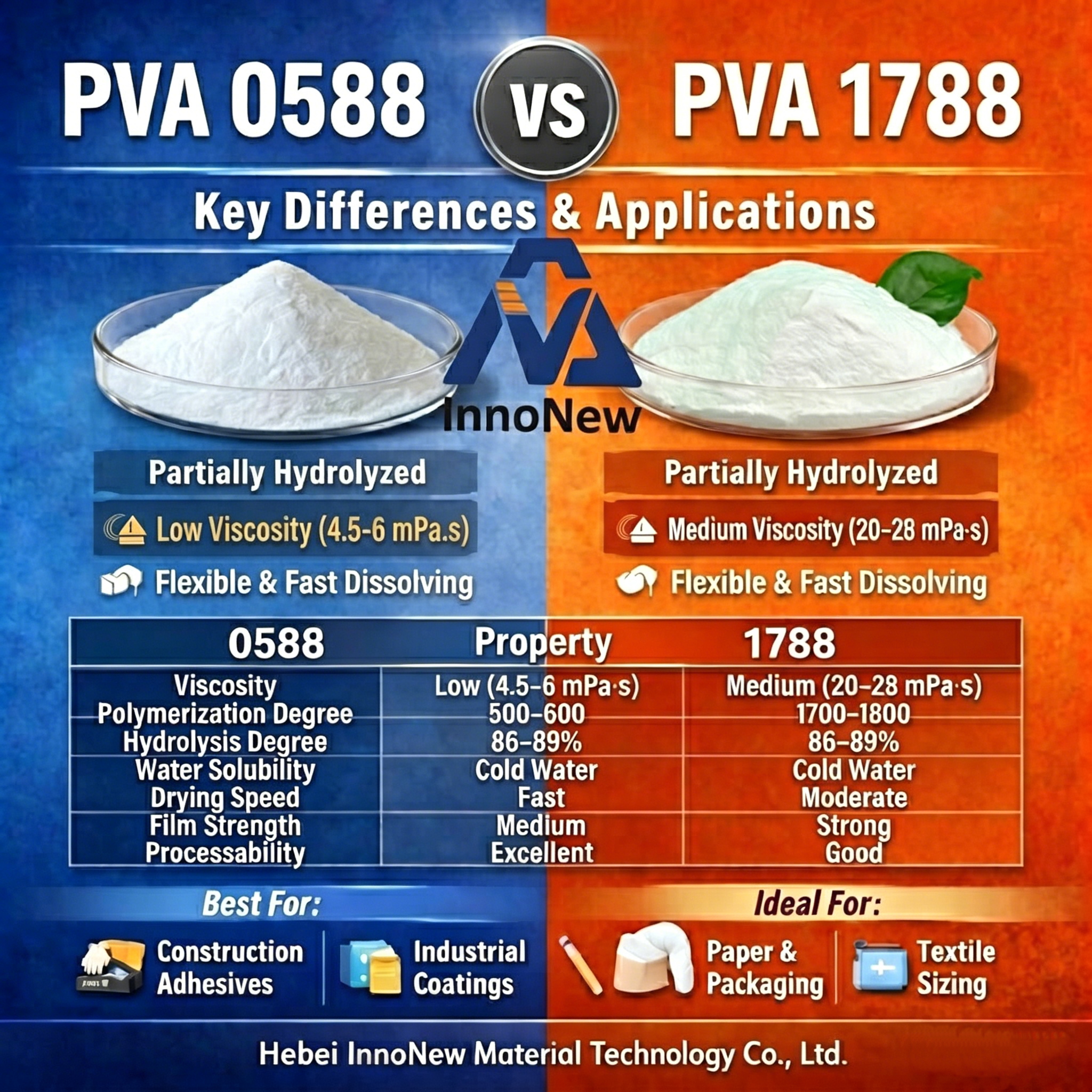
PVA 0588 vs PVA 1788 – Quick Comparison
| Property | PVA 0588 | PVA 1788 |
|---|---|---|
| Viscosity | Low (4.5–6 mPa·s) | Medium (20–28 mPa·s) |
| Polymerization Degree | 500–600 | 1700–1800 |
| Hydrolysis Degree | 86–89% | 86–89% |
| Drying Speed | Fast | Moderate |
| Film Strength | Medium | Strong |
| Processability | Excellent | Good |
👉 Key takeaway:
Key Differences Explained
1. Viscosity & Processing Behavior
The most important difference lies in viscosity, which directly affects application performance.
- PVA 0588 has very low viscosity → ideal for high-speed production, coating, and spray applications
- PVA 1788 offers moderate viscosity → suitable for stable adhesive systems
👉 Lower viscosity means:
- Easier mixing
- Better flow
- Faster processing
2. Drying Speed & Efficiency
- PVA 0588 dries faster → improves production efficiency
- PVA 1788 dries slower → allows deeper penetration into substrates
👉 Practical impact:
- Fast bonding → choose 0588
- Strong bonding → choose 1788
3. Film Strength & Adhesion
- PVA 0588: smooth film, moderate strength
- PVA 1788: stronger film, better durability
👉 In adhesive systems:
- 0588 improves workability
- 1788 improves final bonding strength
4. Dissolution & Operation
- PVA 0588 dissolves faster and more easily
- PVA 1788 requires higher temperature and longer mixing time
👉 This makes 0588 more suitable for:
- Automated production
- Large-scale factories
Application Comparison
PVA 0588 – Best for Fast & Low Viscosity Systems
Typical applications:
- Fast drying adhesives
- Paper coating & paper glue
- Handicraft and school glue
- Emulsion polymerization (protective colloid)
👉 Check our full guide for the exclusive strengths and full application range of PVA 0588
PVA 1788 – Best for Balanced Performance
Typical applications:
- White glue (wood adhesive)
- Furniture bonding
- Textile warp sizing
- Construction putty & coatings
👉 Learn more about our PVA 1788 application, please check the PVA 1788 product page.
How to Choose Between PVA 0588 and 1788
👉 Choose PVA 0588 if you need:
- Low viscosity
- Fast drying
- Easy processing
- High production efficiency
👉 Choose PVA 1788 if you need:
- Strong bonding performance
- Balanced viscosity
- Stable formulation
- General-purpose applications
Industrial Formulation Strategy
In real-world manufacturing, many producers blend both grades:
👉 PVA 0588 + PVA 1788 combination
- 0588 → improves flow & reduces viscosity
- 1788 → enhances strength & durability
Result:
- Better application performance
- Optimized cost
- More stable adhesive system
Which One is Better for Wood Glue?
- Standard white glue → PVA 1788 (best choice)
- Fast-drying wood glue → PVA 0588 or blend
- High-strength bonding → combine with higher viscosity grades
👉 For formulations requiring medium-high viscosity, balanced film flexibility and universal construction performance, PVA 2488 is the industry’s go-to mid-range grade.
If your project demands ultra-high viscosity, superior film toughness, excellent water retention and ultimate bonding strength for heavy-duty industrial systems, PVA 2699 will deliver far more reliable performance.
FAQ
What is the main difference between PVA 0588 and 1788?
The main difference is viscosity—0588 is low viscosity and fast drying, while 1788 is medium viscosity with stronger bonding performance.
Can I mix PVA 0588 and 1788?
Yes, blending both grades is common in industry to balance performance and cost.
Which PVA is better for adhesives?
It depends on the application—0588 for fast processing, 1788 for stronger bonding.
Conclusion
Choosing between PVA 0588 and PVA 1788 depends on your production needs:
- Efficiency & speed → PVA 0588
- Strength & versatility → PVA 1788
For most manufacturers, the optimal solution is not choosing one—but combining both to achieve the best performance.
Looking for the Right PVA Grade?
At InnoNew Material, we provide:
- Stable quality PVA 0588 & 1788
- Technical formulation support
- Factory direct pricing
- Free samples
👉 Contact us today to get your customized solution.
Email: chris@innonew-material.com | WhatsApp: +86 17736063980