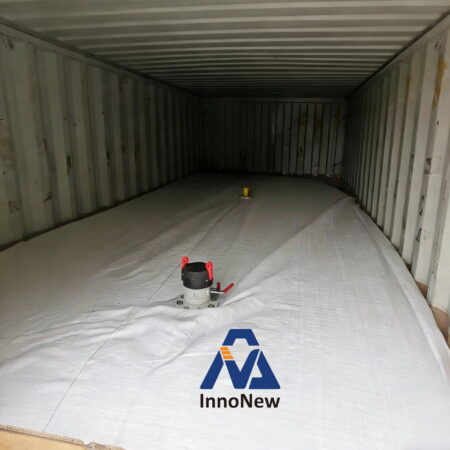
TIPA for Portland Cement Grinding
How Triisopropanolamine Improves Mill Efficiency, Strength Development, and Cement Stability
Introduction
As global cement manufacturers face increasing pressure to reduce energy consumption, improve clinker efficiency, and maintain stable cement performance, cement grinding aids are becoming more important than ever in modern Portland cement production.
Among various alkanolamine-based additives, Triisopropanolamine (TIPA) has emerged as one of the most effective solutions for improving grinding efficiency and enhancing late-stage compressive strength in both ordinary Portland cement (OPC) and blended cement systems.
Unlike conventional grinding aid additives that mainly focus on reducing agglomeration, TIPA 85% provides dual-function performance:
- Improving cement grinding efficiency
- Enhancing long-term hydration and strength development
At Hebei InnoNew Material Technology Co., Ltd., we supply high-purity TIPA 85% for cement grinding aid formulations, blended cement optimization, and high-performance cement production worldwide.
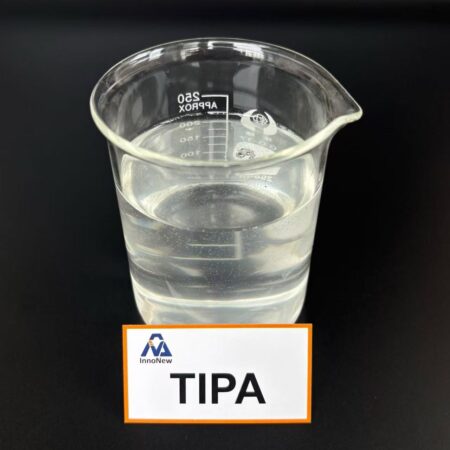
What Is TIPA Triisopropanolamine?
TIPA (Triisopropanolamine) is a tertiary alkanolamine widely used in cement grinding aids and strength-enhancing formulations.
Compared with traditional amines such as:
- Triethanolamine (TEA)
- Diethanol Isopropanolamine (DEIPA)
TIPA demonstrates superior performance in:
- Late compressive strength enhancement
- Hydration optimization
- Mineral activation efficiency
- Cement durability improvement
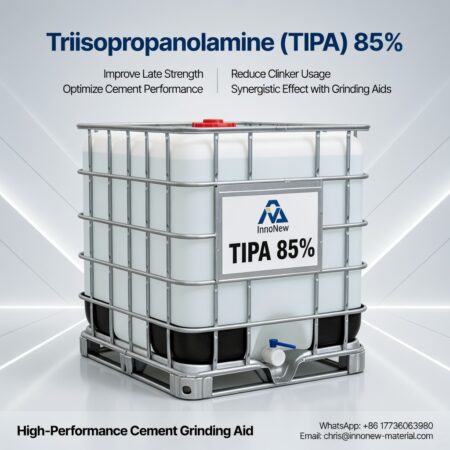
Commercially, TIPA 85% is the most widely used grade in the cement industry due to its balance between:
- Active content
- Handling performance
- Cost efficiency
- Formulation compatibility
Why Cement Plants Use TIPA 85%
Reducing Grinding Energy Consumption
In cement manufacturing, grinding accounts for one of the highest energy consumptions in the entire production process.
During grinding, fine cement particles tend to:
- Agglomerate
- Adhere to grinding media
- Coat mill liners
This reduces grinding efficiency and increases power consumption.
TIPA Triisopropanolamine works by reducing electrostatic attraction between cement particles, leading to:
- Better particle dispersion
- Lower agglomeration
- Reduced coating inside the mill
- Improved separator efficiency
As a result, cement plants can achieve:
- Higher mill output
- Reduced specific power consumption
- More stable grinding conditions
- Finer particle distribution
In many Portland cement systems, properly formulated TIPA grinding aids can significantly improve production efficiency without major equipment modifications.
How TIPA Improves Portland Cement Strength
Late Compressive Strength Enhancement
One of the biggest differences between TIPA and conventional grinding aids is its effect on long-term cement strength.
Traditional amines such as TEA mainly improve:
- Early hydration
- Initial strength
However, TIPA 85% is particularly effective at enhancing:
- 28-day strength
- 56-day strength
- Long-term hydration efficiency
This is especially important for:
- High-performance concrete
- Infrastructure projects
- Precast concrete
- Mass concrete applications
Hydration Mechanism of TIPA Triisopropanolamine
TIPA promotes more efficient hydration of clinker minerals, especially:
- C3S (Tricalcium Silicate)
- C2S (Dicalcium Silicate)
It also improves the utilization efficiency of supplementary cementitious materials (SCMs), including:
- Slag
- Fly ash
- Limestone powder
By enhancing the hydration reaction of these materials, TIPA helps produce:
- Denser cement matrix structures
- Improved microstructure development
- Better long-term durability
This becomes increasingly important as cement plants reduce clinker factor to lower carbon emissions.
TIPA vs TEA vs DEIPA in Cement Grinding
| Property | TIPA | TEA | DEIPA |
|---|---|---|---|
| Grinding efficiency | Excellent | Good | Excellent |
| Early strength | Moderate | Strong | Very strong |
| Late strength | Excellent | Limited | Good |
| Blended cement compatibility | Excellent | Moderate | Excellent |
| Slag activation | Strong | Weak | Good |
| Recommended use | Late strength optimization | Early strength improvement | Balanced performance |
In practical cement grinding aid formulations:
- TEA is often selected for early strength
- DEIPA balances grinding and early strength
- TIPA is preferred when late strength and durability are priorities
Many modern grinding aid formulations combine:
- TIPA
- DEIPA
- Glycols
- Polyols
to achieve optimized overall cement performance.
Applications of TIPA 85% in Different Cement Systems
Ordinary Portland Cement (OPC)
In OPC grinding, TIPA improves:
- Grinding efficiency
- Cement fineness stability
- Long-term compressive strength
It is particularly useful when:
- Clinker quality fluctuates
- Mill temperature rises
- Production load increases
Blended Cement Systems
TIPA performs exceptionally well in blended Portland cement containing:
- Fly ash
- Slag
- Limestone filler
Because blended systems often suffer from slower hydration and lower early activity, TIPA helps improve:
- SCM activation
- Hydration efficiency
- Strength stability
This allows cement producers to:
- Reduce clinker consumption
- Lower CO₂ emissions
- Maintain cement performance
Cement Grinding Aid Manufacturing
TIPA 85% is widely used as an active ingredient in:
- Liquid grinding aids
- Composite cement additives
- Strength-enhancing formulations
It demonstrates excellent compatibility with:
- Glycols
- TEA
- DEIPA
- Polycarboxylate additives
- Performance enhancers
This flexibility allows grinding aid manufacturers to customize formulations for different:
- Cement types
- Clinker compositions
- Climate conditions
- Production systems
Operational Advantages for Cement Plants
By using properly formulated TIPA grinding aids, cement manufacturers may achieve:
- Reduced power consumption per ton of cement
- Increased mill throughput
- Improved particle distribution
- Better cement flowability
- Enhanced late compressive strength
- Lower clinker factor
- Improved blended cement performance
For high-volume cement plants, even small efficiency improvements can generate substantial annual cost savings.
Why Choose Hebei InnoNew Material Technology Co., Ltd.
Hebei InnoNew Material Technology Co., Ltd. is a professional supplier of construction chemical raw materials and cement additive solutions.
Our TIPA 85% products are designed for:
- Cement grinding aid manufacturers
- Cement plants
- Blended cement producers
- Construction chemical companies
Our Advantages
- High purity and stable active content
- Reliable performance consistency
- Excellent compatibility in grinding aid formulations
- Bulk supply capability
- Export experience in Asia, Middle East, Africa, and South America
- Technical support for formulation optimization
We focus on helping cement manufacturers improve:
- Production efficiency
- Cement strength stability
- Grinding system performance
- Cost optimization
Future Trend: High-Efficiency and Low-Carbon Cement Production
As the cement industry moves toward:
- Energy reduction
- Lower carbon emissions
- Higher SCM utilization
- Sustainable construction materials
TIPA Triisopropanolamine is becoming increasingly important in modern cement grinding technology.
Its ability to simultaneously improve:
- Grinding efficiency
- Strength development
- Blended cement activation
makes TIPA 85% a key additive for next-generation Portland cement manufacturing.
FAQ
What is TIPA used for in cement grinding?
TIPA is mainly used as:
- Cement grinding aid
- Strength enhancer
- Hydration performance improver
It helps reduce grinding energy consumption while improving cement strength development.
Does TIPA improve late compressive strength?
Yes. Compared with many conventional grinding aids, TIPA is particularly effective at improving:
- 28-day strength
- 56-day strength
- Long-term hydration performance
Can TIPA be used in blended cement?
Yes. TIPA performs very well in cement systems containing:
- Slag
- Fly ash
- Limestone powder
because it improves SCM activation efficiency.
Is TIPA compatible with DEIPA and TEA?
Yes. TIPA is commonly formulated together with:
- DEIPA
- TEA
- Glycols
- Polyols
in composite grinding aid systems.
What is the recommended TIPA grade for cement grinding aids?
TIPA 85% is the most widely used industrial grade due to its:
- High active content
- Good handling performance
- Cost-effectiveness
Conclusion
TIPA 85% (Triisopropanolamine) is one of the most effective cement grinding aid additives for improving:
- Grinding efficiency
- Mill productivity
- Cement strength
- Long-term durability
Compared with traditional amines, TIPA provides stronger late compressive strength enhancement and better blended cement performance, making it an essential solution for modern Portland cement manufacturing.
For cement plants and grinding aid manufacturers seeking stable quality and professional supply support, Hebei InnoNew Material Technology Co., Ltd. provides reliable TIPA 85% solutions for global cement applications.