
What Is PVA 2488? Complete Technical Guide to Bond Strength, Workability, Applications & Industrial Performance
What Is PVA 2488?
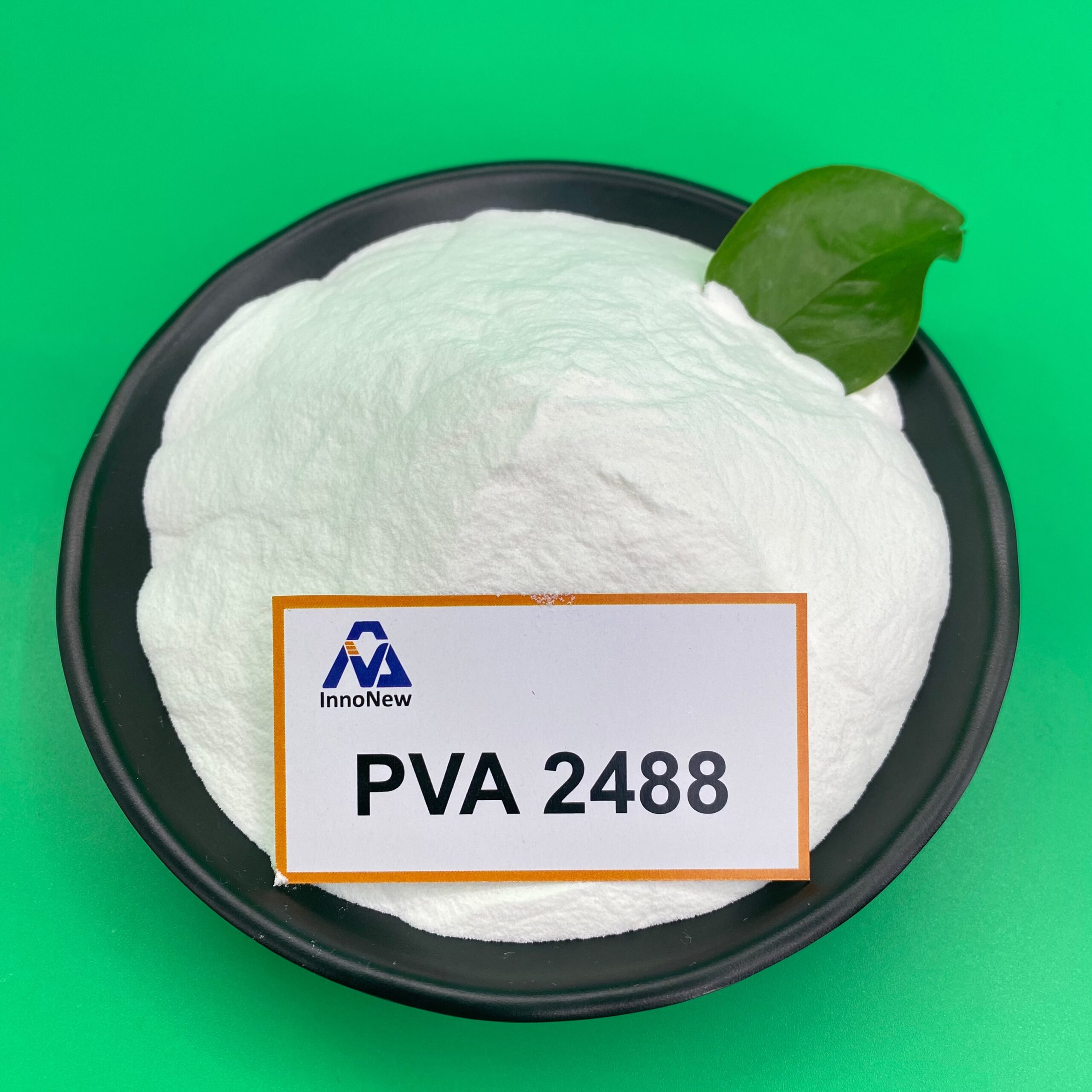
Polyvinyl Alcohol (PVA), also known as PVOH, is a water-soluble synthetic polymer widely used as a binder, film-forming agent, stabilizer, and adhesion promoter across multiple industries.
Among all commercial grades, PVA 2488 is one of the most versatile and widely used products due to its excellent balance of:
- Bond strength
- Water solubility
- Film formation
- Flexibility
- Processability
- Cost-performance ratio
Today, PVA 2488 is extensively used in:
- Dry mix mortar
- Tile adhesive
- Wall putty
- Construction additives
- Textile sizing
- Paper coating
- Wood glue
- Packaging adhesives
- Fertilizer granulation
- Water-soluble films
Its outstanding adhesion and compatibility with cementitious systems make it a critical functional polymer in modern construction chemistry.
What Does PVA 2488 Mean?
Many users know the product name but do not understand what “2488” actually represents.
In the Chinese and Asian PVA grading system:
| Number | Meaning |
|---|---|
| 24 | Degree of Polymerization ≈ 2400 |
| 88 | Degree of Hydrolysis ≈ 88% |
Therefore:
PVA 2488 = Polymerization Degree 2400 + Hydrolysis Degree 88%
These two parameters largely determine:
- Viscosity
- Solubility
- Film strength
- Adhesion performance
- Flexibility
- Processing behavior
Compared with lower polymerization grades, PVA 2488 provides significantly stronger film formation and bonding performance while maintaining good dissolution speed.
Technical Specifications of PVA 2488
| Property | Typical Value |
|---|---|
| Appearance | White Powder |
| Hydrolysis Degree | 87–89% |
| Polymerization Degree | 2400–2500 |
| Viscosity (4% Solution) | 45–55 mPa·s |
| pH Value | 5–7 |
| Moisture | ≤5% |
| Ash Content | ≤0.5% |
| Solubility | Water Soluble |
| Film Formation | Excellent |
| Adhesion | Excellent |
Why PVA 2488 Has Excellent Bond Strength
The biggest reason manufacturers use PVA 2488 is not simply because it is a polymer.
It is because of its unique molecular interaction mechanism.
1. Hydrogen Bonding Mechanism
PVA molecules contain a large number of hydroxyl groups (-OH).
These hydroxyl groups create strong hydrogen bonds with:
- Cement hydration products
- Cellulose fibers
- Wood fibers
- Paper fibers
- Ceramic surfaces
This molecular attraction significantly increases interface adhesion.
As a result:
- Better substrate bonding
- Reduced delamination
- Higher tensile adhesion strength
2. Polymer Film Formation
When water evaporates, PVA molecules form a continuous polymer film.
This film acts as a flexible bridge between:
- Cement particles
- Aggregates
- Fillers
- Substrates
The film effectively connects otherwise disconnected particles.
This mechanism dramatically improves:
- Cohesion
- Internal strength
- Surface adhesion
3. Interfacial Bridging Effect
In dry mix mortar systems, microscopic gaps exist between hydration products and aggregates.
PVA 2488 fills these gaps by creating a polymer network structure.
Benefits include:
- Reduced voids
- Improved compactness
- Stronger interfacial adhesion
- Better durability
This phenomenon is often referred to as:
Interfacial Polymer Bridging
which is one of the key reasons for improved bonding performance.
4. Micro-Crack Resistance
Cement materials naturally develop micro-cracks during drying and shrinkage.
PVA film provides flexibility inside the matrix.
Instead of allowing cracks to propagate, the polymer network absorbs stress and redistributes loads.
Benefits:
- Reduced shrinkage cracking
- Improved impact resistance
- Better durability
- Extended service life
How PVA 2488 Improves Workability
Besides bond strength, PVA 2488 significantly improves construction performance.
Enhanced Water Retention
PVA molecules retain water within the mortar system.
Benefits:
- Slower water evaporation
- Better cement hydration
- Reduced premature drying
- Longer open time
This is particularly important in:
- Hot climates
- Windy environments
- Large tile installation projects
Improved Lubrication
The dissolved polymer creates a lubricating effect.
Mortar becomes:
- Easier to mix
- Easier to pump
- Easier to spread
- Easier to trowel
Workers experience smoother application and improved construction efficiency.
Reduced Bleeding and Segregation
PVA increases system cohesion.
This minimizes:
- Water separation
- Aggregate settlement
- Surface bleeding
Resulting in:
- More uniform mortar
- Better appearance
- Higher quality finishing
PVA 2488 vs PVA 1788 vs PVA 2688
Selecting the correct PVA grade is critical.
| Property | PVA 1788 | PVA 2488 | PVA 2688 |
|---|---|---|---|
| Polymerization Degree | 1700 | 2400 | 2600 |
| Viscosity | Low | Medium | High |
| Solubility | Excellent | Excellent | Good |
| Film Strength | Medium | High | Very High |
| Flexibility | High | High | Medium |
| Bond Strength | Medium | High | Very High |
| Workability | Excellent | Excellent | Good |
| Cost | Low | Medium | Higher |
| Mortar Application | Good | Excellent | Excellent |
Selection Recommendation
Choose PVA 1788 when:
- Fast dissolution is required
- Cost is critical
Choose PVA 2488 when:
- Balanced performance is needed
- General industrial applications dominate
Choose PVA 2688 when:
- Maximum strength is required
- Heavy-duty formulations are used
Major Applications of PVA 2488
Construction Materials
PVA 2488 is widely used in:
- Tile adhesive
- Wall putty
- Repair mortar
- EIFS systems
- Self-leveling compounds
- Cement-based bonding agents
Benefits:
- Better adhesion
- Higher flexibility
- Reduced cracking
- Improved workability
Adhesives Industry
PVA 2488 is a core raw material for:
- White glue
- Wood glue
- Paper glue
- Packaging adhesive
- Bookbinding adhesive
Advantages:
- Strong bonding
- Stable viscosity
- Excellent film formation
Textile Industry
As a sizing agent, PVA 2488:
- Improves yarn strength
- Reduces breakage
- Enhances weaving efficiency
- Provides excellent desizing performance
Widely used for:
- Cotton yarn
- Polyester yarn
- Blended fibers
Paper Industry
PVA 2488 improves:
- Surface strength
- Printability
- Coating quality
- Fiber bonding
Applications include:
- Packaging paper
- Specialty paper
- Surface sizing
- Paper coating
Fertilizer Granulation
Modern fertilizer manufacturers increasingly use PVA 2488 as a green binder.
Benefits:
- Higher granule strength
- Reduced dust generation
- Better transportation stability
- Improved particle uniformity
Suitable for:
- NPK fertilizer
- Compound fertilizer
- Organic fertilizer
Recommended Dosage
| Application | Recommended Dosage |
|---|---|
| Tile Adhesive | 0.5–1.0% |
| Wall Putty | 0.3–0.8% |
| Repair Mortar | 0.5–1.5% |
| EIFS Mortar | 0.5–1.2% |
| Wood Glue | 10–20% |
| Paper Coating | 0.5–2.0% |
| Textile Sizing | 5–12% |
| Fertilizer Granulation | 0.8–2.0% |
Actual dosage should be adjusted according to formulation design and performance requirements.
Common Problems and Solutions
Why Does PVA 2488 Form Lumps?
Causes
- Direct addition into hot water
- Insufficient stirring
Solution
- Add slowly under continuous agitation
- Use staged dissolution
Why Is Dissolution Slow?
Causes
- Low temperature
- Excessive loading
Solution
- Heat water to 85–95°C
- Increase mixing efficiency
Why Does Mortar Become Sticky?
Causes
- Excessive dosage
- High polymer concentration
Solution
- Reduce dosage
- Balance with cellulose ether system
Why Global Manufacturers Prefer PVA 2488
PVA 2488 has become one of the most widely used industrial PVA grades because it offers an exceptional balance between performance and cost.
Compared with lower grades, it delivers stronger adhesion and film strength.
Compared with higher viscosity grades, it offers easier processing and faster dissolution.
This balance makes PVA 2488 an ideal choice for:
- Dry mix mortar manufacturers
- Tile adhesive producers
- Textile mills
- Adhesive factories
- Paper mills
- Fertilizer manufacturers
Across global markets, PVA 2488 remains one of the most commercially successful Polyvinyl Alcohol grades because it combines reliable performance, broad compatibility, excellent workability, and strong economic value.
Conclusion
PVA 2488 is far more than a simple water-soluble polymer. Through hydrogen bonding, film formation, interfacial bridging, and crack-resistance mechanisms, it significantly improves adhesion, cohesion, flexibility, and workability across multiple industrial systems.
Whether used in construction materials, textile sizing, paper coating, industrial adhesives, or fertilizer granulation, PVA 2488 continues to be one of the most important functional polymers in modern manufacturing.
For manufacturers seeking a balance of bond strength, processing efficiency, flexibility, and cost-performance, PVA 2488 remains one of the most reliable and versatile solutions available today.
FAQ
A: PVA 2488 is a partially hydrolyzed polyvinyl alcohol with high viscosity and good water solubility. It is widely used in dry mix mortar, tile adhesive, wall putty and cement-based materials as a bonding and thickening additive.
A: It forms a flexible polymer film between cement hydration products and aggregates, increasing interfacial adhesion to substrates like concrete, ceramic tiles and walls, effectively reducing peeling and hollowing.
A: It improves water retention, lubricates the mix, reduces segregation and bleeding, makes mortar easier to trowel and construct, and extends open time without rapid drying.
A: It is highly suitable for most dry mix mortars including tile adhesive, wall putty, plaster and repair mortar. It is not recommended for high‑temperature or special chemical‑resistant scenarios without formulation adjustment.
A: In general dry mix mortar, the dosage is 0.3%–1.5% by weight of cement. Higher dosage improves adhesion and flexibility but may slightly affect setting time.