In modern construction chemicals, cellulose ether additives play a crucial role in improving the performance of building materials. Among the most widely used cellulose ethers are Methyl Hydroxyethyl Cellulose (MHEC) and Hydroxyethyl Cellulose (HEC). Both products are derived from natural cellulose and widely used as thickeners, rheology modifiers, and water retention agents in various industrial formulations.
However, despite their similar origins, MHEC powder and HEC powder are designed for different applications and exhibit distinct performance characteristics. Choosing the right cellulose ether is essential for manufacturers producing tile adhesives, wall putty, cement mortar, coatings, and construction chemicals.
Hebei InnoNew Material Technology Co., Ltd., a professional cellulose ether manufacturer, supplies high-performance MHEC and HEC products for global building material producers. In this article, we explore the key differences between MHEC vs HEC and help you determine which additive is better suited for your specific formulation.
Understanding MHEC and HEC
What is MHEC (Methyl Hydroxyethyl Cellulose)?
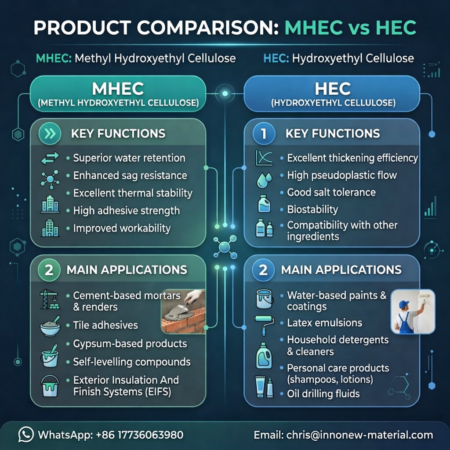
Methyl Hydroxyethyl Cellulose (MHEC) is a non-ionic cellulose ether produced by modifying natural cellulose with methyl and hydroxyethyl functional groups. This chemical structure gives MHEC excellent performance in cement-based construction materials.
As a multifunctional additive, construction grade MHEC is widely used as a thickener, water retention agent, and rheology modifier in dry mix mortar systems.
Main Applications of MHEC
MHEC powder is commonly used in:
- Tile Adhesive
- Wall Putty
- Cement Mortar
- Self-Leveling Compounds
- Gypsum Plaster
- Dry Mix Mortar
In these applications, MHEC for tile adhesive and mortar improves workability, enhances bonding strength, and prevents rapid water loss during the cement hydration process.
What is HEC (Hydroxyethyl Cellulose)?
Hydroxyethyl Cellulose (HEC) is another important cellulose ether thickener, produced by reacting cellulose with ethylene oxide to introduce hydroxyethyl groups.
Compared with MHEC, HEC powder is more commonly used in water-based systems, especially in industries such as coatings, paints, detergents, personal care products, and oilfield drilling fluids.
Main Applications of HEC
Typical applications of HEC cellulose ether include:
- Water-based paints and coatings
- Latex paints
- Oil drilling fluids
- Detergents and household chemicals
- Personal care products
Because of its excellent thickening and suspension properties, HEC performs extremely well in liquid formulations.
Key Differences Between MHEC and HEC
Although both products belong to the cellulose ether family, their chemical structures, performance characteristics, and application fields differ significantly.
1. Application Industry
The most obvious difference between MHEC vs HEC lies in their primary application fields.
MHEC
- Mainly used in construction materials
- Ideal for tile adhesive, wall putty, and cement mortar
- Essential additive for dry mix mortar
HEC
- Mainly used in water-based liquid systems
- Widely used in paint, coatings, detergents, and oil drilling fluids
For manufacturers producing cement-based building materials, MHEC powder is generally the preferred cellulose ether.
2. Water Retention Performance
Water retention is one of the most critical properties in construction applications.
MHEC for dry mix mortar provides excellent water retention capability, which helps:
- Prevent rapid water evaporation
- Improve cement hydration
- Extend open time for installers
While HEC powder also provides thickening performance, its water retention efficiency in cement systems is generally lower than that of MHEC.
Therefore, MHEC is typically the better choice for mortar and tile adhesive formulations.
3. Thickening and Rheology Control
Both MHEC and HEC act as thickening agents, but their rheological behavior differs depending on the system.
MHEC
- Provides stable viscosity in cement-based systems
- Improves mortar workability
- Enhances anti-sag performance in tile adhesive
HEC
- Excellent thickening performance in liquid formulations
- Provides suspension stability in paints and coatings
- Improves flow properties in drilling fluids
This difference is why HEC is widely used in paints, while MHEC dominates in dry mix mortar products.
4. Temperature Stability
In hot climate construction environments, gel temperature becomes an important performance parameter.
High-quality MHEC powder with high gel temperature can maintain stable viscosity even under 40°C or higher temperatures, ensuring reliable performance in tile adhesive and wall putty.
This makes MHEC particularly suitable for construction in regions such as the Middle East, Southeast Asia, and Africa.
HEC is less commonly used in these cement-based high-temperature construction applications.
5. Compatibility with Cement Systems
Another critical difference lies in compatibility with cement hydration systems.
MHEC cellulose ether is specifically designed for cement-based materials, offering:
- Improved bonding strength
- Enhanced workability
- Better open time control
HEC, on the other hand, performs best in aqueous solutions and polymer systems, making it ideal for paints and coatings rather than mortar systems.
When Should You Use MHEC?
Manufacturers should choose MHEC powder when producing:
- Tile adhesive
- Wall putty
- Dry mix mortar
- Cement plaster
- Self-leveling compounds
In these systems, MHEC acts as a critical construction chemical additive that ensures proper consistency, strong adhesion, and long-lasting durability.
When Should You Use HEC?
HEC cellulose ether is the better choice for applications such as:
- Water-based paints and coatings
- Latex paint thickener
- Detergents and cleaning products
- Personal care formulations
- Oilfield drilling fluids
In these industries, HEC powder provides superior thickening, suspension, and viscosity control.
Why Choose Hebei InnoNew Material Technology Co., Ltd.?
Hebei InnoNew Material Technology Co., Ltd. is a professional cellulose ether manufacturer and supplier specializing in high-quality MHEC and HEC products for global industrial customers.
Advanced Production Technology
We utilize modern synthesis technology to ensure high purity, stable viscosity, and consistent product performance.
Wide Application Expertise
Our cellulose ether products are widely used in:
- Construction chemicals
- Paint and coating systems
- Oil drilling fluids
- Industrial formulations
Competitive Factory Pricing
As a direct manufacturer, we offer high-quality cellulose ether at competitive factory prices for international customers.
Reliable Global Supply
With strong logistics capabilities, we ensure fast and reliable delivery to customers worldwide.
Conclusion
Both MHEC (Methyl Hydroxyethyl Cellulose) and HEC (Hydroxyethyl Cellulose) are important cellulose ether products, but they are optimized for different applications.
- MHEC is primarily used in construction materials such as tile adhesive, wall putty, and dry mix mortar.
- HEC is mainly used in paints, coatings, detergents, and oilfield applications.
Selecting the right cellulose ether additive can significantly improve the performance and quality of your final products.
If you are looking for a reliable MHEC manufacturer or HEC supplier, Hebei InnoNew Material Technology Co., Ltd. is ready to provide premium cellulose ether solutions for your business.
Contact us today to request samples, technical data sheets, or formulation support.