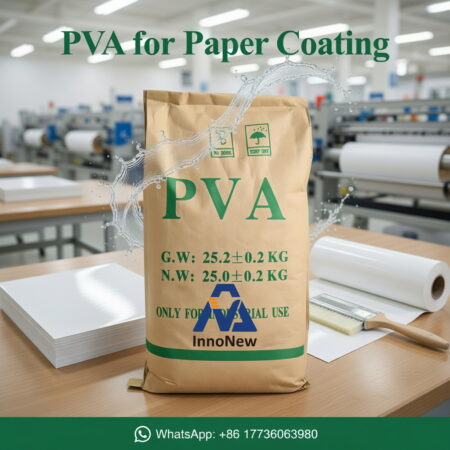
Polyvinyl Alcohol (PVA) for paper coating has become a cornerstone material in the coated paper industry. As a high-performance water-soluble polymer, PVA Powder is widely used as a binder to enhance coating structure, surface smoothness, and printing performance in paper industry.
Among the various grades available, PVA 1788 and PVA 2488 are the most commonly used in paper coating formulations due to their balanced viscosity, excellent film-forming ability, and strong adhesion properties.
Compared with conventional binders such as starch, PVA Powder provides more consistent quality, better strength, and improved process stability.
Key Performance Advantages of PVA Powder
1. Excellent Film-Forming Performance
PVA Powder forms a continuous and flexible film on the paper surface, improving gloss, smoothness, and coating uniformity.
2. Strong Adhesion and Binding
As a polyvinyl alcohol binder formulation, PVA significantly enhances the bonding between pigments (such as calcium carbonate or kaolin) and paper fibers.
3. Improved Printability
Using Polyvinyl Alcohol for paper coating ensures better ink absorption and ink holdout, resulting in sharper images and higher color density.
4. Enhanced Mechanical Strength
PVA 1788 and PVA 2488 improve both dry and wet strength, reducing surface picking and dusting during high-speed printing.
5. Water Solubility and Environmental Compatibility
PVA Powder is easy to dissolve and handle in aqueous systems, making it suitable for environmentally friendly coating processes.
PVA 1788 vs PVA 2488 in Paper Coating
Choosing the right grade is critical for optimizing coating performance.
PVA 1788 for Paper Coating
- Medium viscosity
- High film strength
- Good solubility
- Widely used in standard coated paper
PVA 2488 Coating Performance
- Higher viscosity
- Stronger adhesion and binding strength
- Better performance in high-end paper applications
- Suitable for premium coated paper and specialty paper
In practice, many manufacturers combine PVA 1788 and PVA 2488 to achieve a balance between performance and cost efficiency.
PVA vs Starch in Paper Coating
When comparing PVA vs starch paper coating, the advantages of PVA Powder become clear:
- Higher bonding strength and durability
- Better film uniformity
- More stable viscosity during processing
- Improved print quality
While starch remains a cost-effective option, PVA Powder is preferred for high-performance and high-value paper products.
Basic PVA Powder Formulation Guide
A typical polyvinyl alcohol binder formulation includes:
- Binder: PVA Powder (PVA 1788 / PVA 2488) – 5–10%
- Pigments: Calcium carbonate / Kaolin clay
- Additives: Dispersants, defoamers, lubricants
- Water: Adjust solids and viscosity
Formulation Optimization Tips
- Select appropriate hydrolysis degree for solubility control
- Adjust viscosity based on coating method (blade, roll, spray)
- Combine PVA with modified starch for cost-performance balance
Cross-Industry Applications of PVA Powder
Beyond paper coating, PVA Powder is widely used across multiple industries:
Paper Industry
- Coated paper
- Inkjet printing paper
- Packaging paper
Textile Industry
- Warp sizing agent
- Improves yarn strength and reduces breakage
Adhesive Industry
- Water-based adhesives
- Packaging glue and woodworking adhesives
In advanced material systems, PVA is often used together with Redispersible Polymer Powder (RDP) to enhance flexibility and adhesion in dry-mix mortar formulations, forming a complete solution within construction chemicals.
Why Choose Hebei InnoNew Material Technology Co., Ltd.
Hebei InnoNew Material Technology Co., Ltd. is a professional manufacturer specializing in PVA Powder and construction chemical materials.
Our Core Advantages:
- Factory Direct Supply – Stable quality and competitive pricing
- OEM & Customization – Tailor-made PVA 1788 and PVA 2488 solutions
- Technical Support – Professional formulation guidance
- Global Export Experience – Serving B2B clients worldwide
We also provide integrated product solutions including Redispersible Polymer Powder (RDP), Hydroxypropyl Starch Ether (HPS), Hydroxyethyl Cellulose (HEC) and other construction chemicals, helping customers improve performance across industries.
FAQ – Polyvinyl Alcohol for Paper Coating
Q1: What is the role of PVA Powder in paper coating?
It acts as a binder to improve coating strength, smoothness, and printability.
Q2: What is the difference between PVA 1788 and PVA 2488?
PVA 2488 has higher viscosity and stronger bonding strength, while PVA 1788 offers better solubility and balanced performance.
Q3: Can PVA Powder replace starch completely?
Yes, but it is often combined with starch to optimize cost and performance.
Q4: How to choose the right PVA grade?
It depends on coating requirements, viscosity, and final paper quality.
Q5: Is PVA Powder environmentally friendly?
Yes, it is water-soluble and suitable for eco-friendly coating systems.