HEMC vs HPMC: Whick Cellulose Ether is Better for Mortar and Tile Adhesive?
In construction chemical formulations, selecting the right Cellulose ether is critical to achieving optimal performance. Two of the most widely used materials are hydroxyethyl methyl cellulose (HEMC) and HPMC.
For manufacturers sourcing from a reliable HEMC supplier or evaluating options from a professional HEMC manufacturer, understanding the difference between HEMC powder and HPMC is essential. This guide provides a detailed comparison to help you choose the best solution for tile adhesive and dry mix mortar applications.
What is HEMC and HPMC?
Hydroxyethyl Methyl Cellulose (HEMC)
Hydroxyethyl methyl cellulose is a non-ionic cellulose ether known for excellent water retention, workability, and stability. It is commonly supplied as mhec powder or hemc powder and widely used in cement-based systems.
Hydroxypropyl Methyl Cellulose (HPMC)
HPMC is another widely used cellulose ether, offering similar thickening and water retention functions. However, differences in substitution groups lead to performance variations in real applications.
HEMC vs HPMC: Key Differences
1. Water Retention Performance
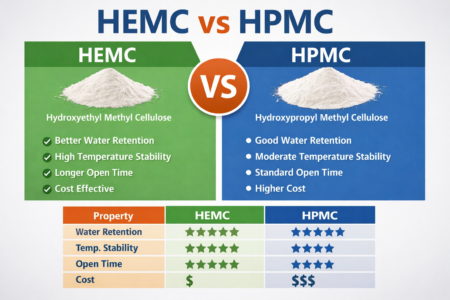
HEMC generally provides better water retention compared to HPMC.
- Slower water evaporation
- Improved cement hydration
- Better bonding strength
This makes hemc powder a preferred choice for tile adhesive formulations.
2. Workability and Open Time
Hydroxyethyl methyl cellulose offers:
- Longer open time
- Smoother application
- Better spreadability
For contractors, choosing a high-quality hemc supplier ensures consistent performance in different climates.
3. Temperature Stability
Compared to HPMC, HEMC shows better performance in high-temperature environments.
- More stable viscosity
- Reduced performance fluctuation
This is especially important for export markets in the Middle East and Southeast Asia.
4. Anti-Sagging Performance
High viscosity hemc powder provides stronger anti-sagging properties:
- Ideal for vertical tile applications
- Improved adhesion control
5. Cost Efficiency
While both materials perform well, sourcing from a competitive HEMC factory can make HEMC more cost-effective than premium HPMC brands.
Many buyers are shifting from premium brands like Tylose HEMC and Tylose MHECto high-quality alternatives from trusted manufacturers.
HEMC vs HPMC Comparison Table
Which One Should You Choose?
Choose HEMC if you need:
Better water retention
Longer open time
High temperature stability
Recommended for:
Wall putty
Tile adhesive
Dry mix mortar
Choose HPMC if you need:
General-purpose applications
Standard performance requirements
Why Work with a Professional HEMC Manufacturer
Choosing the right supplier is as important as selecting the right material.
A reliable HEMC manufacturer or MHEC supplier should offer:
- Stable viscosity grades
- Consistent quality control
- Technical formulation support
- Competitive pricing
At Hebei InnoNew Material Technology Co., Ltd., we provide high-quality hydroxyethyl methyl cellulose, HEMC powder, and MHEC powder for global construction applications, ensuring stable performance and cost efficiency.
Applications of HEMC in Construction
Hydroxyethyl methyl cellulose is widely used in:
- Tile adhesive
- Dry mix mortar
- Wall putty
- Self-leveling compounds
Its versatility makes cellulose ether an essential additive in modern construction materials.
FAQ
What is the main difference between HEMC and HPMC?
HEMC offers better water retention and temperature stability, while HPMC is more general-purpose.
Is HEMC more cost-effective than HPMC?
Yes, especially when sourced from a reliable MHEC factory, HEMC provides excellent performance at a lower cost.
Can HEMC replace Tylose HEMC?
Yes, many modern HEMC products can match the performance of Tylose HEMC and tylose MHEC.
Which cellulose ether is best for tile adhesive?
Hydroxyethyl methyl cellulose (HEMC) is generally the best choice due to its superior water retention and workability.