How HEC Enhances Drilling Fluid Efficiency and Stability
In oilfield drilling operations, the performance of drilling fluids directly influences operational safety, drilling speed, and cost efficiency. As drilling conditions become more complex, the demand for high-performance additives continues to increase. Among these, HEC for oil drilling has emerged as a reliable and efficient solution for improving fluid behavior in water-based systems.
At Hebei InnoNew Material Technology Co., Ltd., we specialize in manufacturing high-quality hydroxyethyl cellulose drilling fluid additives designed to meet the evolving needs of modern oilfield operations.
Understanding the Role of Drilling Fluids
Drilling fluids, commonly known as drilling muds, serve multiple functions during drilling operations. These include transporting drill cuttings, maintaining wellbore stability, cooling drilling equipment, and controlling formation pressure.
To achieve these functions effectively, the fluid must maintain stable rheological properties. This is where HEC drilling fluid additive plays a critical role.
Why HEC is Essential in Modern Drilling Fluids
Hydroxyethyl Cellulose (HEC) is a non-ionic polymer derived from natural cellulose. It is widely used as a rheology modifier in drilling fluids, offering a balance between viscosity control and system stability.
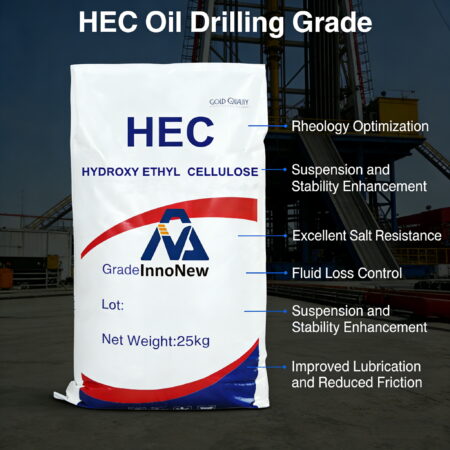
Unlike conventional additives, HEC provides consistent performance across a wide range of temperatures, salinity levels, and drilling conditions. Learn more about our HEC Oil Drilling Grade.
Key Mechanisms: How HEC Improves Drilling Fluid Performance
1. Rheology Control for Efficient Cuttings Transport
Efficient removal of drill cuttings is essential to prevent blockages and maintain drilling speed. HEC improves the flow characteristics of drilling fluids, ensuring that cuttings are effectively carried to the surface.
By optimizing viscosity, HEC for oil drilling enhances hole cleaning efficiency and reduces the risk of operational delays.
2. Formation Protection Through Fluid Loss Reduction
Uncontrolled fluid loss can damage formations and reduce well productivity. HEC contributes to the formation of a thin, flexible filter cake that minimizes fluid invasion.
This makes hydroxyethyl cellulose drilling fluid systems particularly suitable for sensitive formations where fluid control is critical.
3. Stabilization of Solid Particles
Maintaining uniform dispersion of solids such as barite and drill cuttings is essential for fluid stability. HEC improves the suspension capacity of drilling fluids, preventing particle settling and ensuring consistent density.
This function is especially important in extended drilling operations where stability must be maintained over long periods.
4. Performance in High Salinity Conditions
Drilling environments often involve exposure to salts and electrolytes, which can negatively affect many polymers. However, HEC exhibits excellent salt tolerance, maintaining its thickening and stabilizing properties even in challenging conditions.
This makes it a preferred drilling fluid thickener for offshore and complex geological environments.
5. Enhanced Lubricity and Reduced Torque
HEC also improves the lubricating properties of drilling fluids, reducing friction between the drill string and the wellbore. This leads to lower torque and drag, improving overall drilling efficiency and reducing equipment wear.
👉 Get expert support for your formulation
Optimal Usage and Dosage
The performance of HEC drilling fluid additive depends on proper dosage and dispersion. In most drilling applications, the recommended dosage ranges from 0.2% to 0.6%.
Adjustments may be required depending on factors such as fluid composition, temperature, and drilling depth. Proper mixing techniques are also important to ensure full hydration and maximum performance.
Comparison: HEC vs Other Drilling Fluid Additives
Compared to traditional additives, HEC offers a unique balance of properties. While some additives focus solely on fluid loss control or viscosity, HEC provides a multifunctional solution.
For example, PAC (Polyanionic Cellulose) is often used for stronger filtration control, whereas HEC excels in maintaining stable rheology and improving overall fluid performance. In many formulations, combining both can yield optimal results.
Typical Applications in Oilfield Operations
HEC is widely used across various drilling scenarios, including:
- Water-based drilling fluids
- Completion and workover fluids
- Directional and horizontal drilling
- Shale gas and tight formations
Its adaptability makes it a critical component in modern oilfield chemical systems.
Selecting the Right HEC Supplier
To achieve consistent performance, it is essential to choose high-quality HEC products. Key factors to consider include:
- Consistent viscosity grades
- Rapid hydration characteristics
- Stability under high temperature and salinity
- Reliable technical support
At Hebei InnoNew Material Technology Co., Ltd., we provide tailored HEC solutions to meet specific drilling requirements and ensure optimal performance in the field.
Conclusion
As drilling operations become increasingly demanding, the importance of high-performance additives continues to grow. HEC for oil drilling offers a comprehensive solution for improving drilling fluid efficiency, stability, and reliability.
By enhancing rheology, controlling fluid loss, and maintaining stability under challenging conditions, HEC plays a vital role in optimizing drilling performance and reducing operational risks.