HEC vs PAC in Drilling Fluid: Which Additive is Better?
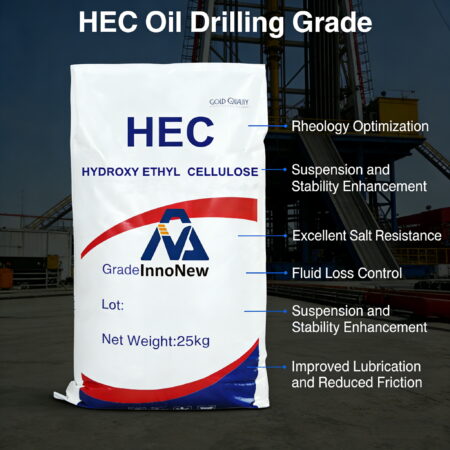
In oilfield drilling operations, selecting the right drilling fluid additive is critical for achieving optimal performance, reducing operational risks, and controlling overall costs. Among the most widely used additives in water-based drilling fluids are HEC (Hydroxyethyl Cellulose) and PAC (Polyanionic Cellulose).
Both materials play essential roles in drilling fluid systems, but they differ significantly in performance characteristics and application focus. Understanding the differences between HEC vs PAC in drilling fluid is crucial for engineers, formulators, and procurement professionals.
At Hebei InnoNew Material Technology Co., Ltd., we provide high-performance HEC solutions designed to meet modern oilfield requirements.
What is HEC in Drilling Fluids?
HEC for oil drilling is a non-ionic cellulose ether used primarily as a rheology modifier and viscosity enhancer. It improves the flow behavior of drilling fluids, ensuring efficient transport of drill cuttings and stable fluid performance.
HEC is particularly effective in maintaining viscosity under varying temperature and salinity conditions, making it a reliable drilling fluid thickener.
What is PAC in Drilling Fluids?
PAC, or Polyanionic Cellulose, is an anionic polymer widely used for fluid loss control. It forms a thin and low-permeability filter cake on the wellbore wall, significantly reducing fluid filtration into formations.
PAC is typically selected when minimizing fluid loss is the primary objective.
Key Differences Between HEC and PAC
The comparison between HEC vs PAC in drilling fluid can be summarized based on their core functions and performance characteristics.
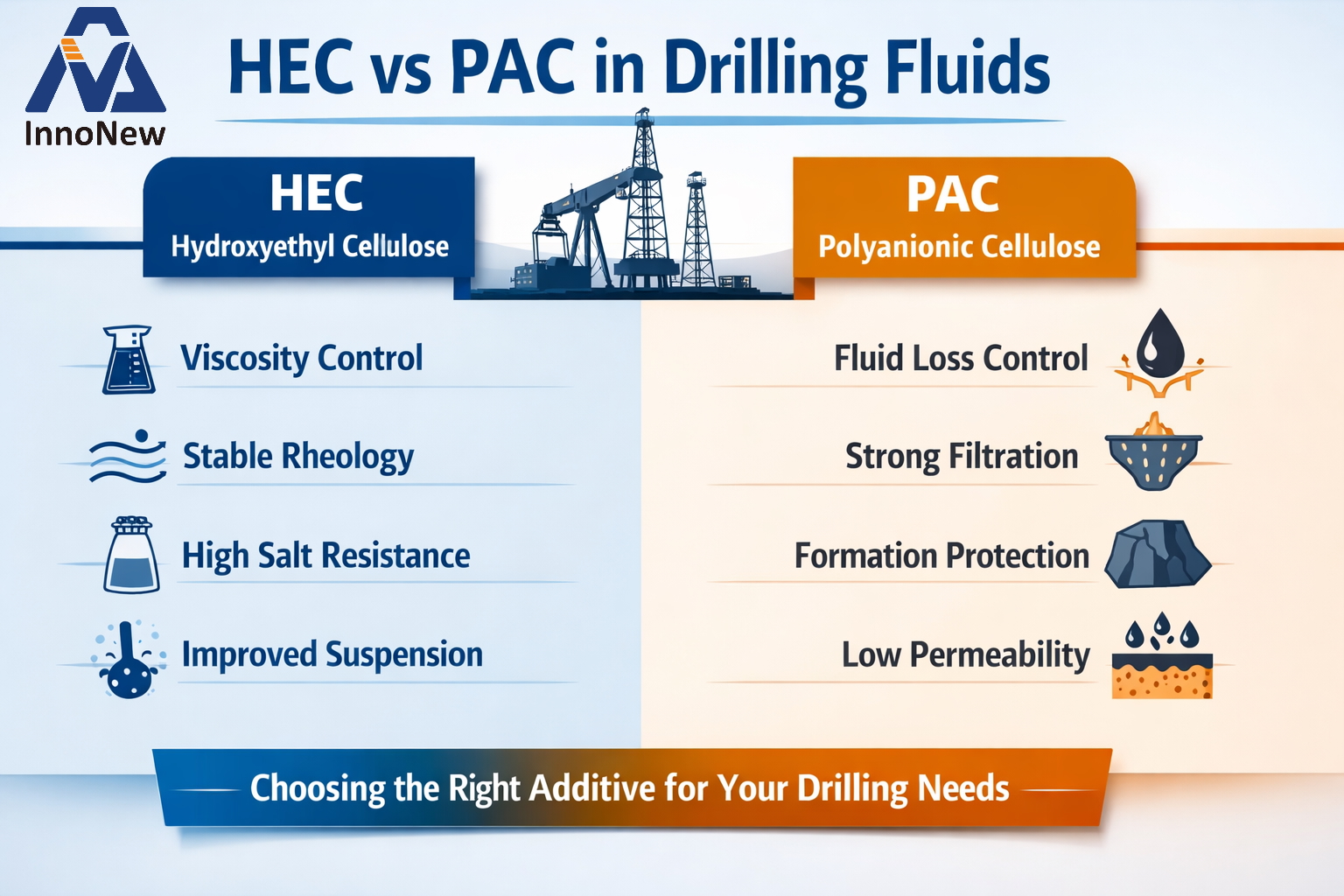
HEC is mainly used for viscosity control and rheology optimization, while PAC is more focused on fluid loss control. HEC provides better stability in high salinity environments, whereas PAC delivers stronger filtration control performance.
HEC also offers improved suspension properties, helping to keep solids uniformly dispersed. PAC, on the other hand, is more effective in forming a compact filter cake to protect formations.
Performance Comparison
When comparing HEC drilling fluid additive and PAC drilling fluid additive, it is important to consider the specific application requirements.
For drilling operations that require stable viscosity, improved suspension, and high salt resistance, HEC is the preferred choice. It ensures smooth fluid flow, efficient cuttings transport, and overall system stability.
For applications where fluid loss control is critical, such as sensitive formations, PAC provides superior performance by minimizing filtration and protecting the formation.
When to Use HEC vs PAC
Choosing between HEC vs PAC in drilling fluid depends on the drilling conditions and performance priorities.
HEC is recommended when:
- Stable rheology and viscosity control are required
- High salinity environments are involved
- Improved suspension and stability are needed
PAC is recommended when:
- Strong fluid loss control is necessary
- Formation protection is a priority
- Filtration reduction is critical
In many modern drilling fluid formulations, HEC and PAC are used together to achieve a balanced performance.
Recommended Dosage
The typical dosage for HEC ranges from 0.2% to 0.6%, depending on the required viscosity and drilling conditions.
PAC dosage may vary depending on the level of fluid loss control required, often used in similar or slightly higher concentrations depending on system design.
Proper formulation and testing are essential to determine the optimal combination.
Why HEC is Gaining Popularity in Oilfield Applications
In recent years, HEC has gained increasing attention in oilfield applications due to its versatility and stability. Its ability to provide consistent viscosity, excellent salt resistance, and improved suspension makes it a valuable additive in modern drilling fluids.
Compared to traditional additives, HEC offers a more balanced performance, especially in complex drilling environments.
Conclusion
Understanding the differences between HEC vs PAC in drilling fluid is essential for selecting the right additive for your application. While PAC excels in fluid loss control, HEC provides superior rheology control, stability, and versatility.
For optimal performance, many drilling operations combine both additives to achieve the best balance between viscosity and filtration control.
👉 Explore our high-quality HEC products
FAQ:
Q: What’s the main difference between HEC and PAC in drilling fluids?
A: HEC is nonionic with excellent salt tolerance; PAC is anionic with stronger fluid-loss control.
Q: Which performs better in high-temperature wells?
A: PAC generally offers better thermal stability for high-temperature drilling conditions.
Q: Which is more suitable for high-salinity formations?
A: HEC has superior tolerance to salt and calcium ions in high-salinity environments.
Q: How do they differ in formation damage?
A: HEC causes less formation damage; PAC provides tighter filter cake with moderate damage risk.
Q: When to choose HEC over PAC, and vice versa?
A: Use HEC for high-salt, low-damage needs; use PAC for high-temperature and strict fluid-loss control.