
HPS for Self-Leveling Compounds (SLC)
Engineered Stability for High-Fluid Mortar Systems
Why Self-Leveling Systems Need HPS (Search Intent Hook)
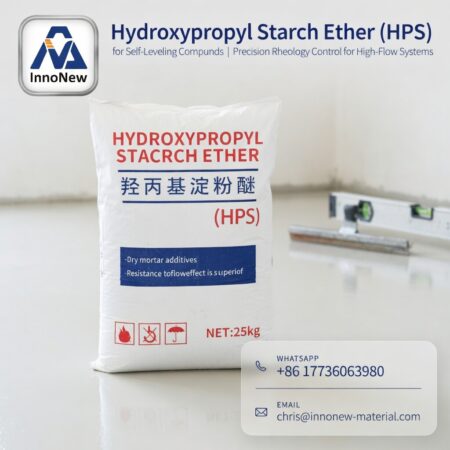
Self-leveling compounds (SLC) demand a delicate balance between high fluidity and structural stability.
Without proper rheology control, common failures include:
- Segregation (sand/cement separation)
- Bleeding (water rising to surface)
- Poor surface finish
- Inconsistent leveling performance
👉 Hydroxypropyl Starch Ether (HPS) is specifically engineered to solve these problems by introducing controlled viscosity and yield stress into high-flow systems.
What Makes HPS Unique in Self-Leveling Formulations
Unlike traditional thickening agents, HPS provides:
✔ Low-Dosage, High-Efficiency Rheology Control
- Effective at ultra-low dosage (0.01–0.05%)
- Maintains flow without excessive thickening
✔ Anti-Segregation Technology
- Stabilizes solid particles in suspension
- Prevents aggregate settlement
✔ Bleeding Control Mechanism
- Reduces water separation
- Improves hydration uniformity
✔ Flow Stability Enhancement
- Maintains consistent flow behavior over time
- Avoids sudden viscosity loss
Core Performance Matrix
| Performance Factor | Without HPS | With HPS |
|---|---|---|
| Flow Stability | Poor | Excellent |
| Segregation Resistance | Low | High |
| Surface Finish | Uneven | Smooth |
| Bleeding Control | Weak | Strong |
| Application Consistency | Variable | Stable |
✔ Conclusion: HPS is not a thickener — it is a precision rheology stabilizer
Mechanism of Action
HPS works through a multi-dimensional rheological modification mechanism:
1. Yield Stress Optimization
- Introduces controlled internal structure
- Prevents particle settlement under gravity
2. Shear-Thinning Behavior
- Low viscosity during mixing/application
- High stability after placement
3. Water Phase Stabilization
- Improves water distribution
- Reduces bleeding and separation
Formulation Engineering (High Conversion Section)
Recommended Additive System
HPS + HPMC
- HPMC → water retention & open time
- HPS → stability & anti-segregation
✔ Balanced fluidity + structural control
HPS + RDP
- RDP → adhesion & flexibility
- HPS → uniform particle distribution
✔ Strong bonding + defect-free surface
Typical Dosage Range
- HPS: 0.01% – 0.05%
- HPMC: 0.1% – 0.3%
- RDP: 1% – 4%
Application Scope
HPS is ideal for:
- Cement-based self-leveling compounds
- Floor leveling systems
- Industrial flooring mortars
- Underlayment systems
Competitive Advantage
Why Choose Our HPS for SLC?
- Ultra-low dosage efficiency (cost advantage)
- Stable performance in high-fluid systems
- Excellent compatibility with cement & additives
- Proven anti-segregation performance
✔ Designed specifically for high-performance leveling formulations
Technical Comparison vs Cellulose Ether
| Property | HPMC Only | HPMC + HPS |
|---|---|---|
| Flow Retention | Good | Excellent |
| Segregation Resistance | Medium | High |
| Surface Quality | Medium | Premium |
| System Stability | Medium | High |
✔ Insight: HPS upgrades HPMC systems into high-end SLC formulations
FAQ
1. What does HPS do in self-leveling compounds?
It controls segregation, improves flow stability, and reduces bleeding.
2. Will HPS reduce flowability?
No. It stabilizes flow without significantly increasing viscosity.
3. What is the optimal dosage of HPS in SLC?
Typically 0.01%–0.05%, depending on formulation.
4. Can HPS replace HPMC in self-leveling systems?
No. HPS complements HPMC but does not replace water retention.
5. Is HPS necessary for high-end SLC formulations?
Yes. It is critical for achieving stable, defect-free surfaces.
Call to Action
Need a stable, high-performance self-leveling formulation?
We provide:
- Customized formulation optimization
- Free lab testing support
- Technical consulting for SLC systems
📩 Email: chris@innonew-material.com
📱 WhatsApp: +86 17736063980