
Hydroxypropyl Starch Ether (HPS) for Gypsum-Based Materials
What is HPS in Gypsum Systems?
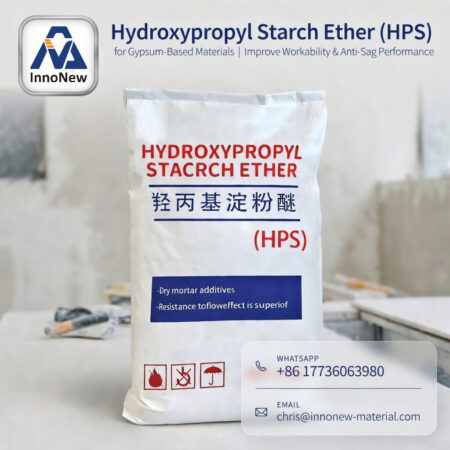
Hydroxypropyl Starch Ether (HPS) is a highly effective rheology modifier and anti-sag additive used in gypsum-based formulations such as gypsum plaster, joint compound, and gypsum mortar.
Unlike cement systems, gypsum materials require precise control of viscosity, open time, and structural stability due to their fast setting characteristics.
HPS plays a critical role in optimizing:
- Application consistency
- Sag resistance
- Surface smoothness
It is typically used in combination with:
- HPMC (Hydroxypropyl Methyl Cellulose) → water retention & workability
- RDP (Redispersible Polymer Powder) → adhesion & flexibility
✔ Result: Balanced gypsum system with superior performance and ease of application
Key Benefits of HPS in Gypsum-Based Materials
1. Excellent Anti-Sagging Performance
- Prevents material slipping on vertical surfaces
- Essential for gypsum plaster and joint compounds
- Enables thicker application layers
2. Improved Workability & Application Feel
- Smooth, creamy texture
- Easy spreading and finishing
- Reduced labor intensity
3. Optimized Rheology Control
- Provides stable viscosity during mixing and application
- Prevents segregation and water separation
4. Enhanced Surface Finish Quality
- Improves leveling performance
- Reduces surface defects
- Supports fine finishing
5. Cost-Effective Formulation
- Reduces excessive reliance on cellulose ether
- Improves additive efficiency
Typical Applications
HPS is widely used in:
- Gypsum Plaster
- Joint Compound
- Gypsum-Based Skim Coat
- Gypsum Mortar
- Decorative Gypsum Finishes
Formulation Synergy (High Conversion Section)
HPS + HPMC System
- HPMC ensures water retention and workable open time
- HPS enhances anti-sagging and structural build-up
✔ Result: Stable, easy-to-apply gypsum mixture
HPS + RDP System
- RDP improves adhesion and flexibility
- HPS stabilizes rheology and prevents sagging
✔ Result: Strong bonding + crack-resistant structure
Recommended Dosage
- HPS: 0.02% – 0.1%
- HPMC: 0.2% – 0.5%
- RDP: 0.5% – 2%
Performance Comparison
| Property | HPS Modified Gypsum | Conventional Gypsum |
|---|---|---|
| Anti-Sagging | ★★★★★ | ★★★ |
| Workability | ★★★★★ | ★★★★ |
| Surface Finish | ★★★★★ | ★★★ |
| Stability | ★★★★★ | ★★★ |
✔ Conclusion: HPS significantly enhances gypsum material performance and application efficiency
Technical Advantages
HPS introduces advanced rheological behavior:
- Shear-thinning effect → easy spreading under force
- Yield stress enhancement → prevents sagging after application
- Water distribution stability → improves consistency
These properties are especially critical in:
- Fast-setting gypsum systems
- Vertical surface applications
- High-quality finishing requirements
Why Choose Our HPS?
- Consistent viscosity performance
- Excellent compatibility with gypsum systems
- Stable quality across batches
- Proven in global construction applications
FAQ
1. What does HPS do in gypsum materials?
It improves anti-sagging, workability, and rheology stability.
2. Is HPS suitable for gypsum plaster?
Yes. It enhances application performance and surface quality.
3. Can HPS replace HPMC in gypsum systems?
No. HPS complements HPMC but does not replace its water retention function.
4. What is the typical dosage of HPS?
Usually 0.02%–0.1%, depending on formulation.
5. Does HPS affect gypsum setting time?
It has minimal impact when used at recommended dosage.
Call to Action
Looking to improve your gypsum-based formulations?
We offer:
- Customized formulation support
- Free sample testing
- Technical consultation
📩 Email: chris@innonew-material.com
📱 WhatsApp: +86 17736063980