Sagging is one of the most common and costly problems in dry-mix mortar applications, especially in:
- Tile adhesive
- Wall putty
- Plaster systems
If not properly controlled, it leads to:
- Poor adhesion
- Uneven thickness
- Rework and material waste
Main Causes of Mortar Sagging
1. Insufficient Yield Stress
Mortar lacks internal structure → cannot resist gravity
2. Poor Rheology Control
Unstable viscosity leads to flow inconsistency
3. Over-Reliance on Water Retention Agents
Using only cellulose ether (HPMC) without structural modifiers
How HPS Solves Sagging
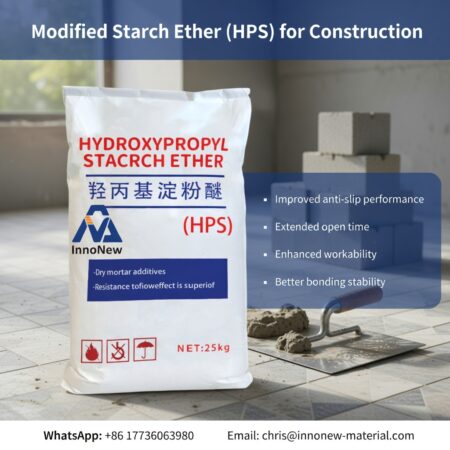
Hydroxypropyl Starch Ether introduces:
✔ Structural Build-Up
- Increases yield stress
- Prevents vertical slipping
✔ Shear-Thinning Behavior
- Easy to apply
- Stable after placement
✔ Synergy with HPMC
- HPMC → water retention
- HPS → anti-sag structure
Recommended Solution System
- HPMC: 0.3–0.5%
- HPS: 0.03–0.08%
- RDP: 1–3%
Application Optimization
👉 For tile adhesive: see HPS for Tile Adhesive
👉 For putty: see HPS for Putty Powder
👉 For mortar systems: see HPS for Dry Mix Mortar
Conclusion
HPS is the core anti-sag additive, not optional but essential for modern mortar systems.
FAQ:
Why does dry mix mortar sag easily during construction?
Main causes: insufficient water retention, poor thickening effect, weak anti-sagging performance, or improper compatibility of additives.
Main causes: insufficient water retention, poor thickening effect, weak anti-sagging performance, or improper compatibility of additives.
How does HPS (Hydroxypropyl Starch Ether) solve mortar sagging?
HPS improves rheology, enhances thickening and anti-sagging, stabilizes the mortar system, and reduces flow under vertical construction.
HPS improves rheology, enhances thickening and anti-sagging, stabilizes the mortar system, and reduces flow under vertical construction.
Can HPS replace cellulose ethers in anti-sagging?
No, it complements them. HPS boosts anti-sagging and workability at a low dosage, while cellulose ethers mainly provide water retention.
No, it complements them. HPS boosts anti-sagging and workability at a low dosage, while cellulose ethers mainly provide water retention.
What is the recommended dosage of HPS for sagging control?
Generally 0.1%–0.5% of the total dry mix, adjusted based on mortar formula and construction requirements.
Generally 0.1%–0.5% of the total dry mix, adjusted based on mortar formula and construction requirements.
Besides sagging, what other improvements does HPS bring?
It improves workability, reduces segregation, enhances adhesion, and helps maintain consistency in cement and gypsum-based mortars.
It improves workability, reduces segregation, enhances adhesion, and helps maintain consistency in cement and gypsum-based mortars.
Contact Us:
Need to fix sagging issues?