
A Technical White Paper for Modern Dry-Mix Mortars, Tile Adhesives, Self-Leveling Compounds and Cementitious Systems
1. The Hidden Cost of Air Entrapment
Many mortar producers focus on:
- Cement quality
- RDP selection
- Cellulose ether performance
- Aggregate grading
Yet one of the most overlooked performance variables is air content.
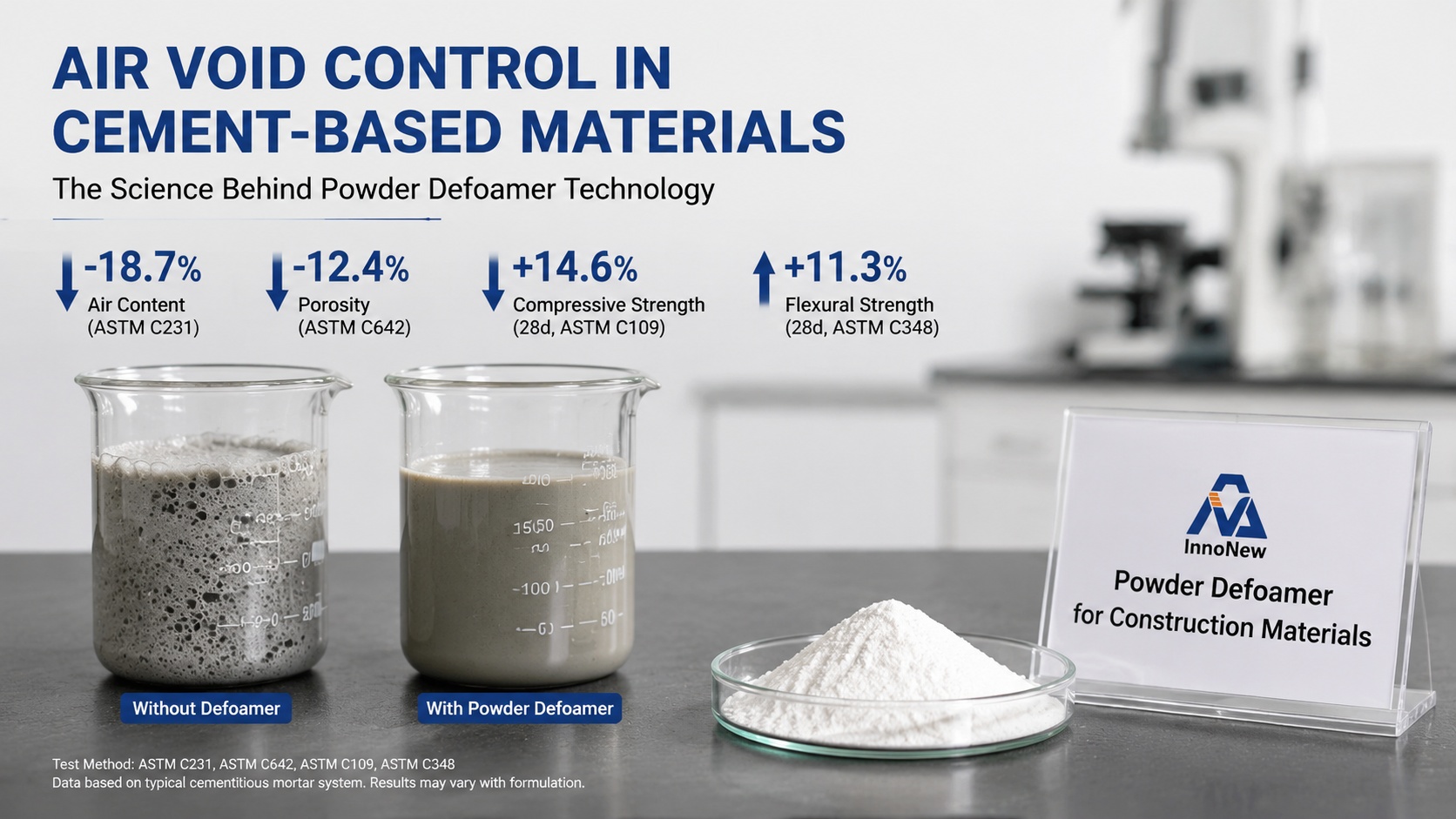
Research consistently demonstrates that every increase in entrained air results in measurable reductions in density and strength.
The reason is straightforward.
Air occupies volume without contributing structural integrity.
Once hardened, these air pockets become defects within the cement matrix.
Unlike aggregates, hydration products, or polymer films, air voids cannot transfer stress.
They act as weak points under mechanical loading.
Air Voids Are Not All the Same
This is where many discussions oversimplify the issue.
There are two distinct categories:
Entrained Air
Intentionally introduced microscopic air bubbles.
Typically:
- Stable
- Uniformly distributed
- Sometimes beneficial
Examples:
Freeze-thaw resistant concrete.
Entrapped Air
Unwanted air generated during mixing.
Characteristics:
- Large bubble size
- Irregular distribution
- Structural defects
This is the primary target of powder defoamers.
The challenge is not eliminating all air.
The challenge is eliminating the wrong air.
2. Why Modern Mortars Generate More Foam Than Ever
The construction industry has undergone a major shift over the last two decades.
Traditional cement-sand systems have evolved into highly engineered formulations.
Modern dry-mix products often contain:
- Cellulose ethers
- Redispersible polymer powders
- Starch ethers
- Wetting agents
- Rheology modifiers
These additives significantly improve:
- Water retention
- Open time
- Sag resistance
- Workability
However, they also increase surface activity.
The consequence is greater foam stabilization during mixing.
As formulations become more sophisticated, the demand for effective defoaming technology increases accordingly.
3. The Relationship Between Air Content and Mechanical Performance
The impact of air content extends far beyond appearance.
Compressive Strength
A higher volume of air means:
- Lower bulk density
- Reduced load-bearing area
- Greater stress concentration
The result is reduced compressive strength.
This effect becomes increasingly pronounced in high-performance mortars.
Flexural Strength
Air voids act as crack initiation sites.
During bending stress:
Microcracks often originate around pores.
This leads to:
- Earlier failure
- Reduced toughness
- Lower flexural performance
Adhesion Strength
For tile adhesives and repair mortars:
Air pockets reduce effective contact area.
The result:
- Lower bond strength
- Reduced substrate wetting
- Increased risk of debonding
4. Powder Defoamers as Microstructure Engineering Tools
Traditional thinking treats defoamers as processing aids.
Modern formulation science views them differently.
Powder defoamers influence:
Pore Structure Development
Capillary Network Formation
Hydration Uniformity
Final Density
In other words:
A powder defoamer affects not only fresh mortar properties but also hardened material performance.
5. Understanding How Powder Defoamers Work
The mechanism is more complex than “bubble breaking.”
A high-performance powder defoamer must perform four tasks simultaneously.
Rapid Dispersion
The defoamer must distribute evenly throughout the mixing water.
Poor dispersion leads to:
- Localized effectiveness
- Inconsistent performance
Foam Film Penetration
Active particles penetrate the surfactant film surrounding air bubbles.
This weakens foam stability.
Bubble Coalescence
Multiple small bubbles merge into larger bubbles.
Large bubbles escape more easily.
Air Release
The trapped air exits the system before hydration progresses.
This prevents permanent pore formation.
6. Why Powder Defoamer Selection Has Become More Difficult
Many manufacturers still choose defoamers primarily based on initial foam reduction.
This approach is outdated.
A modern evaluation should consider:
Initial Defoaming Efficiency
Long-Term Air Release
Compatibility with RDP
Compatibility with Cellulose Ether
Impact on Flow
Impact on Open Time
Impact on Adhesion
The most effective defoamer is not necessarily the one that destroys foam fastest.
It is the one that delivers the best overall balance of fresh-state and hardened-state performance.
7. Future Trends in Construction Powder Defoamer Technology
The next generation of powder defoamers is being driven by four major trends.
Ultra-Low Dosage Systems
Higher efficiency with lower addition levels.
Enhanced Compatibility
Optimized for advanced polymer-modified mortars.
Sustainable Formulations
Reduced environmental footprint.
Performance-Driven Design
Future products will be selected based on:
- Strength contribution
- Durability enhancement
- Lifecycle performance
rather than simple foam reduction.
Why InnoNew Material Focuses on Air Void Engineering
At InnoNew Material, powder defoamer development extends beyond traditional antifoaming performance.
Our formulation philosophy focuses on:
Air Void Management
Pore Structure Optimization
Cement Matrix Densification
Long-Term Durability Enhancement
This approach allows manufacturers to achieve:
- Improved compressive strength
- Better adhesion
- Superior surface quality
- More consistent production performance
across a wide range of dry-mix construction applications.
Conclusion
The future of dry-mix mortar technology is not merely about adding more functional additives.
It is about achieving a better balance between workability, performance, and durability.
Air void control sits at the center of this challenge.
Powder defoamers are no longer simple processing aids; they have become critical tools for microstructure engineering and performance optimization in modern cement-based materials.
As construction materials continue to evolve, manufacturers that understand and control air void formation will be best positioned to deliver stronger, denser, and more durable building products.
FAQ
1. What is a construction powder defoamer and how does it work?
A construction powder defoamer is a dry antifoaming additive designed for cement-based and gypsum-based dry-mix systems. It works by dispersing throughout the water phase, penetrating foam films, promoting bubble coalescence, and releasing trapped air. This results in a denser matrix, improved surface finish, and enhanced mechanical performance without compromising workability.
2. Which construction materials benefit most from powder defoamers?
Powder defoamers are widely used in:
- Dry-mix mortars and repair mortars
- Tile adhesives and grouts
- Self-leveling compounds
- Gypsum plasters and joint compounds
- Waterproof mortars and cementitious coatings
These materials often contain polymers and cellulose ethers that stabilize foam, making defoamers essential for controlling air voids and ensuring product consistency.
3. How does air void control affect mortar and concrete performance?
Excessive entrapped air reduces compressive and flexural strength, lowers density, creates surface defects, and can impair adhesion. Proper air void control with powder defoamers ensures:
- Higher bulk density and mechanical strength
- Improved surface finish without pinholes or craters
- Consistent rheology and workability
- Enhanced adhesion and long-term durability
4. What is the difference between powder and liquid defoamers in construction applications?
Powder defoamers are optimized for dry-mix formulations, providing:
- Direct integration with powders
- Superior storage stability and longer shelf life
- Precise dosage control
- Consistent batch-to-batch performance
Liquid defoamers are generally better suited for pre-mixed or wet systems but may be less compatible with dry powders, require dilution, and have shorter shelf life.
5. Are powder defoamers compatible with polymers and cellulose ethers?
Yes. High-performance powder defoamers are specifically formulated to work alongside redispersible polymer powders (RDP) and cellulose ethers without affecting water retention, open time, or viscosity. Compatibility ensures stable foam suppression while maintaining material rheology and application performance.
6. How much powder defoamer should be used in construction formulations?
Typical dosage ranges from 0.1% to 0.5% of total dry mix weight, depending on material type, foam generation tendency, and performance requirements. Optimizing dosage through small-scale mixing tests ensures maximum air void reduction without negatively impacting workability, open time, or adhesion.