
Masonry Dry Mortar Formulation Guide: Materials, Mix Design, Performance Optimization & Industrial Applications
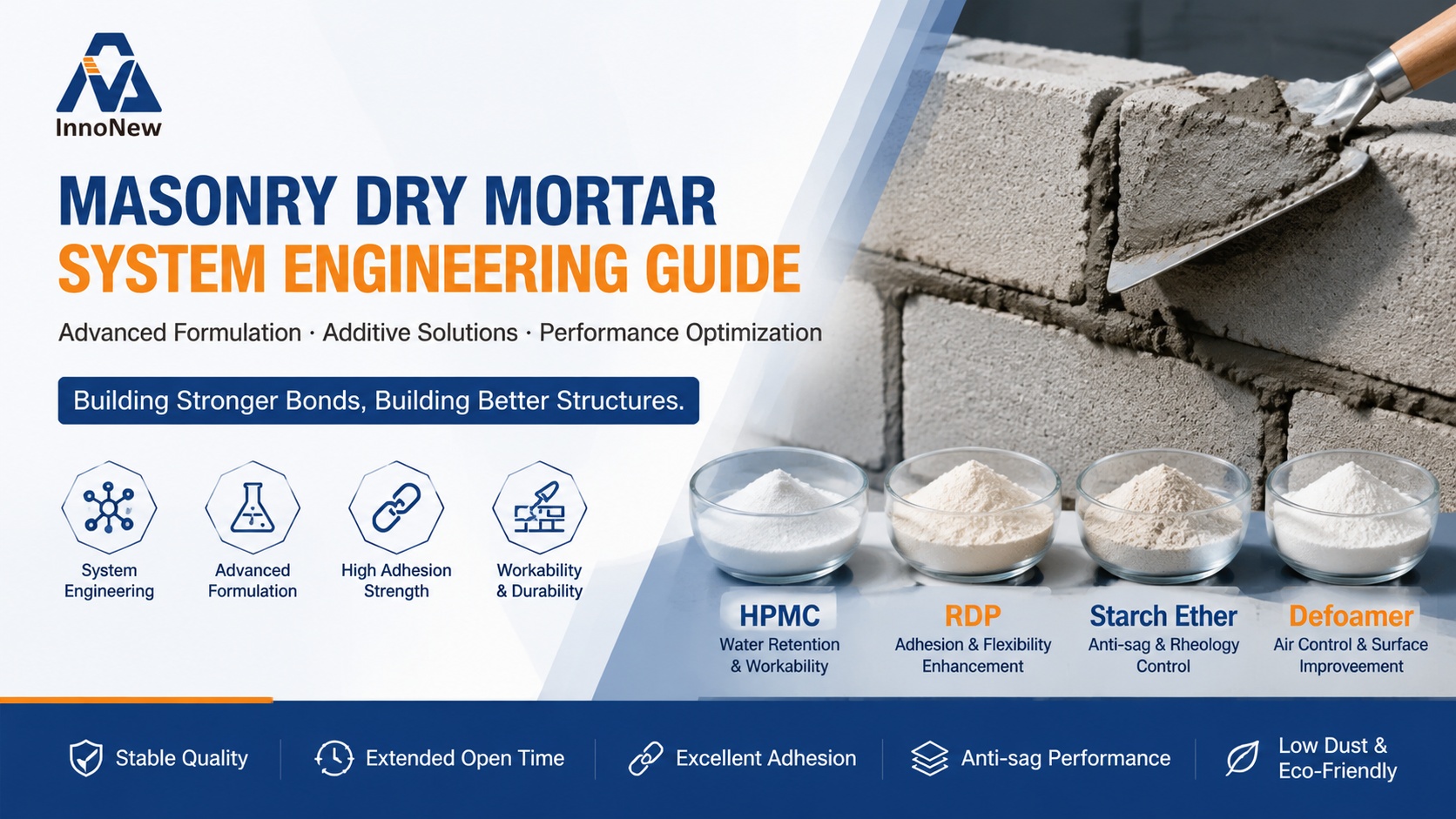
Introduction: From “Mortar Mix” to “Material System Engineering”
Traditional masonry mortar design is often treated as a fixed ratio problem:
Cement + Sand + Water = Mortar
However, modern dry-mix masonry mortar is no longer a simple mixture. It is a:
Multiphase colloidal cement-polymer composite system
It involves:
- Cement hydration kinetics
- Particle packing theory
- Polymer film formation
- Capillary water transport
- Rheology (yield stress + thixotropy)
Therefore, industrial masonry mortar must be designed as a system engineering product, not a recipe.
Masonry Dry Mortar System Architecture (Industrial Model)
            MASONRY DRY MORTAR SYSTEM ENGINEERING MODEL

┌──────────────────────────────────────────────┐
│                BINDER SYSTEM                 │
│        Cement + (Optional Lime)              │
└──────────────────────────────────────────────┘
                        ↓
┌──────────────────────────────────────────────┐
│             PARTICLE PACKING SYSTEM          │
│   Graded Sand + Mineral Fillers (0–2 mm)     │
└──────────────────────────────────────────────┘
                        ↓
┌──────────────────────────────────────────────┐
│          WATER RETENTION SYSTEM              │
│        INNOCELL™ HPMC Network Layer          │
└──────────────────────────────────────────────┘
                        ↓
┌──────────────────────────────────────────────┐
│        POLYMER MODIFICATION SYSTEM           │
│        INNOPOLY™ RDP Film Formation          │
└──────────────────────────────────────────────┘
                        ↓
┌──────────────────────────────────────────────┐
│         RHEOLOGY CONTROL SYSTEM              │
│     Starch Ether + HPMC Synergy Network      │
└──────────────────────────────────────────────┘
                        ↓
┌──────────────────────────────────────────────┐
│          AIR & DEFECT CONTROL SYSTEM         │
│        INNODEFOAM™ Microbubble Control       │
└──────────────────────────────────────────────┘
                        ↓
            FINAL ENGINEERED PERFORMANCE
   Strength | Adhesion | Workability | Durability
Cementitious Matrix Engineering (Not Just “Cement”)
1. Cement Hydration as a Controlled Reaction System
Cement in masonry mortar is not only a binder, but a reaction engine:
- C3S → early strength
- C2S → long-term strength
- C3A → setting behavior sensitivity
In dry-mix systems, hydration is intentionally delayed and controlled by:
- HPMC water retention film
- Polymer coating effect
- Reduced free water availability
2. Performance Risk Without System Design
Without additives:
- Rapid water loss → incomplete hydration
- Shrinkage microcracks
- Weak interface transition zone (ITZ)
Particle Packing System
A high-performance masonry mortar is not strength-driven only by cement, but by:
Optimized particle packing density
Key mechanism:
- Fine sand fills voids between coarse sand
- Fillers reduce porosity
- Lower void ratio = higher compressive strength
Engineering outcome:
- Reduced cement demand
- Improved density
- Lower shrinkage
Functional Additive System
1. INNOCELL™ HPMC – Water Retention & Rheology Backbone
Molecular mechanism:
- Hydrophilic cellulose backbone
- Forms 3D hydrated gel network
- Traps free water inside capillary system
Engineering effects:
- Controls cement hydration rate
- Extends open time (critical in hot climates)
- Improves vertical anti-sag behavior
- Stabilizes viscosity under shear
In system terms:
HPMC = “Water distribution control architecture”
2. INNOPOLY™ RDP – Polymer Film Reinforcement System
Mechanism:
- Redispersed latex particles coalesce during drying
- Forms continuous polymer film inside cement matrix
Functional impact:
- Improves adhesion to:
- Concrete blocks
- Clay bricks
- AAC blocks
- Enhances:
- Flexural strength
- Crack bridging ability
- Thermal stress resistance
System role:
RDP = “Microstructural reinforcement layer”
3. INNOSTAR™ Starch Ether – Rheology Intelligence Modifier
Function:
- Controls thixotropy (shear thinning behavior)
- Works synergistically with HPMC network
Engineering benefit:
- Prevents wall sagging
- Improves trowel smoothness
- Stabilizes vertical build-up thickness
4. INNODEFOAM™ Defoamer – Defect Elimination System
Problem addressed:
Entrapped air → voids → strength loss
Function:
- Breaks unstable foam films
- Reduces microbubble formation
Result:
- Higher density consistency
- Improved compressive strength reliability
- Better surface finish quality
System-Level Formulation Engineering Principles
1. Water Retention–Hydration Coupling Model
Water is not “added”, but regulated:
- Too much free water → segregation
- Too little → incomplete hydration
HPMC defines water availability curve, not just retention
2. Polymer–Cement Interface Transition Zone (ITZ)
RDP modifies weakest zone:
- Cement paste ↔ aggregate interface
Improvement mechanism:
- Polymer penetration into pores
- Reduced microcrack propagation
3. Rheology Design (Yield Stress Engineering)
Masonry mortar must satisfy:
- High static yield stress → no sag
- Low dynamic viscosity → easy application
This is achieved by:
- HPMC network
- Starch ether synergy
- Particle grading balance
4. Climate Engineering Adaptation
Hot climates (Middle East / SEA):
- High evaporation control required
- Increased HPMC retention grade
Humid climates:
- Anti-slump stability required
- Adjust starch ether ratio
Industrial Formulation System
1. Standard Masonry Mortar (Structural Block Work)
| Component | Engineering Role |
|---|---|
| Cement (25–30%) | Hydration matrix |
| Sand (65–70%) | Structural skeleton |
| INNOCELL™ HPMC (0.15–0.3%) | Water control system |
| INNOPOLY™ RDP (0.5–1.0%) | Bonding reinforcement |
| INNODEFOAM™ (0.1–0.2%) | Air control |
2. High-Performance AAC Block Mortar System
| Component | Function |
|---|---|
| Cement (30–35%) | Strength base |
| Fine fillers | Packing density |
| INNOCELL™ HPMC (0.2–0.4%) | High water retention |
| INNOPOLY™ RDP (1.5–3.0%) | High adhesion system |
| INNOSTAR™ Starch Ether | Anti-sag control |
| INNODEFOAM™ | Microvoid elimination |
3. Thin-Bed Adhesive Mortar System
- High polymer ratio
- Low thickness application (2–3 mm)
- High bonding efficiency system
Designed for modern energy-efficient masonry
Performance Engineering Parameters
- Compressive strength (7/28 days)
- Adhesion strength (pull-off test)
- Open time (critical in field application)
- Water retention ratio (>95% target systems)
- Shrinkage control index
- Workability index (labor efficiency factor)
Failure Mode Engineering
Crack formation
- Polymer deficiency
- Rapid moisture loss
Sagging failure
- Insufficient rheology control
- Low starch ether synergy
Weak adhesion
- Low RDP film continuity
- Poor ITZ formation
Dusting / surface weakness
- Poor air control (foam defects)
Industrial Application Scenarios
- High-rise infill masonry systems
- Precast concrete construction
- AAC block energy-efficient housing
- Commercial block wall systems
- Modular construction systems
INNONEW Material System Positioning
Our product system is designed as a complete dry-mix mortar engineering solution:
- INNOCELL™ HPMC → hydration + water control system
- INNOPOLY™ RDP → adhesion + structural reinforcement
- INNOSTAR™ Starch Ether → rheology intelligence system
- INNODEFOAM™ Defoamer → defect elimination system
Designed for:
- High temperature construction environments
- High absorption masonry units
- Industrial dry mortar production lines
Future Trend: Digital Mortar Formulation
- AI-assisted mix design optimization
- Carbon-reduced binder systems
- Polymer-cement hybrid systems
- Smart rheology-controlled mortars
FAQ
Q1: Why is masonry mortar considered a system rather than a formula?
Because performance depends on interactions between cement hydration, polymer film formation, particle packing, and rheology control.
Q2: What is the function of HPMC in dry mortar systems?
It regulates water retention, controls hydration speed, and stabilizes mortar rheology.
Q3: How does RDP improve masonry performance?
It forms polymer films that strengthen adhesion and improve crack resistance.
Q4: Why is starch ether used together with HPMC?
It enhances anti-sag performance by modifying thixotropic behavior.
Q5: What causes performance instability in masonry mortar?
Main causes include poor particle grading, insufficient polymer system, or air entrapment.
Q6: Is dry-mix masonry mortar suitable for hot climates?
Yes, but requires high-performance HPMC and optimized water retention system.