
Hydroxyethyl Cellulose (HEC) for Real Stone Coating Systems
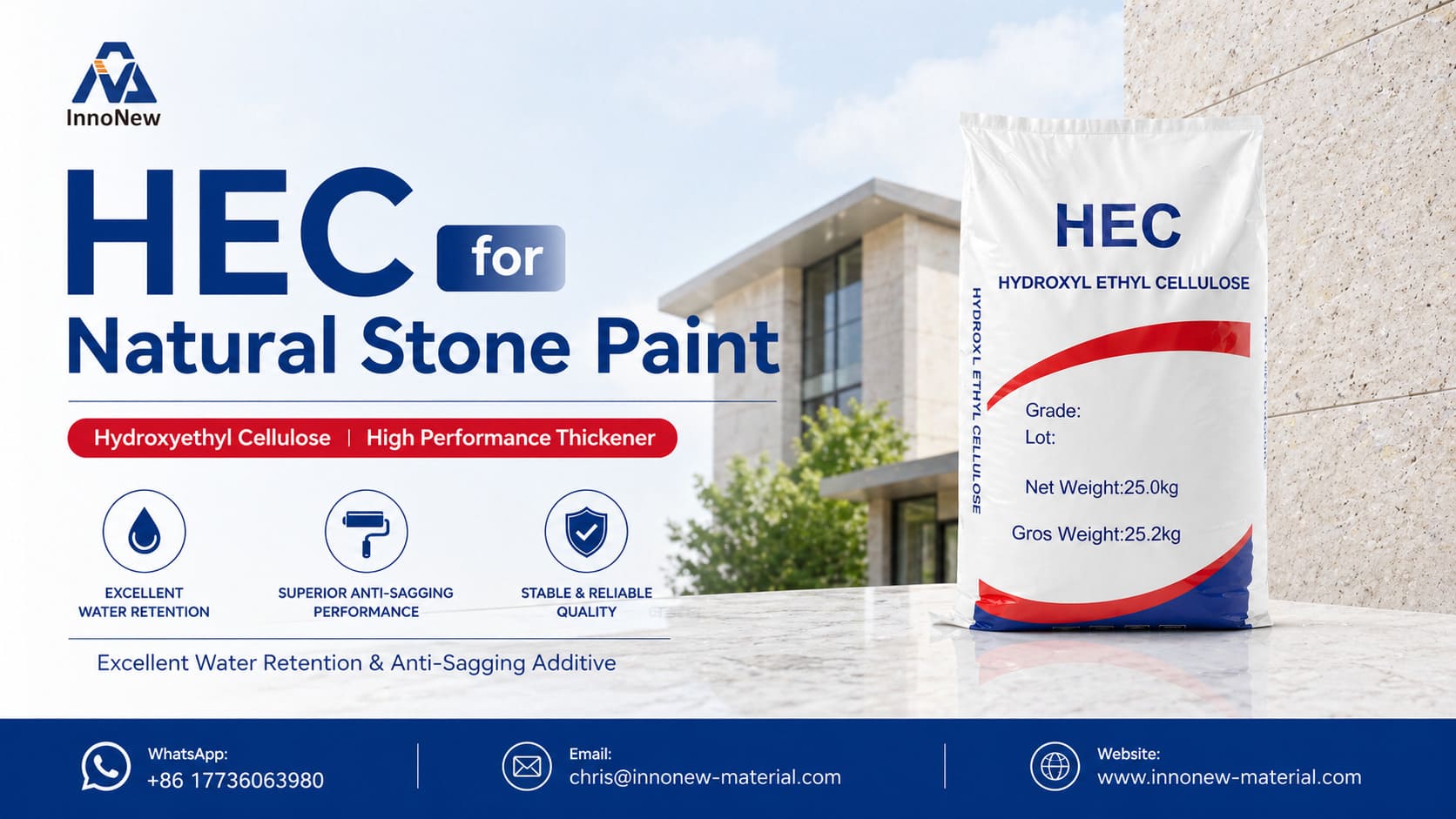
Introduction: HEC in Real Stone Coating Systems
Real stone coating (also known as natural stone paint or granite texture coating) is a high-solids architectural finish system composed of colored quartz sand, mineral aggregates, and polymer emulsions. Its solids content typically exceeds 70–85%, making it one of the most rheologically demanding water-based coating systems.
In such systems, Hydroxyethyl Cellulose (HEC) is not a simple thickener, but a core rheology architecture component responsible for:
- Suspension stability of heavy mineral particles
- Anti-sedimentation during storage and transport
- Sprayability through hopper guns or airless systems
- Texture formation and profile retention after application
Without properly engineered HEC selection, real stone coatings will suffer from:
- rapid sedimentation
- inconsistent spray pattern
- clogging in application equipment
- poor texture definition
- phase separation during storage
These issues are not just formulation problems — they are rheology control failures.
Hydroxyethyl Cellulose (HEC) is engineered to solve these challenges by precisely controlling viscosity, suspension, and flow behavior in real stone coating systems.
Functional Mechanism of HEC in Stone Texture Systems
HEC is a non-ionic, water-soluble cellulose ether that forms a three-dimensional hydrated polymer network in aqueous systems.
Its performance in real stone coatings is governed by three key rheological functions:
Low-Shear Viscosity Build-Up (Storage Stability)
At rest, HEC forms an entangled polymer network that increases yield stress, enabling:
- Suspension of quartz sand (0.5–3.0 mm particles)
- Prevention of sedimentation under gravity
- Long-term storage stability
Shear-Thinning Behavior (Sprayability)
Under high shear (mixing or spraying), the polymer network temporarily breaks down:
- viscosity decreases rapidly
- material becomes pumpable and sprayable
- clogging risk is minimized
Structural Recovery (Anti-Sag & Texture Locking)
After application:
- viscosity rebuilds quickly
- aggregates are locked in position
- vertical sagging is prevented
- stone texture is preserved
This “reversible rheology behavior” is the key reason HEC is irreplaceable in stone coating systems.
Key Technical Requirements for HEC in Real Stone Paint
Real stone coatings require significantly higher-performance HEC grades compared to conventional latex paints.
Recommended Molecular Weight Range
- High to ultra-high molecular weight HEC
- Solution viscosity: 200,000 – 400,000 mPa·s (2% solution)
Typical Dosage Range
- 0.3% – 0.8% (depending on sand loading and viscosity target)
Target System Viscosity
- 80,000 – 100,000 mPa·s (Brookfield range)
- High yield stress for anti-sedimentation
Critical Performance Indicators
- Anti-settling efficiency
- Spray pattern stability
- Re-dispersion after storage
- Texture retention after curing
Application:
HEC for real stone coating is optimized for:
- Thick build granite coatings
- Multi-layer exterior façade systems
- Spray-applied textured coatings
- Colored sand suspension systems
- High solid content decorative coatings
Typical Real Stone Coating Formulation System
| Component | Function | Typical Range |
|---|---|---|
| Water | Continuous phase | 10–15% |
| Acrylic emulsion | Film formation | 10–18% |
| Quartz sand / stone chips | Texture body | 60–75% |
| HEC (high MW) | Rheology control | 0.5–0.8% |
| Attapulgite / silica | Co-thickener | 0.3–0.8% |
| Dispersant | Pigment stability | 0.1–0.3% |
| Defoamer | Foam control | 0.1–0.3% |
| Biocide | Preservation | 0.1–0.2% |
Technical Interpretation:
- HEC provides primary structural viscosity
- mineral fillers provide mechanical texture
- co-thickeners stabilize static yield stress system
Application & Dispersion Technology
Correct incorporation of HEC is critical for performance consistency.
Recommended Process:
- Pre-wet HEC in water phase under agitation
- Maintain moderate shear (avoid vortex aeration)
- Allow full hydration (20–40 minutes depending on grade)
- Add emulsions and fillers sequentially
- Adjust final viscosity after full dispersion
Key Control Parameters:
- hydration temperature: 20–35°C
- pH: neutral to slightly alkaline
- avoid direct dry powder dumping
Best Practice for Using HEC:
- Pre-disperse HEC in clean water
- Use high-speed mixing for uniform hydration
- Allow sufficient swelling time (critical step)
- Introduce binders and additives
- Add colored sand under slow agitation
Avoid direct dry mixing with aggregates
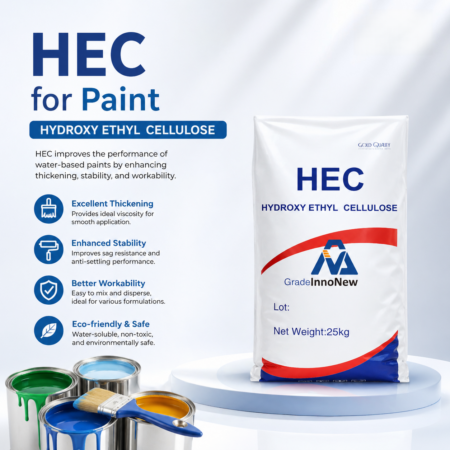
Performance Benefits of HEC in Real Stone Coating:
- ✔ Stable suspension over long storage periods
- ✔ Smooth spray without nozzle clogging
- ✔ Uniform stone-like texture formation
- ✔ Reduced cracking and improved durability
- ✔ Better construction efficiency
WHY CHOOSE US
We are not just a supplier — we are a formulation partner.
- ✔ Consistent viscosity control
- ✔ Tailored grades for coating systems
- ✔ Technical support for formulation optimization
- ✔ Export experience in global coating markets
- ✔ Fast response & stable supply chain
FAQ
1. Why is HEC preferred in real stone coatings?
Because it controls rheology, which directly affects texture, sprayability, and stability.
2. What viscosity grade of HEC is recommended?
Medium to high viscosity grades depending on coating thickness and system design.
3. Can HEC replace other thickeners?
In most cases yes, but optimal performance may come from system combination.
4. Does HEC affect coating durability?
Yes, by improving water retention and film formation.
5. How to avoid lump formation when using HEC?
Use proper dispersion and hydration process.
CTA
Looking to improve your real stone coating performance and production stability?
Choose a reliable Hydroxyethyl Cellulose (HEC) supplier to upgrade your formulation.
👉 Contact us today for free samples & formulation support
🌐 www.innonew-material.com
📧 chris@innonew-material.com
📱 WhatsApp: +86 17736063980