
Hydroxyethyl Cellulose (HEC) for Personal Care & Cosmetics
Premium Thickener | Stabilizer | Rheology Modifier for High-Performance Formulations
Introduction
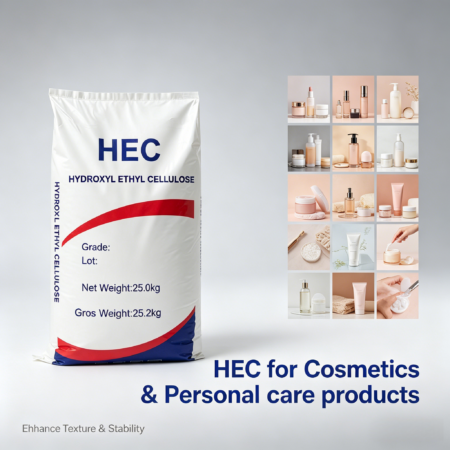
Hydroxyethyl Cellulose (HEC) is a non-ionic, water-soluble polymer widely used in personal care and cosmetic formulations as a thickener, stabilizer, film-forming agent, and rheology modifier.
In modern formulations, Cellulose Ether HEC plays a critical role in delivering smooth texture, stable viscosity, and enhanced sensory experience, making it essential for products such as shampoos, body washes, creams, lotions, and gels.
For manufacturers seeking consistent quality, formulation flexibility, and cost efficiency, HEC is one of the most reliable cellulose ethers available.
Why HEC is Essential in Cosmetics
✔ Excellent Thickening Performance
HEC provides efficient viscosity building even at low dosage, improving product body and texture.
✔ Non-Ionic Compatibility
Compatible with:
- Anionic surfactants
- Cationic conditioners
- Electrolytes & salts
✔ Superior Stability
- pH stable (2–12 range)
- Salt tolerant
- Temperature resistant
✔ Smooth Sensory Feel
- Non-sticky
- Silky application
- Enhances spreadability
✔ Transparent Formulation Capability
Ideal for clear shampoos and gels due to high clarity.
Key Applications
Shampoo & Conditioner
- Thickening agent
- Foam stabilizer
- Improves texture and feel
Body Wash & Shower Gel
- Provides smooth viscosity
- Enhances transparency
- Stabilizes surfactant systems
Creams & Lotions
- Emulsion stabilizer
- Improves spreadability
- Prevents phase separation
Cosmetic Gels (Hair Gel / Aloe Gel)
- High clarity
- Strong viscosity control
- Film-forming effect
Liquid Soap & Hand Wash
- Consistent thickness
- Salt tolerance
- Cost-effective solution
Technical Advantages
| Property | Benefit |
|---|---|
| Non-ionic structure | Wide formulation compatibility |
| Water solubility | Easy processing |
| Adjustable viscosity | Flexible formulation design |
| Salt resistance | Stable in surfactant systems |
| Film-forming | Better skin & hair feel |
Specifications
| Parameter | Value |
|---|---|
| Appearance | White powder |
| Viscosity | 400 – 100,000 mPa.s |
| pH Value | 6.0 – 8.5 |
| Moisture | ≤ 5% |
| Ash Content | ≤ 5% |
How to Use HEC in Formulations
- Slowly add HEC into water under stirring
- Allow full hydration (20–30 min)
- Adjust pH if needed
- Add surfactants or other ingredients
- Fine-tune viscosity
✔ Tip: Pre-dispersing HEC improves dissolution efficiency.
Recommended Dosage
| Application | Dosage |
|---|---|
| Shampoo | 0.3 – 1.0% |
| Body Wash | 0.2 – 0.8% |
| Lotion/Cream | 0.2 – 0.5% |
| Gel | 0.5 – 2.0% |
HEC vs Other Thickeners
| Feature | HEC | Carbomer | Xanthan Gum |
|---|---|---|---|
| Electrolyte tolerance | Excellent | Poor | Moderate |
| Transparency | High | Very high | Low |
| Skin feel | Smooth | Slightly sticky | Heavy |
| Ease of use | Easy | Neutralization needed | Easy |
👉 Conclusion: HEC offers the best balance between performance, cost, and formulation flexibility.
Why Choose Our HEC
- Factory direct supply (cost advantage)
- Stable viscosity batches
- Custom grades available
- Fast global shipping
- Technical formulation support
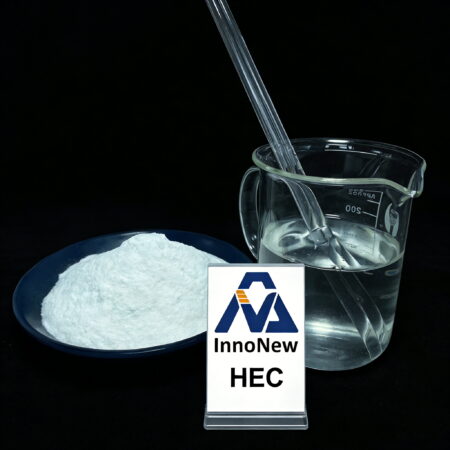
FAQ
What is HEC used for in cosmetics?
HEC is used as a thickener, stabilizer, and rheology modifier in shampoos, lotions, gels, and creams.
Is HEC safe for skin?
Yes, HEC is widely considered safe, non-toxic, and non-irritating, suitable for personal care formulations.
Can HEC be used in clear shampoo?
Yes, HEC provides excellent clarity, making it ideal for transparent formulations.
What is the difference between HEC and Carbomer?
HEC is non-ionic and salt tolerant, while Carbomer requires neutralization and is sensitive to electrolytes.
Get High-Quality HEC Detergent Grade?
Looking for a reliable supplier of HEC for Personal cares & Cosmetics?
 Stable viscosity performance Competitive pricing Fast global delivery
 Contact us now for:
- Technical Data Sheet (TDS)
- Free samples
- Customized solutions
WhatsApp: +86 17736063980
Email: chris@innonew-material.com