
Hydroxypropyl Starch Ether (HPS) in Construction Applications
Introduction: Why Hydroxypropyl Starch Ether Matters in Construction
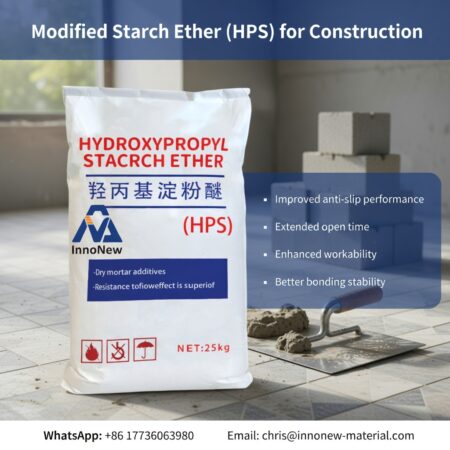
Hydroxypropyl starch ether (HPS) is a high-performance modified starch widely used in modern construction formulations. As a key rheology modifier, hydroxypropyl starch ether enhances workability, improves water retention, and significantly boosts anti-sagging performance.
In today’s competitive building materials market, contractors and manufacturers increasingly rely on HPS for dry mix mortar, tile adhesive, and wall putty to achieve superior consistency and application efficiency.
Compared with traditional additives, hydroxypropyl starch ether provides a cost-effective and environmentally friendly solution, making it a preferred choice for global construction chemical manufacturers.
1. Hydroxypropyl Starch Ether for Tile Adhesive
Hydroxypropyl starch ether plays a critical role in tile adhesive formulations. As a highly efficient anti-sagging additive, HPS Powder ensures excellent vertical hold, preventing tiles from slipping during installation.
Key Benefits:
- Improved anti-slip performance
- Extended open time
- Enhanced workability
- Better bonding stability
2. HPS for Dry Mix Mortar
In dry mix mortar systems, hydroxypropyl starch ether functions as a thickening and stabilizing agent. It optimizes the rheological behavior and improves consistency during application.
Advantages:
- Enhanced workability
- Reduced cracking
- Improved cohesion
- Better water retention
3. Hydroxypropyl Starch Ether in Wall Putty & Skim Coat
Hydroxypropyl starch ether improves the surface finish and application smoothness of wall putty formulations. It ensures uniform spreading and reduces labor intensity.
Performance:
- Smooth application
- Increased open time
- Improved water retention
- Crack resistance
Starch Ether HPS Powder for Self-Leveling Compounds
Hydroxypropyl starch ether enhances the flow control and stability of self-leveling mortar systems.
Key Functions:
- Prevent segregation
- Improve viscosity balance
- Enhance leveling performance
5. Gypsum-Based Products
In gypsum-based applications, hydroxypropyl starch ether regulates setting time and improves adhesion.
✔ Benefits:
- Controlled setting
- Improved bonding strength
- Reduced shrinkage
6. Synergistic Use with Other Construction Additives
Hydroxypropyl starch ether is commonly used together with:
- Cellulose Ether (HPMC / HEMC) → water retention
- RDP Powder → adhesion & flexibility
- PCE Superplasticizer → flow performance
This synergy significantly enhances overall system performance, making hydroxypropyl starch ether an essential component in high-end formulations.
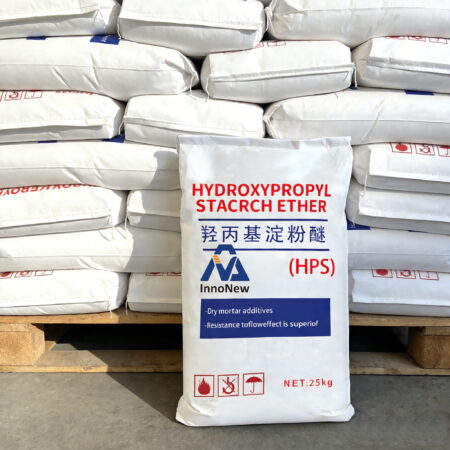
Why Choose Our Hydroxypropyl Starch Ether (HPS)
As a professional HPS supplier in China, we provide high-quality hydroxypropyl starch ether with stable performance and competitive pricing.
Competitive Advantages:
- Factory direct supply
- Consistent quality control
- Customizable specifications
- Global export experience
FAQ:
Q1: What is hydroxypropyl starch ether used for?
Used in tile adhesive, dry mix mortar, wall putty and gypsum systems.
Q2: How does HPS improve anti-sagging?
By increasing viscosity and structural stability.
Q3: Can HPS be used in both interior and exterior construction?
Yes, it’s suitable for both interior and exterior materials (wall putty, more, tile adhesive), enhancing adhesion and weather resistance for exterior applications.
Q4: Can HPS replace HPMC?
No, but it works synergistically to enhance performance.