
PVA for Construction: Enhance Bonding Strength & Cement Performance
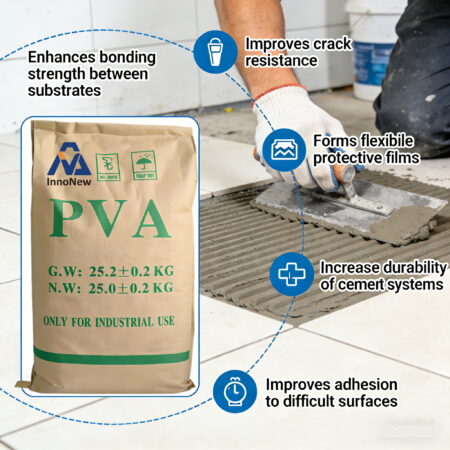
Polyvinyl Alcohol (PVA) is widely used in construction materials as a bonding enhancer and film-forming polymer, improving the performance of cement-based systems.
It plays a key role in enhancing adhesion strength, flexibility, and crack resistance, making it an effective additive for mortar, concrete interfaces, and construction bonding applications.
At Hebei InnoNew Material Technology Co., Ltd., we supply high-quality PVA 2488 powder, engineered to deliver stable performance, strong bonding, and reliable consistency in construction applications.
Why Use PVA in Construction
PVA acts as a functional polymer additive that significantly improves the mechanical properties of building materials.
Key Benefits:
- ✔ Enhances bonding strength between substrates
- ✔ Improves crack resistance
- ✔ Forms flexible protective films
- ✔ Increases durability of cement systems
- ✔ Improves adhesion to difficult surfaces
👉 These advantages make PVA an essential additive in modern construction materials.
Main Applications of PVA in Construction
1. Cement Mortar Modification
- Dry mix mortar
- Repair mortar
Performance:
- Increased bonding strength
- Reduced cracking
- Improved durability
2. Bonding Agent / Interface Treatment
- Concrete interface agents
- Surface bonding layers
Benefits:
- Strong adhesion to old and new surfaces
- Improved compatibility between materials
3. Tile Adhesive Enhancement
- Improves adhesion performance
- Enhances flexibility
4. Wall Putty & Skim Coat
- Improves film formation
- Enhances surface integrity
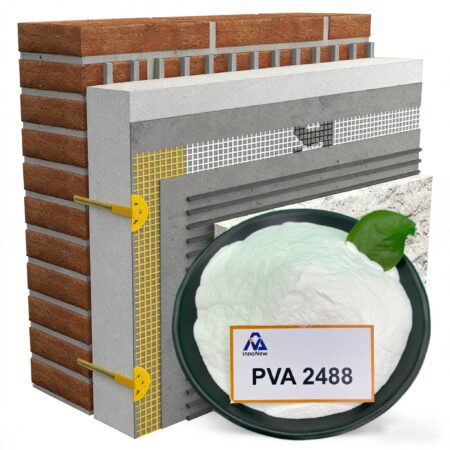
Recommended Product – PVA 2488 for Construction
Key Specifications:
- Degree of polymerization: 2400–2500
- Alcoholysis degree: 88% ±1%
- Excellent film-forming ability
- Stable viscosity
Why It Works:
- Strong adhesion performance
- Good compatibility with cement systems
- Consistent quality for industrial use
👉 If you’re looking for a reliable PVA grade optimized for construction, explore our full-spec PVA 2488 product page for detailed parameters and application guidelines.
Technical Advantages in Construction Materials
| Property | Benefit |
|---|---|
| Film formation | Flexible protective layer |
| Adhesion | Strong bonding performance |
| Flexibility | Crack resistance |
| Stability | Long-term durability |
PVA vs Other Construction Additives
| Material | Advantage | Limitation |
|---|---|---|
| PVA 2488 | Strong bonding, film-forming | Water sensitivity |
| Redispersible Polymer Powder (RDP) | Flexibility | Higher cost |
| Cellulose Ether (HPMC) | Water retention | Lower bonding strength |
Application Guidelines
- Recommended dosage: 0.5% – 2% (by weight of cement)
- Dissolution temperature: 80–90°C
- Can be used with other additives such as RDP and cellulose ether
Why Choose InnoNew PVA
At Hebei InnoNew Material Technology Co., Ltd., we provide:
- High-quality and stable PVA supply
- Competitive pricing
- Global export capability
- Technical support for construction formulations
InnoNew help customers improve material performance and cost efficiency in construction applications.
FAQ
1. What is PVA used for in construction?
PVA is used to improve bonding strength, flexibility, and crack resistance in cement-based materials.
2. Can PVA improve mortar performance?
Yes, PVA enhances adhesion, reduces cracking, and improves durability.
3. How is PVA used in cement systems?
It is dissolved in water and added during mixing.
4. What is the dosage of PVA in construction?
Typically 0.5% to 2% of cement weight.
5. Is PVA compatible with other additives?
Yes, it works well with RDP and cellulose ether HPMC powder in construction.
Call To Action
Looking for reliable PVA for construction applications?
👉 Contact us for:
- Free samples
- Technical consultation
- Customized solutions