
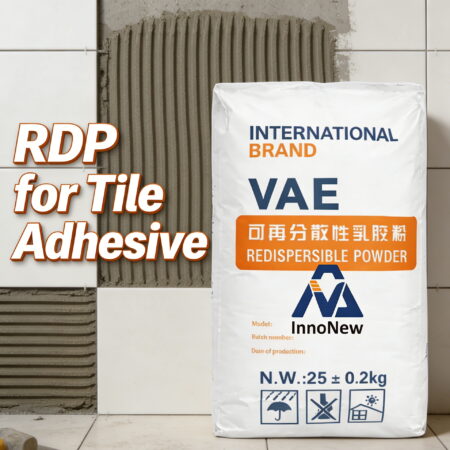
1. Introduction: Evolution of Tile Adhesive Technology
In traditional construction, tiles were installed using a simple cement-sand mortar. However, with the development of:
- Large-format porcelain tiles
- Low-absorption substrates
- Exterior façade systems
- High-rise construction requirements
traditional mortars are no longer sufficient.
Modern tile installation systems require engineered adhesive formulations that provide:
- High bonding strength
- Long open time
- Anti-slip performance
- Thermal and moisture resistance
- Durability under dynamic stress
This shift has transformed tile adhesive from a construction material into a chemically engineered system.
2. Standard Tile Adhesive Formula Design
A professional dry mix tile adhesive formula is typically based on four key material groups:
Basic Formula Structure (Weight %)
| Component | Content | Function |
|---|---|---|
| Cement | 30% | Hydraulic bonding strength |
| Quartz Sand | 68% | Structural skeleton & filler |
| RDP | 1.5–2.5% | Polymer bonding & flexibility |
| HPMC | 0.2–0.4% | Water retention & rheology control |
| Defoamer | 0.1–0.3% | Air void control |
3. Functional Role of Each Component
3.1 Cement: The Hydraulic Backbone
Cement is the primary binder responsible for hydration reactions.
Key roles include:
- Formation of calcium silicate hydrate (C-S-H)
- Mechanical strength development
- Initial and final setting control
However, cement alone creates brittle systems, which is why modification is required.
3.2 Quartz Sand: Structural Stability Matrix
Quartz sand provides:
- Volume stability
- Reduced shrinkage cracking
- Improved compressive resistance
- Controlled workability
Particle size distribution (PSD) plays a critical role in final performance. Poor grading often leads to:
- Segregation
- Weak bonding zones
- Inconsistent application behavior
3.3 HPMC: Water Retention & Rheology Controller
Hydroxypropyl Methylcellulose (HPMC) is essential for modern tile adhesives.
Key functions:
- Water retention improvement
- Extended open time
- Improved slip resistance
- Smooth trowel application
- Reduced water loss into substrates
Engineering insight:
Without HPMC, cement hydration becomes uncontrolled due to rapid water loss, leading to weak bonding and poor workability.
3.4 RDP: Polymer Reinforcement System
Redispersible Polymer Powder (RDP) transforms brittle cement systems into flexible adhesive networks.
Mechanism:
After water addition, RDP forms a polymer film that:
- Bridges cement particles
- Enhances substrate adhesion
- Improves flexibility under stress
- Reduces crack propagation
Performance improvements:
- Higher tensile adhesion strength
- Improved freeze-thaw resistance
- Better deformation tolerance
3.5 Defoamer: Air Void Control Agent
Air entrainment is one of the most underestimated problems in tile adhesive systems.
Excess foam leads to:
- Weak bonding points
- Reduced density
- Surface pinholes
- Lower mechanical strength
Defoamer ensures:
- Compact mortar structure
- Higher strength consistency
- Improved surface finish
- Reduced porosity
4. Engineering Principles of Tile Adhesive Design
A high-performance tile adhesive system must balance multiple competing parameters:
4.1 Workability vs Strength
- Higher water retention improves workability
- Excess water reduces final strength
4.2 Open Time vs Setting Speed
- Longer open time improves installation flexibility
- Too slow setting delays construction progress
4.3 Flexibility vs Rigidity
- Polymer improves flexibility
- Cement provides rigidity
4.4 Air Content vs Density
- Controlled air improves workability
- Excess air reduces strength
A successful formulation is always a balanced multi-variable system, not a single-material optimization.
5. Performance Classification of Tile Adhesive Systems
Modern tile adhesives are typically classified into:
C1 Type (Standard Adhesive)
- Basic bonding strength
- Interior wall applications
C2 Type (High Performance)
- Enhanced adhesion strength
- Suitable for porcelain tiles
- Exterior wall applications
S1 / S2 Flexible Systems
- High deformation capacity
- Suitable for large-format tiles
- Critical substrates (metal, wood panels)
6. Application Scenarios
A properly engineered tile adhesive formula is used in:
- Ceramic tile wall systems
- Porcelain floor installations
- Bathroom & kitchen wet areas
- Exterior insulation finishing systems (EIFS)
- High-rise façade cladding systems
- Commercial flooring systems
7. Advanced Formulation Trends (2026 Industry Direction)
The global dry mix mortar industry is shifting toward:
7.1 Low Carbon Cement Systems
Reducing clinker content while maintaining strength.
7.2 High Polymer Modified Adhesives
Increasing RDP content for flexibility and durability.
7.3 Dust-Free Mortar Technology
Improving construction safety and environmental compliance.
7.4 Multi-Functional Additive Systems
Integration of:
- HPMC (rheology)
- RDP (bonding)
- PCE (dispersion)
- Defoamer (air control)
8. Technical Problem Analysis in Real Applications
Problem 1: Tile Slippage
Cause:
- Low viscosity
- Insufficient HPMC
Problem 2: Hollow Sound After Installation
Cause:
- Excess air entrainment
- Poor defoamer control
Problem 3: Weak Bond Strength
Cause:
- Low RDP content
- Poor cement hydration control
Problem 4: Fast Water Loss
Cause:
- Low water retention (HPMC deficiency)
9. Role of Chemical Additives in System Optimization
Modern tile adhesive performance is primarily controlled by:
- HPMC → Workability system
- RDP → Bonding system
- Defoamer → Density system
- PCE → Dispersion system
These additives act as a multi-layer performance control network.
10. Industrial Value of Formulation Optimization
Optimized tile adhesive formulas provide:
- Lower material cost per m²
- Higher installation efficiency
- Reduced defect rate
- Extended service life
- Improved brand competitiveness
For manufacturers, formulation control directly determines market positioning.
Conclusion
Tile adhesive formulation is a highly engineered system combining cement chemistry, polymer modification, rheology control, and air management technology.
The interaction between cement, quartz sand, HPMC, RDP, and defoamer determines:
- Strength
- Durability
- Workability
- Installation performance
As global construction standards continue to evolve, advanced tile adhesive systems will increasingly rely on multi-functional chemical additive engineering.
About Technical Support
Hebei InnoNew Material Technology Co., Ltd. provides advanced construction chemical solutions including:
- HPMC for rheology control
- RDP for adhesion enhancement
- Defoamer for air void optimization
- PCE for dispersion systems
These materials are widely used in global dry mix mortar and tile adhesive manufacturing industries.