
Concrete Admixtures for Myanmar Construction Industry
Myanmar’s concrete engineering environment is fundamentally different from temperate regions. The combination of high ambient temperature, rapid cement hydration, variable aggregate quality, and inconsistent batching control creates a highly unstable concrete system.
In this context, concrete admixtures are not optional additives—they are performance stabilization materials that determine whether concrete is structurally reliable or not.
Modern construction in Myanmar increasingly relies on advanced chemical systems such as:
- Polycarboxylate Ether (PCE) superplasticizers
- Concrete retarders for hydration control
- Accelerators for early strength development
- Defoamers for air void elimination
These materials collectively define the rheology, hydration kinetics, and final microstructure of concrete.
Engineering Challenges of Concrete in Myanmar
1. Hot Climate Acceleration of Cement Hydration
In Myanmar, ambient temperatures often exceed 30–38°C. Under such conditions:
- Cement hydration rate increases significantly
- Initial setting time becomes unpredictable
- Slump loss occurs within 30–60 minutes
- Pumpability decreases rapidly during transport
This leads to construction delays and structural inconsistency if no chemical control system is used.
2. Water Addition on Site (Field Re-tempering)
A common practice in Southeast Asia construction sites:
Workers add water to restore slump during transportation loss.
This causes:
- Increased water-cement ratio (w/c ratio instability)
- Reduced compressive strength
- Increased shrinkage and cracking risk
- Poor durability in long-term service
This is one of the most critical quality issues in Myanmar concrete practice.
3. Cement & Aggregate Variability
Myanmar projects often use mixed sources of materials:
- Imported cement (variable C3A content)
- Local limestone aggregates
- River sand with inconsistent grading
This leads to unpredictable adsorption of admixtures, making formulation design essential.
Role of Concrete Admixtures in Myanmar Concrete System
Concrete admixtures are not simply “improvers”—they act as chemical regulators of cement hydration and particle dispersion systems.
They control three core parameters:
1. Rheology Control (Workability)
Maintains flowability during transport and pumping
2. Hydration Kinetics Control
Adjusts setting time and early strength development
3. Microstructure Optimization
Reduces voids and improves density and durability
Advanced Admixture System for Myanmar
1. PCE Superplasticizer
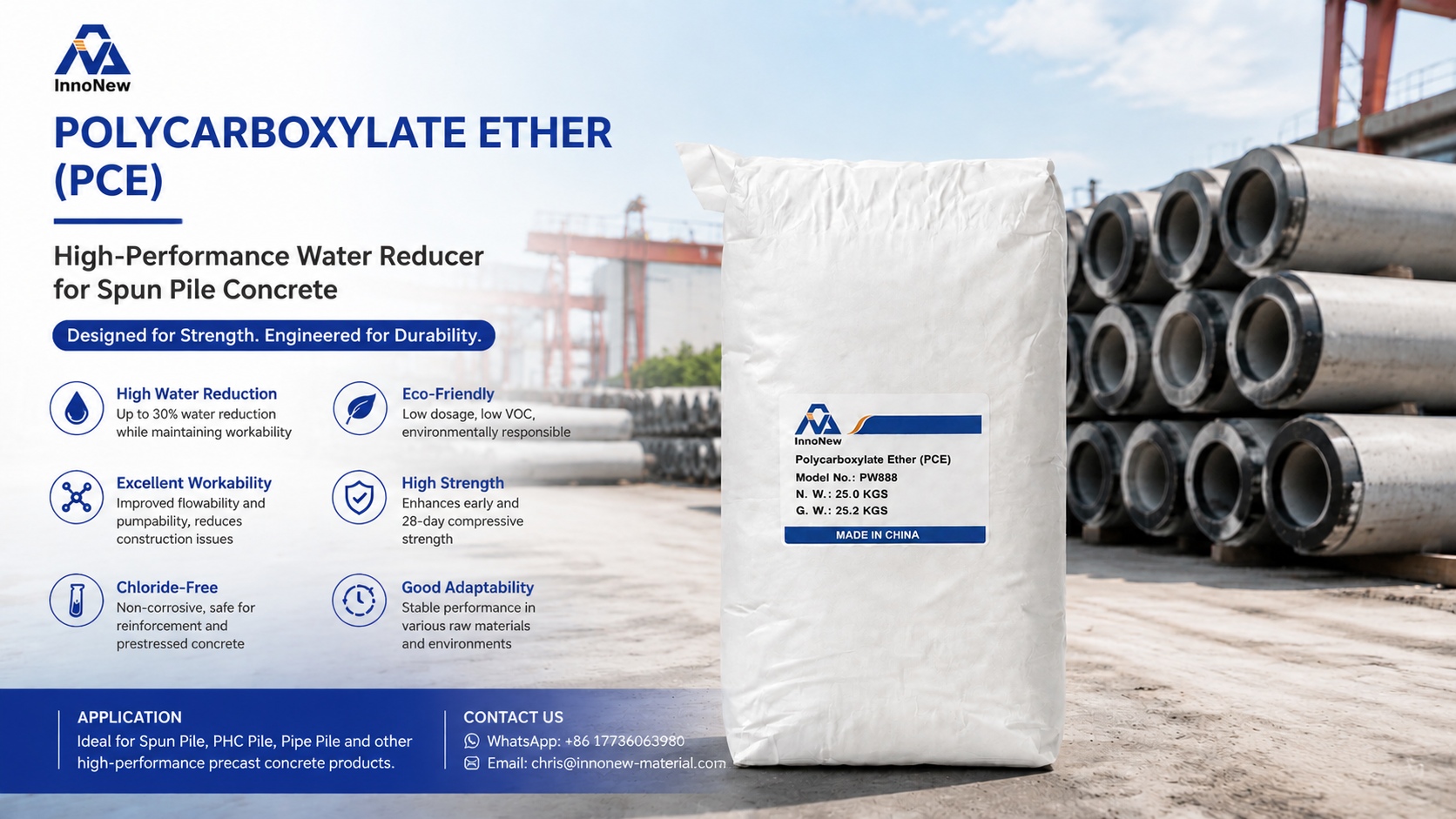
PCE is the backbone of high-performance concrete systems in Myanmar.
Mechanism of Action:
PCE works through steric hindrance + electrostatic dispersion, separating cement particles and releasing trapped water.
This results in:
- Lower water demand at same slump
- Improved particle dispersion
- Reduced flocculation of cement grains
- Stable rheology over time
Engineering Advantages in Myanmar Conditions:
✔ High slump retention under 35°C+
✔ Reduced slump loss during long transport
✔ Stable performance with variable cement
✔ Improved pumpability for high-rise construction
✔ Higher final compressive strength due to low w/c ratio
Typical Application Scenarios:
- Ready-mix concrete plants in Yangon & Mandalay
- Pumped concrete for high-rise structures
- Bridge deck concreting
- Infrastructure slab casting
2. Concrete Retarder (Hydration Time Control System)
In tropical climates, retarder is not just a delay agent—it is a hydration energy management tool.
Mechanism:
Retarders slow down C3S and C3A hydration reaction, extending induction period.
Engineering Function:
- Extends workable time (open time control)
- Prevents cold joints in large pours
- Stabilizes temperature-induced acceleration effects
Critical Applications:
- Mass concrete structures (foundation slabs)
- Road paving in high temperature environments
- Long-distance transport ready-mix concrete
- Large volume pours requiring continuous placement
3. Accelerator (Early Strength Development System)
Accelerators are essential for Myanmar’s fast-track construction environment.
Function Mechanism:
Accelerators increase early hydration rate and accelerate C-S-H gel formation.
Engineering Benefits:
- Rapid early compressive strength gain (1–3 days)
- Reduced formwork removal time
- Increased construction cycle speed
- Improved precast production efficiency
Applications:
- Precast concrete factories
- Emergency repair works
- Tunnel and underground engineering
- Cold joint repair sections
4. Defoamer (Micro-Air Void Control System)
Air bubbles are often underestimated, but they directly affect:
- Concrete strength
- Surface finish quality
- Durability and permeability
Mechanism:
Defoamer reduces surface tension and destabilizes entrapped air bubbles in cement slurry.
Engineering Impact:
✔ Reduced micro-voids in hardened concrete
✔ Increased density and compressive strength
✔ Improved architectural surface finish
✔ Lower permeability (better durability)
Applications:
- Precast decorative panels
- Self-leveling compounds
- High-performance architectural concrete
- Exposed concrete structures
Integrated Admixture System Design for Myanmar
In real engineering practice, single admixtures are not sufficient.
Recommended system for Myanmar:
System A: Ready-Mix Concrete
- PCE (slump retention type)
- Retarder (hot weather control)
- Defoamer (surface quality)
System B: Precast Concrete
- PCE (high early strength type)
- Accelerator (cycle time reduction)
- Defoamer (surface finish)
Engineering Logic:
Each admixture controls a different phase:
- PCE → fresh state stability
- Retarder → time control
- Accelerator → early strength
- Defoamer → microstructure quality
Together they form a complete concrete performance control system
Myanmar Market Engineering Reality
Most competitors ignore this section, but it is critical for ranking:
Myanmar-specific constraints:
- High temperature concrete (>35°C)
- Limited onsite QC systems
- Variable cement quality
- Long transport distances between batching plant and site
- Manual construction practices still common
This means admixture must be:
- robust
- tolerant to variation
- stable across different cement sources
Technical Support Capability
We provide engineering-level support, not just products:
- Concrete mix design optimization
- Dosage adjustment for local cement
- Slump retention curve analysis
- Compatibility testing with Myanmar aggregates
- Field troubleshooting support
Application Engineering Cases in Myanmar
- High-rise buildings in Yangon urban area
- Infrastructure bridge projects
- Industrial park concrete flooring
- Precast pipe and panel factories
- Road expansion projects in hot regions
FAQ
Q1: Why does concrete slump drop so fast in Myanmar?
Because of high temperature acceleration of cement hydration and water evaporation, which destabilizes fresh concrete structure.
Q2: Can PCE alone solve slump loss problems?
Partially. In Myanmar conditions, PCE should be combined with retarder for optimal performance.
Q3: Why is defoamer important in concrete?
Because entrapped air reduces density and creates weak points in hardened concrete structure.
Q4: What is the best admixture system for ready-mix concrete?
PCE + Retarder + Defoamer is the most stable system for hot climate ready-mix applications.