
HEC vs CMC: Complete Comparison for Textile Printing Applications
In cost-sensitive textile markets, selecting the right thickener is not just a technical decision—it is a profit-driven strategy.
Two of the most widely used options are:
- HEC (Hydroxyethyl Cellulose) → performance-oriented
- CMC (Carboxymethyl Cellulose) → cost-driven
But the real question is:
👉 Can CMC replace HEC to reduce cost without sacrificing quality?
👉 Or does HEC deliver better long-term value despite higher price?
This guide answers these questions with real production-level insights.
What is HEC and CMC in Textile Printing?
HEC (Hydroxyethyl Cellulose)
- Non-ionic cellulose ether
- High electrolyte resistance
- Stable viscosity across wide conditions
HEC for Textile Application Page
CMC (Carboxymethyl Cellulose)
- Anionic cellulose derivative
- Widely used as low-cost thickener
- Easy to dissolve
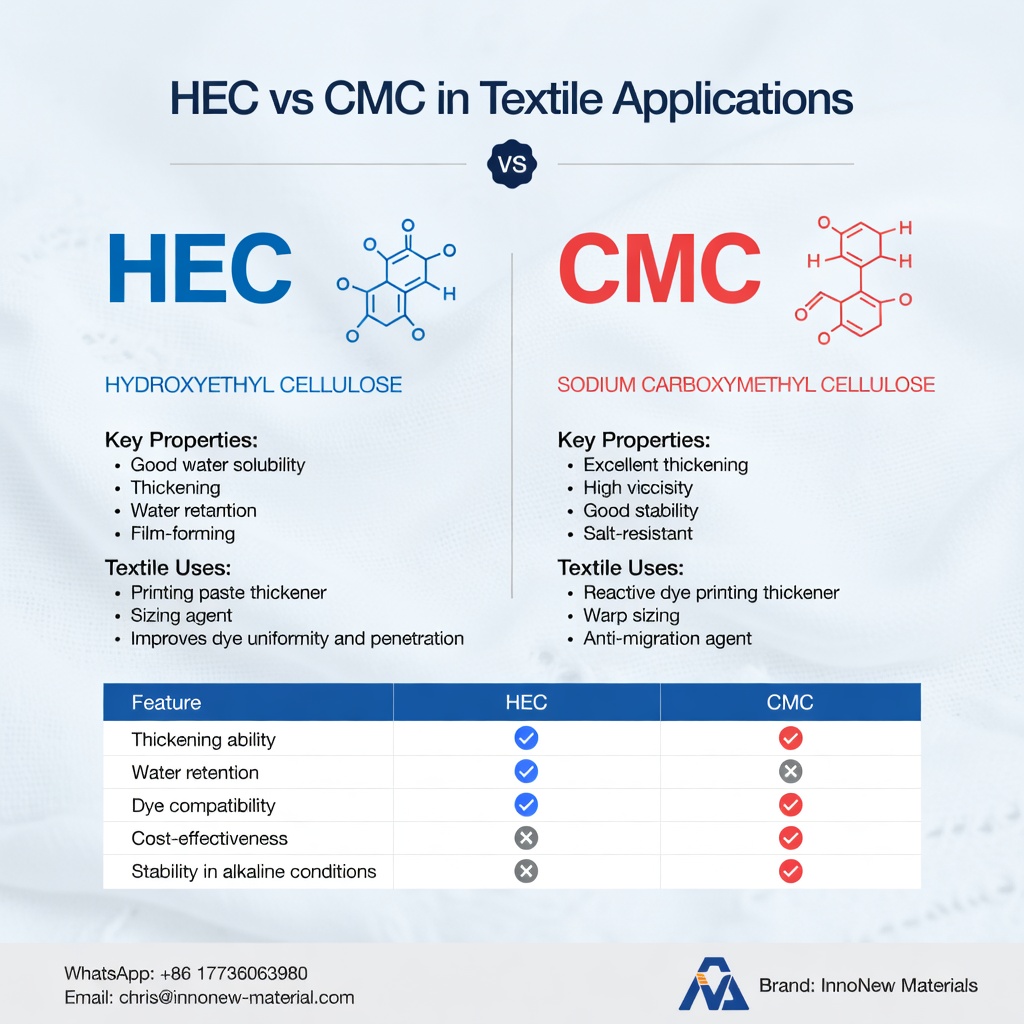
HEC vs CMC: Core Technical Differences
1. Ionic Nature & Stability
| Property | HEC | CMC |
|---|---|---|
| Ionic Type | Non-ionic | Anionic |
| Electrolyte Sensitivity | Low | High |
| Stability in dyes | Excellent | Limited |
👉 Key Insight:
CMC reacts with salts and dyes, leading to viscosity instability
2. Electrolyte Resistance
Textile printing systems often contain:
- Sodium chloride
- Sodium sulfate
| Property | HEC | CMC |
|---|---|---|
| Salt tolerance | Excellent | Poor |
| Viscosity retention | Stable | Drops significantly |
✅ Conclusion:
CMC is not suitable for high-salt reactive printing systems
3. Printing Performance
Print Sharpness
- HEC → sharp, clean edges
- CMC → blurred edges (in many cases)
Color Uniformity
- HEC → consistent
- CMC → uneven in complex systems
4. Rheology Behavior
| Property | HEC | CMC |
|---|---|---|
| Shear thinning | Excellent | Moderate |
| Flow control | Precise | Less controlled |
| Paste stability | High | Medium–Low |
5. Cost Comparison
| Factor | HEC | CMC |
|---|---|---|
| Price per ton | Higher | Lower |
| Dosage required | Lower | Higher |
| Cost efficiency | High | Medium |
👉 Important Insight:
Although CMC is cheaper per ton, it often requires:
- Higher dosage
- More rework
- Lower efficiency
✅ Real Cost Conclusion:
HEC is often more cost-effective in actual production
Performance Summary: HEC vs CMC
| Application | Better Choice |
|---|---|
| Reactive printing | HEC |
| Pigment printing | HEC |
| Low-end printing | CMC |
| Cost-sensitive markets | CMC (limited use) |
When to Choose HEC
Choose HEC if you need:
- Stable viscosity in complex systems
- High-quality printing
- Consistent production
- Reduced defect rate
HEC for Textile (Full Application Guide)
When to Choose CMC
Choose CMC if:
- Cost is the primary concern
- Printing quality requirements are low
- System has low electrolyte content
Can CMC Replace HEC?
Short Answer: Partially
Detailed Answer:
CMC can replace HEC only in:
- Simple printing systems
- Low-end fabric production
Limitations
- Poor salt resistance
- Lower print clarity
- Higher failure risk
Hybrid Strategy: HEC + CMC
A common industrial solution:
Blend Formulation
- 60–80% HEC
- 20–40% CMC
Advantages
- Reduced cost
- Maintained performance
- Improved stability vs pure CMC
Common Problems & Solutions
Problem: High Production Cost
→ Replace part of HEC with CMC
Problem: Blurred Printing
→ Increase HEC ratio
Problem: Viscosity Drop
→ Eliminate or reduce CMC
Why HEC is Preferred in Modern Textile Printing
1. Process Stability
Less sensitive to salts and chemicals
2. Lower Risk
Fewer defects and reprocessing
3. Better Reproducibility
Critical for large-scale production
Why CMC Still Exists in the Market
1. Low Price Advantage
Attractive for small factories
2. Simple Applications
Suitable for low-end printing
Why Choose InnoNew Textile Thickeners?
- Stable HEC quality
- Competitive pricing
- Custom blending solutions (HEC + CMC)
- Technical formulation support
FAQ – HEC vs CMC
Q1: Is CMC cheaper than HEC?
Yes per ton, but not always in actual use.
Q2: Can CMC be used in reactive dye printing?
Not recommended due to electrolyte sensitivity.
Q3: Why does CMC cause unstable viscosity?
Because it reacts with salts and dye components.
Q4: Can I mix HEC and CMC?
Yes, blending is a common cost-reduction strategy.
Q5: Which gives better print quality?
HEC.
Call to Action
Want to reduce cost without sacrificing textile printing quality?
We offer:
- High-performance HEC and CMC
- Cost-optimized blends (HEC + CMC)
- Free samples & formulation support
WhatsApp: +86 17736063980
Email: chris@innonew-material.com