
HEC vs Sodium Alginate: Complete Technical Comparison for Textile Printing
In textile printing, selecting the right thickener directly impacts:
- Print sharpness
- Color yield
- Production stability
- Overall cost
Among all available options, Hydroxyethyl Cellulsoe (HEC) and Sodium Alginate are the two most widely used thickeners for reactive dye printing systems.
But which one is better?
This guide provides a real-world, production-level comparison to help textile manufacturers and procurement teams choose the most suitable solution.
What is HEC and Sodium Alginate?
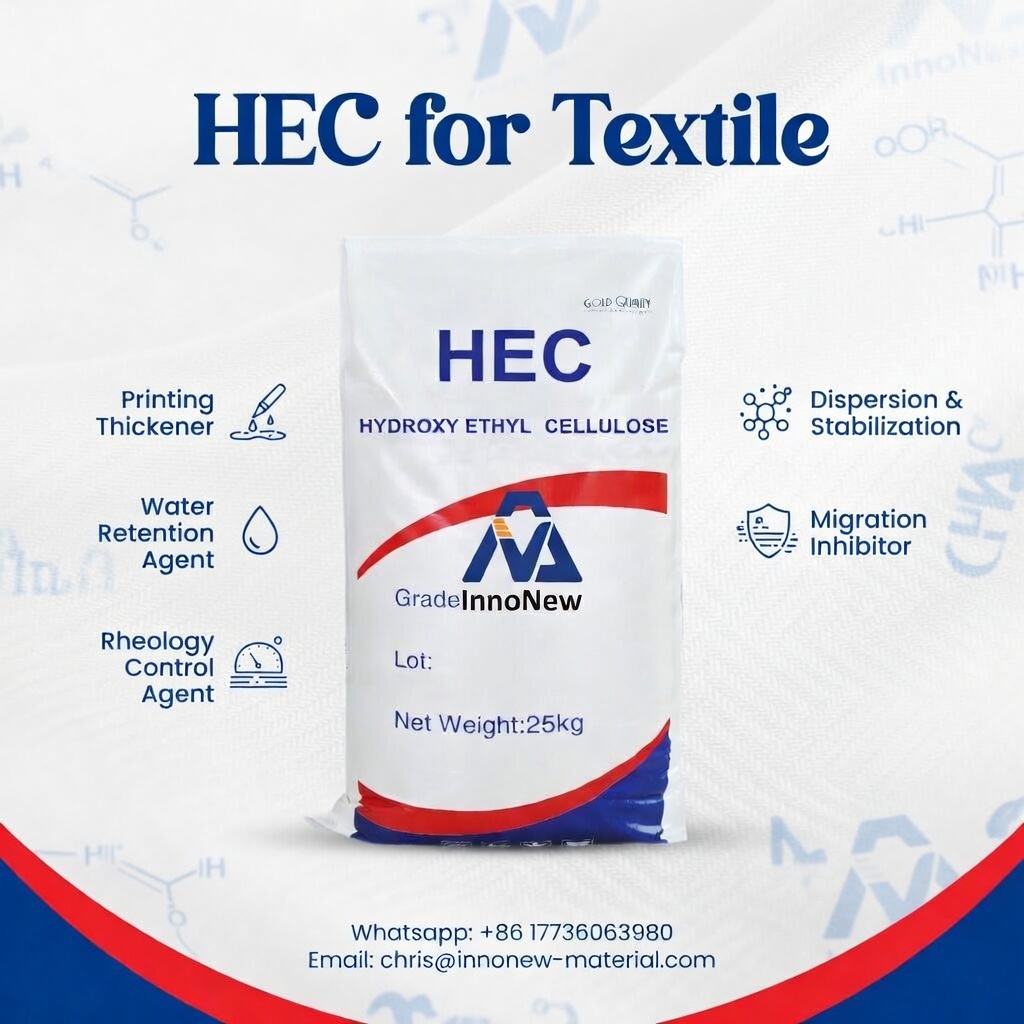
HEC (Hydroxyethyl Cellulose)
- Non-ionic cellulose ether
- Synthetic modified polymer
- High electrolyte resistance
- Excellent rheology control
HEC for Textile Application page
Sodium Alginate
- Natural polysaccharide from seaweed
- Anionic thickener
- Traditionally used in reactive printing
HEC vs Alginate: Core Differences
1. Chemical Structure & Stability
| Property | HEC | Sodium Alginate |
|---|---|---|
| Type | Non-ionic | Anionic |
| Source | Modified cellulose | Natural seaweed |
| Stability | Very high | Moderate |
| Microbial Resistance | High | Low |
👉 Key Insight:
Alginate is more sensitive to biological degradation, especially in warm climates.
2. Electrolyte Resistance
Reactive dye systems often contain:
- Sodium chloride
- Sodium sulfate
| Property | HEC | Alginate |
|---|---|---|
| Salt tolerance | Excellent | Moderate |
| Viscosity stability | Stable | Drops over time |
✅ Conclusion:
HEC performs significantly better in high-electrolyte environments.
3. Printing Performance
Print Definition
- HEC → Sharp, controlled
- Alginate → Excellent but less stable
Color Yield
- Alginate → Slightly higher in premium systems
- HEC → Very competitive with optimized formulation
4. Rheology Behavior
| Property | HEC | Alginate |
|---|---|---|
| Shear thinning | Excellent | Good |
| Flow control | Precise | Moderate |
| Paste stability | High | Medium |
5. Cost Comparison
| Factor | HEC | Alginate |
|---|---|---|
| Raw material cost | Lower | High |
| Price fluctuation | Stable | High |
| Supply chain | Reliable | Seasonal |
✅ Conclusion:
HEC offers significantly better cost-performance ratio
6. Environmental & Sustainability
| Factor | HEC | Alginate |
|---|---|---|
| Biodegradability | Good | Excellent |
| Sustainability | High | Very high |
| Waste impact | Moderate | Low |
Performance Summary: HEC vs Alginate
| Application | Better Choice |
|---|---|
| Reactive printing | HEC (cost-performance) |
| High-end printing | Alginate |
| Mass production | HEC |
| Cost-sensitive markets | HEC |
When to Choose HEC
Choose HEC if you need:
- Stable production performance
- Lower cost
- High electrolyte tolerance
- Consistent quality
HEC for Textile (Detailed Application Guide)
When to Choose Sodium Alginate
Choose alginate if you need:
- Premium print clarity
- Maximum color yield
- Eco-label positioning
Can HEC Replace Alginate?
Short Answer: YES (in most cases)
Long Answer:
HEC can:
- Fully replace alginate in standard printing
- Partially replace alginate in high-end systems
Common Strategy:
- 70% HEC + 30% Alginate
👉 Balance performance and cost
Hybrid Formulation Strategy
Modern textile printing increasingly uses:
HEC + Alginate Systems
Advantages:
- Reduced cost
- Improved stability
- Maintained print quality
Common Problems & Solutions
Problem: High Printing Cost
→ Reduce alginate, increase HEC
Problem: Viscosity Instability
→ Replace alginate with HEC
Problem: Poor Print Sharpness
→ Optimize HEC viscosity grade
Why HEC is Replacing Alginate Globally
1. Supply Chain Stability
Alginate depends on seaweed harvesting → unstable supply
2. Cost Pressure
HEC is significantly more economical
3. Process Reliability
HEC offers better reproducibility
Why Choose InnoNew Textile Thickeners?
- Consistent HEC quality
- Custom viscosity grades
- Technical formulation support
- Competitive global pricing
FAQ – HEC vs Alginate
Q1: Is alginate still necessary?
Yes, for premium applications, but less critical in mass production.
Q2: Does HEC affect color yield?
Minimal impact when properly formulated.
Q3: Which is more stable?
HEC is significantly more stable.
Q4: Which is cheaper?
HEC.
Q5: Can I mix both?
Yes, hybrid systems are widely used.
Call to Action
Looking to reduce textile printing cost without sacrificing quality?
We provide:
- High-performance HEC
- Customized solutions
- Free samples
WhatsApp: +86 17736063980
Email: chris@innonew-material.com