How HPMC Improves Concrete Workability
In modern construction, achieving optimal concrete workability is essential for ensuring efficient placement, uniform structure, and long-term durability. One of the most effective additives used today is HPMC for concrete, a versatile cellulose ether that significantly enhances fresh mix performance. At Hebei InnoNew Material Technology Co., Ltd., we provide high-quality HPMC solutions designed to optimize concrete behavior across a wide range of applications.
What is Concrete Workability?
Concrete workability refers to how easily a concrete mix can be mixed, placed, compacted, and finished without segregation or loss of homogeneity. Poor workability can lead to defects such as honeycombing, uneven surfaces, and reduced structural integrity.
What is HPMC and Why It Matters
Hydroxypropyl Methylcellulose (HPMC) is a non-ionic cellulose ether widely used as a concrete workability improver. It functions as a thickener, water retention agent, and rheology modifier, making it an essential additive in modern cement-based systems.
How HPMC Improves Concrete Workability
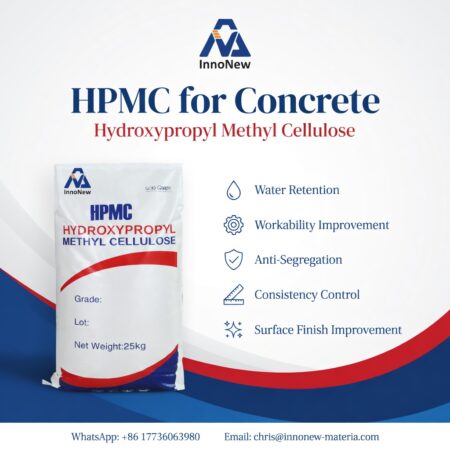
1. Enhanced Water Retention
One of the key mechanisms by which HPMC improves concrete workability is through superior water retention. It reduces water evaporation during mixing and application, ensuring proper cement hydration and preventing premature drying.
2. Improved Rheology and Flow Behavior
HPMC modifies the rheological properties of concrete, resulting in smoother flow and easier handling. This makes the concrete more cohesive and reduces resistance during placement.
3. Anti-Segregation Performance
Segregation is a common issue in poorly designed mixes. HPMC helps maintain uniform distribution of aggregates and cement particles, ensuring a stable and homogeneous mixture.
4. Better Surface Finish
By improving consistency and reducing bleeding, HPMC contributes to a smoother and more uniform surface finish, which is critical for both structural and aesthetic applications.
Recommended Dosage of HPMC in Concrete
The typical dosage of HPMC for concrete ranges from 0.1% to 0.5% depending on the application and formulation requirements. Using the correct dosage is essential to achieving optimal performance without compromising flowability.
HPMC vs Traditional Additives
Compared to traditional concrete additives, HPMC offers superior control over viscosity and stability. While plasticizers improve flow, HPMC ensures cohesion and prevents segregation, making them complementary in advanced formulations.
Applications of HPMC in Concrete
- Self-leveling compounds
- Dry mix mortar
- Repair mortar
- Lightweight concrete
Why Choose High-Quality HPMC?
Not all HPMC products deliver the same performance. High-quality HPMC ensures consistent viscosity, better compatibility with cement systems, and reliable results in various environmental conditions.
👉 Explore our high-quality HPMC products
👉 Contact us for free samples and technical support
Conclusion
Understanding how HPMC improves concrete workability is essential for optimizing modern construction materials. With its ability to enhance water retention, improve flow, and prevent segregation, HPMC has become a key additive in high-performance concrete systems.
This guide provides practical insights into using HPMC effectively as a concrete workability improver, helping manufacturers and engineers achieve better results in their formulations.