
How HPMC Prevents Sedimentation in Intumescent Coatings: Rheology Control & Suspension Stability Explained
Introduction
Water-based intumescent coatings are widely used for passive fire protection in steel structures, tunnels, industrial facilities, and commercial buildings. These coatings rely heavily on flame-retardant fillers such as ammonium polyphosphate (APP), aluminum hydroxide (ATH), magnesium hydroxide, and expandable graphite.
However, one of the biggest formulation challenges in intumescent coating systems is sedimentation.
Due to the high density and large particle size of flame-retardant fillers, coating manufacturers often face problems such as:
- Severe filler settling during storage
- Viscosity instability
- Poor sprayability
- Uneven coating thickness
- Reduced fire protection performance
- Difficult re-dispersion after storage
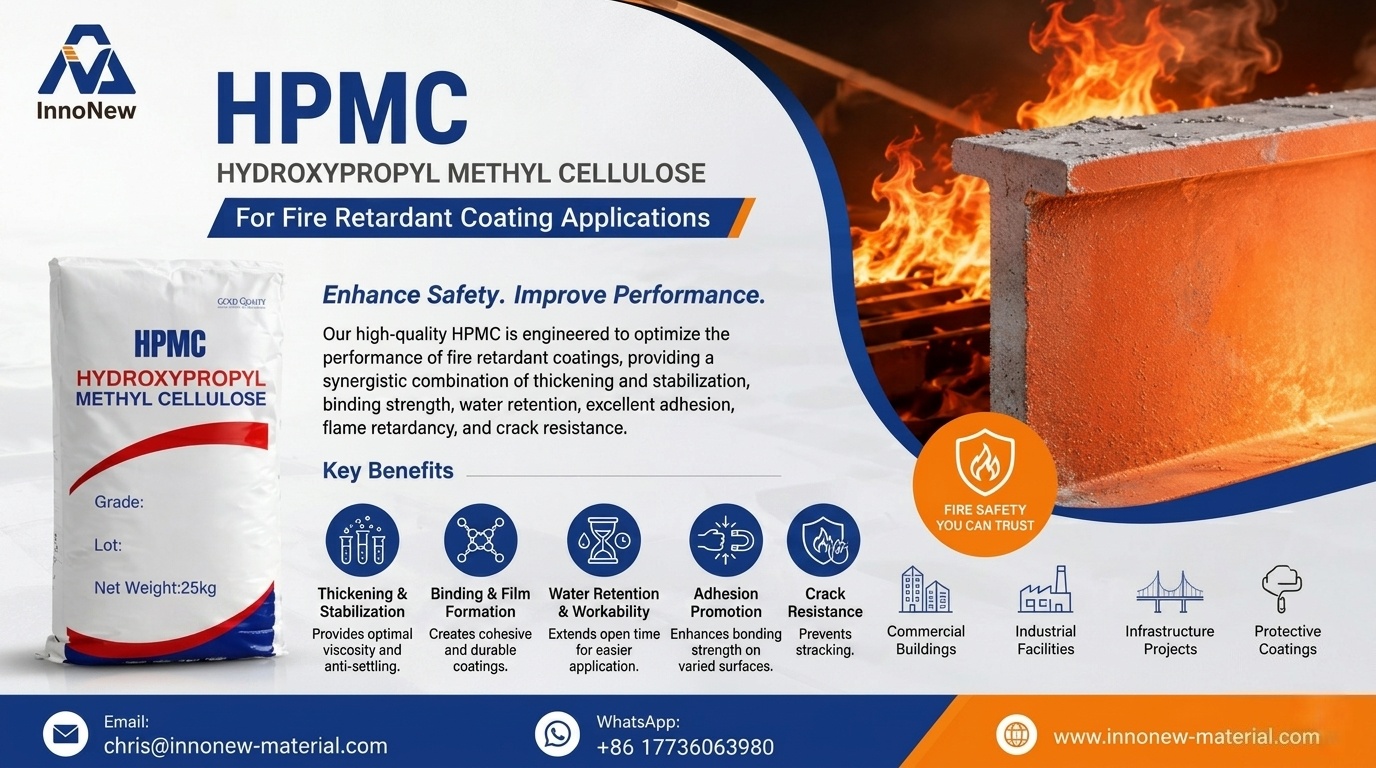
To solve these issues, formulators increasingly use HPMC (Hydroxypropyl Methylcellulose) as a rheology modifier and suspension stabilizer in water-based fire retardant coatings.
This article explains the sedimentation mechanism in intumescent coatings and how HPMC improves formulation stability through rheology control and thixotropic behavior.
Why Sedimentation Happens in Intumescent Coatings
Intumescent coatings typically contain large amounts of inorganic flame-retardant fillers.
Common fillers include:
- Ammonium Polyphosphate (APP)
- Aluminum Hydroxide (ATH)
- Expandable Graphite
- Magnesium Hydroxide
- Titanium Dioxide
These materials possess relatively high specific gravity compared with the aqueous phase of the coating system.
When the rheological structure of the coating is insufficient, gravity causes the fillers to settle gradually during storage.
Several factors accelerate sedimentation:
| Factor | Impact on Coating Stability |
|---|---|
| Low low-shear viscosity | Weak particle suspension |
| Poor thixotropic structure | Faster settling |
| Inadequate water retention | Phase separation |
| Large particle size | Increased sedimentation speed |
| High filler loading | Reduced storage stability |
As sedimentation progresses, manufacturers may observe hard settling, layer separation, and inconsistent viscosity between production batches.
How HPMC Improves Suspension Stability
HPMC plays a critical role in stabilizing intumescent coating formulations.
Its anti-sedimentation mechanism is mainly related to rheology modification and water-phase stabilization.
HPMC prevents sedimentation by:
- Increasing low-shear viscosity
- Building a stable thixotropic network
- Enhancing water retention
- Improving particle suspension capability
- Reducing filler mobility inside the coating matrix
In water-based coating systems, HPMC molecules hydrate and expand in water, forming a three-dimensional network structure.
This rheological network helps suspend heavy fillers such as APP and ATH, significantly reducing sedimentation during storage.
Compared with standard thickeners, HPMC provides a more balanced combination of:
- Suspension stability
- Sprayability
- Leveling
- Sag resistance
- Film uniformity
Rheology Control Mechanism of HPMC in Fireproof Coatings
Rheology control is one of the most important factors in intumescent coating formulation design.
An ideal fire retardant coating should exhibit:
- High low-shear viscosity for filler suspension
- Good shear-thinning behavior for spray application
- Proper leveling after application
- Stable viscosity under temperature changes
HPMC contributes to these properties through its thixotropic behavior.
Under static conditions, HPMC helps maintain high structural viscosity, preventing heavy fillers from settling.
Under shear force during mixing or spraying, viscosity decreases temporarily, improving workability and sprayability.
After application, viscosity gradually recovers, helping maintain coating thickness and preventing sagging.
This rheological balance is essential for achieving uniform fireproof coating performance.
Best HPMC Viscosity for Intumescent Coating Systems
Different coating systems require different HPMC viscosity grades.
Typical recommendations include:
| Coating System | Recommended HPMC Viscosity |
|---|---|
| Spray-applied coatings | Medium viscosity |
| Brush-applied coatings | Medium-high viscosity |
| High filler loading systems | High viscosity |
| Fast leveling systems | Modified medium viscosity |
Selecting the correct viscosity grade is critical.
Excessively high viscosity may cause:
- Poor leveling
- Spray nozzle blockage
- Difficult mixing
Insufficient viscosity may lead to:
- Severe sedimentation
- Layer separation
- Poor storage stability
Therefore, HPMC grade selection should always match the formulation design and application method.
How to Add HPMC Correctly in Intumescent Coating Formulations
Improper HPMC addition may negatively affect coating performance.
Recommended processing method:
- Add HPMC slowly into water under stirring
- Ensure complete wetting and dispersion
- Allow sufficient hydration time
- Add flame-retardant fillers gradually
- Adjust final viscosity according to application requirements
Key formulation considerations include:
- Mixing speed
- Water temperature
- Filler addition sequence
- Hydration time
- Final rheology target
Proper dispersion is essential to avoid:
- Fish eyes
- Gel particles
- Viscosity inconsistency
- Poor coating uniformity
Common Sedimentation Problems and Solutions
| Problem | Possible Cause | HPMC Solution |
|---|---|---|
| Filler settling | Low structural viscosity | Increase HPMC viscosity |
| Hard sedimentation | Weak suspension network | Improve thixotropy |
| Poor sprayability | Excessive thickening | Optimize HPMC grade |
| Uneven coating thickness | Poor rheology balance | Adjust dosage |
| Layer separation | Insufficient water retention | Improve hydration stability |
Industrial Application Case
A U.S.-based intumescent coating manufacturer experienced severe sedimentation problems after increasing APP loading in its water-based formulation.
The coating system showed:
- Heavy filler settling after 48 hours
- Inconsistent viscosity between batches
- Uneven spray application
- Poor storage stability
To solve these problems, a customized medium-high viscosity HPMC grade was introduced into the formulation.
After optimization:
- Sedimentation decreased by more than 70%
- Suspension stability improved significantly
- Sprayability became more consistent
- Coating uniformity improved
- Production adjustment costs were reduced
This case demonstrates the importance of selecting the correct HPMC rheology modifier for fire retardant coating systems.
Why HPMC Is Widely Used in Water-Based Fire Retardant Coatings
Compared with many traditional coating thickeners, HPMC offers several advantages:
- Excellent water solubility
- Stable viscosity performance
- Good compatibility with flame-retardant fillers
- Strong anti-sedimentation capability
- Improved coating workability
- Enhanced film formation
- Better storage stability
These properties make HPMC one of the most widely used cellulose ethers in modern intumescent coating formulations.
FAQ
Why does sedimentation occur in intumescent coatings?
Sedimentation occurs because heavy flame-retardant fillers such as APP and ATH gradually settle under gravity when the coating system lacks sufficient rheological structure.
Can HPMC improve suspension stability in coatings?
Yes. HPMC improves low-shear viscosity and forms a stable thixotropic network that helps suspend fillers and reduce settling.
What viscosity HPMC is best for fireproof coatings?
Medium to high viscosity HPMC grades are commonly used, depending on filler loading, application method, and required rheology.
Is HPMC suitable for water-based intumescent coatings?
Yes. HPMC is widely used in water-based fire retardant coatings because of its excellent water solubility, rheology control, and suspension stability.
How much HPMC is typically used in intumescent coatings?
Typical dosage ranges from 0.2% to 0.6%, depending on formulation requirements and target viscosity.
Conclusion
Sedimentation remains one of the most critical formulation challenges in water-based intumescent coatings.
By improving rheology control, suspension stability, water retention, and thixotropic behavior, HPMC helps coating manufacturers achieve:
- Better storage stability
- Reduced filler settling
- Improved sprayability
- More uniform coating thickness
- Enhanced fire protection consistency
For modern fire retardant coating systems, selecting the appropriate HPMC grade is essential for optimizing formulation performance and industrial production stability.