
Metalworking Fluid Formulation Guide: Ingredients, Ratios & Performance Optimization
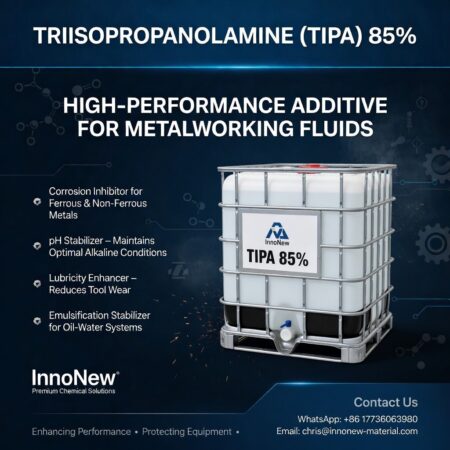
Designing a high-performance metalworking fluid formulation requires precise balancing of lubrication, corrosion protection, cooling efficiency, and pH stability. Whether developing cutting fluids, grinding fluids, or industrial coolants, selecting the right raw materials and ratios is critical.
This comprehensive cutting fluid formulation guide provides a practical, industry-ready framework for formulators and chemical suppliers.
Core Components of Metalworking Fluid Formulation
A standard water-based metalworking fluid formulation consists of the following key components:
1. Base Fluid (Water or Oil Phase)
- Water (for cooling & cost efficiency)
- Mineral oil / synthetic oil (for lubrication)
Typical ratio: 60–95%
2. Emulsifiers
Ensure stable oil-water mixing in semi-synthetic cutting fluid formulation
- Nonionic surfactants
- Anionic emulsifiers
Dosage: 2–10%
3. Corrosion Inhibitors
Critical for protecting metal surfaces:
- TIPA (Triisopropanolamine)
- Borates
- Carboxylates
TIPA in metalworking fluids formulation provides:
- Strong anti-rust protection
- pH buffering
- Aluminum compatibility
Dosage: 0.5–2%
4. Lubricity Additives
Enhance machining performance:
- Esters
- Fatty acids
- EP additives
Dosage: 3–15%
5. pH Stabilizers
Maintain alkaline environment:
- TIPA / TEA
- Amines
Target pH: 8.5–10.5
6. Biocides
Prevent bacterial growth:
- Isothiazolinones
- Formaldehyde releasers
Dosage: 0.05–0.2%
7. Defoamers
Control foam during high-speed machining:
- Silicone-based defoamers
Dosage: 0.01–0.1%
Example Formulation (Semi-Synthetic Cutting Fluid)
Below is a proven semi synthetic cutting fluid formulation recipe:
| Component | Function | % Range |
|---|---|---|
| Water | Base | 75–85% |
| Mineral Oil | Lubrication | 5–10% |
| Emulsifier | Stability | 3–6% |
| TIPA | Corrosion inhibitor & pH stabilizer | 1–2% |
| Ester | Lubricity | 2–5% |
| Biocide | Preservation | 0.1% |
| Defoamer | Foam control | 0.05% |
This metalworking fluid formulation ensures:
- Long service life
- Low foam
- Excellent corrosion resistance
Advanced Formulation Optimization
1. TIPA-Based High-Performance System
Using TIPA in metalworking fluids formulation improves:
- Corrosion resistance for steel & aluminum
- Long-term pH stability
- Reduced maintenance frequency
Recommended for export-grade cutting fluids
2. Low-Foam Formulation Strategy
- Replace TEA with TIPA
- Add silicone defoamer
- Optimize surfactant system
3. Long-Life Coolant Design
- Use high-purity water
- Combine TIPA + biocide system
- Maintain stable pH buffering
Why Choose TIPA in Formulation
Compared to traditional amines:
- Better corrosion inhibition
- Lower foaming tendency
- Higher thermal stability
TIPA for metalworking fluids is now widely used in high-end formulations replacing TEA.
FAQ
Q1: What is the ideal pH for cutting fluids?
Typically 8.5–10.5.
Q2: Why use TIPA instead of TEA?
TIPA in metalworking fluids formulation offers better stability and corrosion protection.
Q3: Can I formulate without biocide?
Not recommended due to bacterial growth.
Q4: What causes foam in cutting fluids?
Excess surfactants or TEA-based systems.
Q5: Is synthetic better than semi-synthetic?
Depends on application; semi-synthetic offers balanced performance.
Looking for high-quality raw materials for metalworking fluid formulation?
We supply:
- High-purity TIPA 85%
- Emulsifiers & additives
- Full technical formulation support
👉 Contact us now for:
- Free formulation consultation
- Sample supply
- Bulk pricing