
TIPA vs TEA in Metalworking Fluids: Which One Delivers Better Performance?
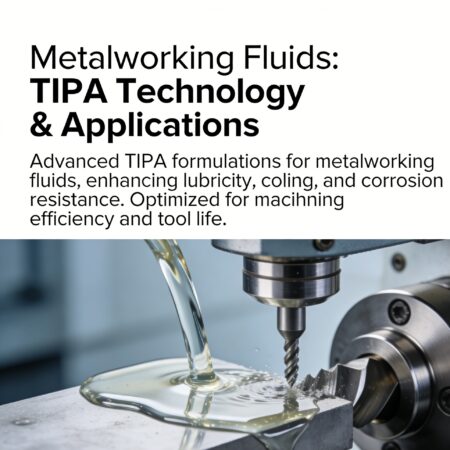
In modern metalworking fluids, selecting the right alkanolamine directly impacts corrosion protection, pH stability, lubrication, and fluid lifespan. Among the most widely used amines, TIPA (Triisopropanolamine) and TEA (Triethanolamine) dominate the market.
This in-depth TIPA vs TEA comparison reveals which performs better in real-world cutting fluid formulations, helping formulators and buyers choose the optimal additive.
What is TIPA vs TEA?
TIPA (Triisopropanolamine)
- Stronger steric structure
- Lower volatility
- Better thermal and chemical stability
- Widely used in high-performance metalworking fluids
TEA (Triethanolamine)
- More cost-effective
- Good neutralizing agent
- Common in standard cutting fluids
- Higher foaming tendency
Core Comparison: TIPA vs TEA in Metalworking Fluids
1. Corrosion Inhibition Performance
TIPA in metalworking fluids provides superior corrosion protection due to stronger adsorption on metal surfaces.
- TIPA: ⭐⭐⭐⭐⭐ (excellent for steel & aluminum)
- TEA: ⭐⭐⭐ (moderate protection, may require boosters)
Conclusion: TIPA corrosion inhibitor outperforms TEA, especially in demanding environments.
2. pH Stability & Buffering Capacity
Maintaining stable pH is critical in cutting fluids.
- TIPA vs TEA pH stability comparison shows:
- TIPA: More stable under high temperature and long-term use
- TEA: Faster pH drift over time
Conclusion: TIPA offers longer-lasting pH stability
3. Lubrication & Tool Life
- TIPA improves boundary lubrication and reduces friction
- TEA provides basic lubrication but less effective
Result: TIPA extends tool life and improves machining efficiency
4. Foam Control
Foaming is a major issue in coolant systems:
- TEA: Higher foaming tendency
- TIPA: Low foam, better system stability
Conclusion: TIPA is preferred in high-speed machining systems
5. Cost vs Performance
| Parameter | TIPA | TEA |
|---|---|---|
| Cost | Higher | Lower |
| Performance | High-end | Standard |
| Stability | Excellent | Moderate |
Final Insight:
- Use TEA for cost-sensitive formulations
- Use TIPA for metalworking fluids where performance is critical
Application-Based Recommendation
Choose TIPA if you need:
- High-end cutting fluids
- Long fluid life
- Superior corrosion protection
- Stable pH system
Choose TEA if you need:
- Low-cost formulations
- Short-term use fluids
- Basic performance
Why TIPA is Replacing TEA in Advanced Formulations
The shift from TEA to Triisopropanolamine in metalworking fluids is driven by:
- Increasing demand for long-life coolants
- Stricter environmental and performance standards
- Need for low foam & high stability systems
As a result, TIPA vs TEA is no longer just a cost comparison — it’s a performance upgrade decision
FAQ
Q1: Is TIPA better than TEA for corrosion protection?
Yes, TIPA corrosion inhibitor offers significantly better protection.
Q2: Can TIPA fully replace TEA?
In many formulations, yes—especially in high-performance fluids.
Q3: Why does TEA foam more than TIPA?
TEA has a molecular structure that promotes foam formation.
Q4: Is TIPA more expensive than TEA?
Yes, but offers better long-term cost efficiency.
Q5: Which is better for aluminum machining?
TIPA in metalworking fluids performs better for aluminum protection.
Looking to upgrade your metalworking fluid performance?
We supply high-purity Triisopropanolamine TIPA with stable quality and competitive pricing.
👉 Contact us for:
- Technical support
- Free samples
- Bulk quotation