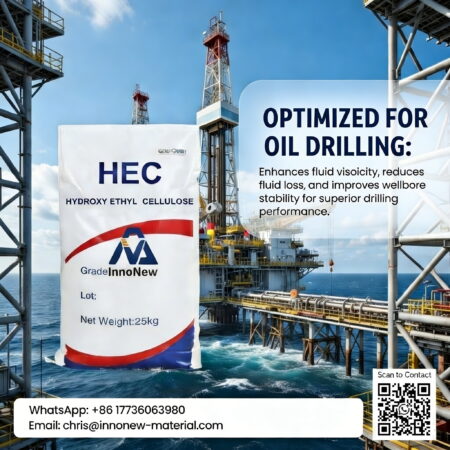
Oilfield-grade HEC is not merely a thickener—it is a precision-engineered polymer designed to optimize fluid rheology, reduce filtration loss, and enhance borehole integrity under demanding downhole conditions. Hebei InnoNew Material Technology Co., Ltd. is a professional manufacturer of Hydroxyethyl Cellulose (HEC), supplying high-quality cellulose ether solutions for oilfield applications. Our Oilfield Grade HEC is specifically developed for water-based drilling fluids, delivering excellent rheology control, effective fluid loss reduction, and reliable cuttings suspension during drilling operations.
What Is Oilfield Grade Hydroxyethyl Cellulose?
Hydroxyethyl Cellulose (HEC) Powder is a nonionic, water-soluble cellulose ether produced through ethoxylation of purified cellulose. In oilfield applications, HEC is specifically modified to deliver:
- Controlled hydration rate
- High viscosity build-up
- Superior salt tolerance
- Thermal stability
- Low residue characteristics
Unlike ionic polymers, Hydroxyethyl Cellulose HEC maintains performance stability across a wide pH range and in brine systems, making it suitable for both freshwater and moderate-salinity drilling environments.
Core Functions in Drilling Fluid Systems
1. Rheology Modification and Viscosity Control
HEC functions as a high-efficiency viscosifier in water-based drilling muds. Its pseudoplastic (shear-thinning) behavior ensures:
- High low-shear-rate viscosity for cuttings suspension
- Reduced high-shear viscosity for improved pumpability
- Stable gel strength for suspension during static periods
This rheological profile enhances hole cleaning while minimizing equivalent circulating density (ECD) risks.
2. Fluid Loss Control
Filtration control is critical to prevent excessive filtrate invasion and formation damage. HEC contributes to:
- Formation of a thin, low-permeability filter cake
- Reduction in API filtration loss
- Improved wellbore wall stabilization
By minimizing filtrate loss, HEC protects permeable formations and supports wellbore integrity in reactive shale zones.
3. Shale Stabilization Support
Although not a primary shale inhibitor, Hydroxyethyl Cellulose HEC improves mechanical stabilization by strengthening the fluid’s carrying capacity and forming protective films on wellbore surfaces. In optimized drilling formulations, it works synergistically with salts and polymer inhibitors to reduce dispersion and sloughing.
4. Compatibility in Complex Systems
Oilfield HEC is compatible with:
- Bentonite-based mud systems
- Polymer drilling fluids
- Brine and KCl systems
- Completion and workover fluids
Its nonionic structure ensures minimal interaction with multivalent ions, making it suitable for moderately saline environments where other polymers may lose efficiency.
Performance Advantages in Field Operations
High Thermal Stability
Premium-grade Hydroxyethyl Cellulose HEC can maintain functional viscosity under elevated bottom-hole temperatures (typically up to 120°C depending on formulation). This makes it suitable for medium-depth wells and geothermal-adjacent operations.
Salt and Electrolyte Resistance
Unlike many anionic polymers, Hydroxyethyl Cellulose HEC exhibits stable hydration and viscosity retention in brine systems. This property supports offshore and coastal drilling programs where saline water sources are common.
Improved Cuttings Transport
Optimized rheology enhances suspension efficiency, especially in horizontal and extended-reach drilling where cuttings bed formation is a major concern.
Reduced Formation Damage
Low residue and clean degradation behavior help minimize permeability impairment in sensitive reservoirs.
Applications Beyond Conventional Drilling
While widely used in water-based drilling fluids (WBM), oilfield HEC also plays a role in:
- Horizontal drilling operations
- Offshore drilling fluids
- Completion and workover fluids
- Fracturing fluid thickening (in select systems)
- Cementing fluid rheology adjustment
Its versatility allows fluid engineers to tailor formulations based on geological complexity and operational requirements.
Key Technical Parameters to Consider
When selecting Hydroxyethyl Cellulose HEC for oilfield applications, procurement and mud engineers typically evaluate:
- Brookfield viscosity (300–6000 mPa·s typical range)
- Particle size (80–120 mesh)
- Moisture content (≤5%)
- Degree of substitution (DS)
- Molar substitution (MS)
- Filtration control performance under API testing
Custom viscosity grades can be engineered to balance pumpability with suspension performance.
Why Oilfield HEC Remains Strategically Relevant
As drilling operations move toward deeper wells, extended laterals, and increasingly complex formations, the demand for stable, efficient, and environmentally acceptable drilling additives continues to grow. Oilfield-grade Hydroxyethyl Cellulose HEC meets these requirements through:
- Predictable rheological control
- Operational stability
- Cost-effective performance
- Environmental compatibility compared to synthetic polymers
Its role in modern mud engineering is not simply additive—it is structural. Hydroxyethyl Cellulose HEC enables drilling fluid systems to perform consistently under mechanical, thermal, and chemical stress.
Final Perspective
In the competitive upstream oil and gas sector, drilling fluid optimization is a decisive factor in operational success. Oilfield Hydroxyethyl Cellulose represents a technically mature yet highly adaptable polymer solution that supports viscosity control, filtration reduction, and wellbore stability in demanding drilling environments.
For oilfield service companies, mud engineers, and drilling contractors seeking reliable polymer performance in water-based systems, Hydroxyethyl Cellulose HEC remains a proven and strategically important component in next-generation drilling fluid formulations.