
Polyvinyl Alcohol (PVA): Complete Technical Guide to Grades, Properties, Applications and Selection
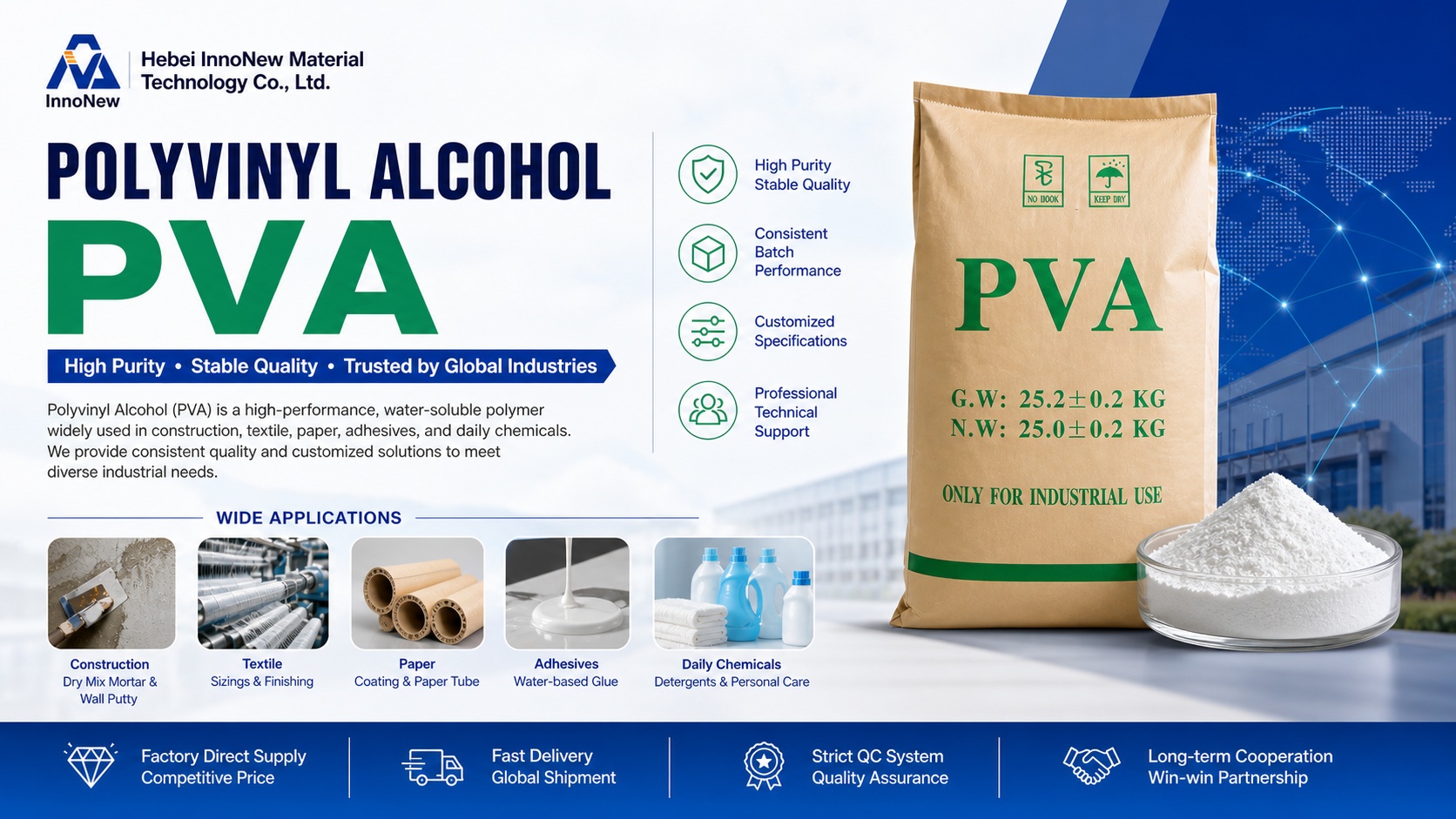
Polyvinyl Alcohol (PVA) is one of the most widely used water-soluble synthetic polymers in modern industry. Thanks to its unique combination of film-forming ability, adhesion, emulsification, water solubility, and mechanical strength, PVA has become an essential raw material for adhesives, construction materials, textiles, paper processing, coatings, and water-soluble packaging solutions.
Despite its widespread use, selecting the right PVA grade remains a challenge for many manufacturers and formulators. Different hydrolysis levels, viscosities, and polymerization degrees can significantly affect processing performance and final product quality.
This technical guide provides a comprehensive overview of Polyvinyl Alcohol, including its manufacturing process, grade classification, key properties, industrial applications, formulation considerations, and selection guidelines.
What Is Polyvinyl Alcohol (PVA)?
Polyvinyl Alcohol (PVA) is a synthetic polymer produced through the hydrolysis of Polyvinyl Acetate (PVAc).
Unlike many conventional polymers, PVA is water-soluble and biodegradable under specific environmental conditions. Its molecular structure contains abundant hydroxyl groups (-OH), which contribute to excellent adhesion, film formation, and compatibility with various inorganic and organic materials.
Key characteristics include:
- Excellent water solubility
- Strong adhesive properties
- Superior film-forming ability
- High tensile strength
- Good chemical resistance
- Excellent emulsification performance
- Low toxicity and environmental friendliness
These properties make PVA one of the most versatile polymers used across multiple industries.
How Polyvinyl Alcohol Is Manufactured
PVA is not produced through direct polymerization.
Instead, it is manufactured through a two-step process:
Vinyl Acetate Monomer (VAM)

↓

Polyvinyl Acetate (PVAc)

↓

Hydrolysis (Alcoholysis)

↓

Polyvinyl Alcohol (PVA)
The final performance of PVA is mainly determined by two critical parameters:
Degree of Hydrolysis
Indicates how many acetate groups are converted into hydroxyl groups.
Higher hydrolysis generally provides:
- Better chemical resistance
- Higher tensile strength
- Reduced water solubility
Degree of Polymerization
Determines molecular chain length.
Higher polymerization generally provides:
- Higher viscosity
- Better film strength
- Improved mechanical properties
Understanding these parameters is essential when selecting the correct PVA grade.
Key Properties of Polyvinyl Alcohol
| Property | Performance |
|---|---|
| Water Solubility | Excellent |
| Film Formation | Excellent |
| Adhesion | Excellent |
| Tensile Strength | High |
| Flexibility | Good |
| Oil Resistance | Good |
| Chemical Resistance | Good |
| Emulsification | Excellent |
| Biodegradability | Partial |
| Toxicity | Low |
The combination of these properties explains why PVA is widely used in both industrial and consumer applications.
Understanding PVA Grades
PVA grades are commonly identified by viscosity and hydrolysis degree.
Selecting the correct grade depends on the balance between dissolution speed, viscosity, film strength, and processing requirements.
PVA 1788 vs PVA 2488 vs PVA 2688
One of the most common questions from buyers is how to select between PVA 1788, PVA 2488, and PVA 2688.
Choose PVA 1788 When:
- Fast dissolution is required
- White glue production
- Textile sizing
- General-purpose adhesives
Choose PVA 2488 When:
- Dry-mix mortar production
- Tile adhesive manufacturing
- Construction chemicals
- Paper coating
Choose PVA 2688 When:
- High-strength films
- Specialty coatings
- Water-soluble packaging films
How Hydrolysis Degree Affects PVA Performance
Hydrolysis degree is one of the most important technical indicators.
Partially Hydrolyzed PVA (87–89%)
Advantages:
- Faster dissolution
- Better flexibility
- Easier processing
Applications:
- Adhesives
- Textile sizing
- Paper chemicals
Fully Hydrolyzed PVA (98–99%)
Advantages:
- Higher tensile strength
- Better solvent resistance
- Improved heat resistance
Applications:
- Water-soluble films
- Specialty coatings
- Technical industrial applications
Major Industrial Applications of PVA
PVA for Adhesives
PVA is one of the most widely used raw materials in adhesive formulations.
Applications include:
- White glue
- Wood glue
- Packaging glue
- Bookbinding adhesive
Benefits:
- Strong bonding
- Excellent film formation
- Good flexibility
- Easy processing
PVA for Construction Materials
In construction chemicals, PVA acts as a binder and performance enhancer.
Applications:
- Tile adhesive
- Wall putty
- Repair mortar
- Gypsum products
- Cement-based formulations
Benefits:
- Improved adhesion
- Enhanced crack resistance
- Better flexibility
- Increased durability
PVA for Textile Industry
PVA has been used in textile sizing for decades.
Functions:
- Yarn protection
- Improved weaving efficiency
- Reduced yarn breakage
- Better abrasion resistance
PVA for Paper Industry
Paper manufacturers use PVA to improve surface quality and strength.
Benefits include:
- Increased paper strength
- Improved printability
- Better coating adhesion
- Enhanced surface smoothness
PVA for Water-Soluble Films
One of the fastest-growing applications for PVA is water-soluble packaging.
Typical products include:
- Detergent pods
- Agrochemical packaging
- Medical laundry bags
- Embroidery films
Growing environmental regulations continue to drive demand in this sector.
PVA vs HPMC vs RDP vs CMC
Selecting the correct additive often requires understanding the differences between various functional polymers.
Practical recommendation:
- Choose PVA for bonding and film formation.
- Choose HPMC for water retention.
- Choose RDP for flexibility and adhesion.
- Choose CMC for thickening and stabilization.
In many formulations, these materials are used together to achieve optimal performance.
How to Choose the Right PVA Grade
The following guide can simplify grade selection:
| Application | Recommended Grade |
|---|---|
| White Glue | PVA 1788 |
| Wood Glue | PVA 1788 / 2488 |
| Tile Adhesive | PVA 2488 |
| Dry Mix Mortar | PVA 2488 |
| Textile Sizing | PVA 1788 |
| Paper Coating | PVA 1788 / 2488 |
| Water-Soluble Film | PVA 2499 / 2688 |
Before finalizing a grade, manufacturers should evaluate:
- Dissolution conditions
- Viscosity requirements
- Production equipment
- End-use performance targets
- Cost-performance balance
Future Trends in the PVA Industry
Several trends are expected to drive future demand for Polyvinyl Alcohol:
Sustainable Packaging
Growing demand for environmentally friendly packaging materials.
Water-Soluble Packaging
Rapid expansion in detergent pods and agrochemical packaging.
Green Construction Materials
Increased use of low-VOC and environmentally friendly additives.
High-Performance Industrial Adhesives
Demand for stronger and more durable bonding systems.
Specialty Films
Expansion of medical and technical film applications.
As sustainability regulations become more stringent worldwide, PVA is expected to play an increasingly important role in advanced material technologies.
Frequently Asked Questions (FAQ)
What is Polyvinyl Alcohol (PVA)?
PVA is a water-soluble synthetic polymer widely used in adhesives, construction materials, textiles, paper processing, and films.
What is the difference between PVA 1788 and PVA 2488?
PVA 2488 has higher viscosity and stronger film-forming performance, making it more suitable for construction and industrial applications.
Is PVA water-soluble?
Yes. Most PVA grades dissolve in water under appropriate temperature conditions.
Is PVA biodegradable?
PVA can biodegrade under specific environmental conditions through microbial activity.
Which PVA grade is best for wood glue?
PVA 1788 and PVA 2488 are commonly used for wood adhesive formulations.
Can PVA improve mortar performance?
Yes. PVA can enhance adhesion, flexibility, and crack resistance in cement-based systems.
What does hydrolysis degree mean?
It indicates the percentage of acetate groups converted into hydroxyl groups during manufacturing.
What industries use PVA?
Construction, adhesives, textiles, paper, coatings, packaging, agriculture, and specialty films.
Is PVA environmentally friendly?
Compared with many synthetic polymers, PVA offers a favorable environmental profile and supports sustainable material development.
How do I select the right PVA grade?
Selection depends on hydrolysis degree, viscosity, dissolution requirements, application type, and target performance.
Conclusion
Polyvinyl Alcohol (PVA) remains one of the most important industrial polymers due to its exceptional balance of water solubility, adhesion, film formation, and mechanical strength. Understanding PVA grades, hydrolysis degree, viscosity, and application requirements is essential for achieving optimal product performance.
Whether used in adhesives, construction materials, textiles, paper processing, or water-soluble films, selecting the right PVA grade can significantly improve formulation efficiency, product quality, and overall manufacturing performance.