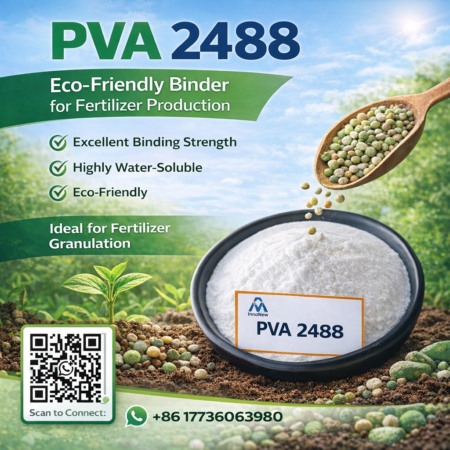
In the evolution of modern agriculture, formulation technology plays a decisive role in improving fertilizer performance, storage stability, and application efficiency. Among the functional additives widely adopted today, Polyvinyl Alcohol (PVA) has emerged as a high-performance solution, especially in granulation systems. In particular, PVA 2488 is increasingly recognized as an efficient and reliable fertilizer binder.
Why Binder Technology Matters in Fertilizer Production
Granular fertilizers must maintain mechanical strength during handling, packaging, transportation, and field application. Weak granules lead to dust formation, material loss, and uneven nutrient distribution. A high-quality water soluble polymer is therefore essential to ensure particle integrity while maintaining nutrient availability in soil.
This is where PVA powder provides a strategic advantage. Polyvinyl Alcohol (PVA) 2488 has emerged as a versatile solution to these problems. As a water-soluble synthetic polymer, PVA 2488 is increasingly specified as a green binder in fertilizer production due to its strong adhesion, film-forming capability, and favorable environmental profile
PVA 2488 as a High-Performance Fertilizer Binder
PVA 2488 is a partially hydrolyzed grade of Polyvinyl Alcohol known for its balanced viscosity, strong adhesion, and excellent film-forming properties. When used as a fertilizer binder, it enhances granule cohesion without compromising solubility.
Key performance benefits include:
- Strong binding strength for uniform granule formation
- Reduced dust generation during processing and handling
- Improved impact resistance of finished fertilizer pellets
- Excellent compatibility with NPK, compound fertilizers, and micronutrient blends
As a water soluble PVA powder, it dissolves efficiently in water to form a stable solution that distributes evenly throughout the fertilizer mixture. This ensures consistent binding performance during drum granulation or extrusion processes.
Controlled Disintegration and Soil Compatibility
One of the major advantages of using PVA in fertilizer production is its controlled solubility. As a water soluble polymer, it gradually dissolves when exposed to soil moisture, allowing fertilizer granules to break down in a controlled manner. This improves nutrient dispersion and reduces localized over-concentration.
Unlike some synthetic binders that may leave residues, PVA powder demonstrates excellent environmental compatibility when used at appropriate dosages. Its clean degradation profile supports sustainable agricultural practices.
Process Efficiency and Cost Optimization
In addition to performance benefits, PVA 2488 contributes to operational efficiency. Its strong binding capacity allows lower dosage levels compared to traditional inorganic binders, helping manufacturers reduce total formulation costs. The stable viscosity profile of water soluble PVA powder also ensures predictable mixing behavior, minimizing production variability.
For fertilizer producers seeking enhanced granule durability, dust control, and process reliability, Polyvinyl Alcohol (PVA) represents a technically sound and economically viable solution.
As agricultural standards continue to evolve toward higher efficiency and sustainability, advanced binder systems such as PVA 2488 will play an increasingly important role in next-generation fertilizer formulations.
PVA 2488 is more than just a binder; it is a multifunctional tool for quality control and product innovation. Whether the goal is to reduce dust in the plant, ensure granules survive logistics, or engineer a slow-release mechanism for the field, PVA 2488 offers a reliable, high-performance, and environmentally conscious solution.