In the global polymer market, selecting the correct grade of Polyvinyl Alcohol (PVA) is critical for achieving optimal performance in industrial applications. Among the most commonly used grades, PVA 2488 and PVA 1788 are frequently compared due to their similar chemical structure but distinct functional properties. As a professional manufacturer, Hebei InnoNew Material Technology Co., Ltd. provides both grades with consistent quality and tailored solutions, helping customers choose the most suitable material for their formulations.
What is PVA 2488 and PVA 1788?
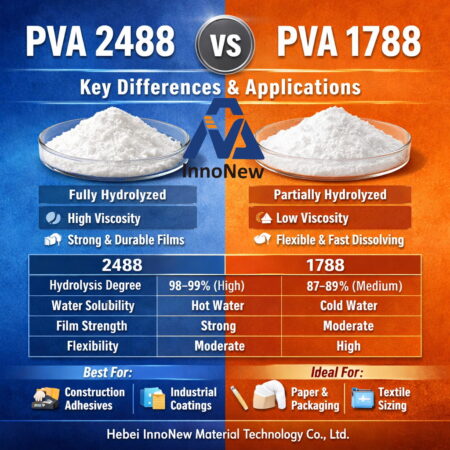
Both PVA 2488 and PVA 1788 are water-soluble synthetic polymers derived from polyvinyl acetate through hydrolysis. The key difference lies in their degree of hydrolysis and viscosity, which directly influence their application performance.
- PVA 2488: Fully hydrolyzed (~98–99%), medium to high viscosity
- PVA 1788: Partially hydrolyzed (~87–89%), lower viscosity
This variation leads to significant differences in solubility, फिल्म formation, and adhesion behavior.
Core Differences: Hydrolysis Degree & Viscosity
1. Degree of Hydrolysis
The hydrolysis level determines the number of hydroxyl groups in the polymer:
- PVA 2488 has a higher hydrolysis degree, resulting in stronger intermolecular hydrogen bonding, better film strength, and higher water resistance.
- PVA 1788, with partial hydrolysis, retains some acetate groups, improving flexibility and solubility in cold water.
2. Viscosity
Viscosity affects processing and final application properties:
- PVA 2488: Higher viscosity → better thickening, stronger mechanical strength
- PVA 1788: Lower viscosity → easier handling, faster dissolution
These differences are critical when designing formulations requiring specific rheological properties.
Performance Comparison in Industrial Applications
Adhesives
- PVA 2488 provides higher bonding strength and durability, especially in wood and construction adhesives.
- PVA 1788 offers better initial tack and flexibility, making it suitable for paper and packaging adhesives.
Textile Industry
- PVA 2488 is preferred for high-strength warp sizing, improving abrasion resistance.
- PVA 1788 is easier to remove during desizing due to its better water solubility.
Construction Materials
- PVA 2488 enhances cement adhesion, crack resistance, and durability, making it ideal for tile adhesives and mortars.
- PVA 1788 is less commonly used in structural applications but can be applied where flexibility is required.
Film & Coating Applications
- PVA 2488 forms strong, water-resistant films
- PVA 1788 produces softer, more flexible films with better clarity
Which One Should You Choose?
Choosing between PVA 2488 and PVA 1788 depends on your specific application requirements:
| Criteria | PVA 2488 | PVA 1788 |
|---|---|---|
| Hydrolysis Degree | High (Fully hydrolyzed) | Medium (Partially hydrolyzed) |
| Water Resistance | Strong | Moderate |
| Solubility | Dissolves in cold and hot water | Dissolves in cold and hotwater |
| Film Strength | High | Medium |
| Flexibility | Moderate | High |
| Typical Use | Construction, high-strength adhesives | Paper, textile, flexible adhesives |
Selection Guidelines:
- Choose PVA 2488 for strength, durability, and water resistance
- Choose PVA 1788 for ease of processing, flexibility, and fast dissolution
In many advanced formulations, both grades can be combined to achieve a balance between strength and flexibility.
Looking for Polyvinyl Alcohol PVA Supplier?
Understanding the differences between PVA 2488 and PVA 1788 is essential for optimizing product performance and cost efficiency. While PVA 2488 excels in strength and durability, PVA 1788 offers superior flexibility and processing advantages. Partnering with a reliable supplier like Hebei InnoNew Material Technology Co., Ltd. ensures access to high-quality materials, stable supply, and customized technical support. With a strong commitment to quality and innovation, the company continues to deliver premium PVA solutions for global industries.