
PVA vs RDP in Tile Adhesive – Which Is Better?
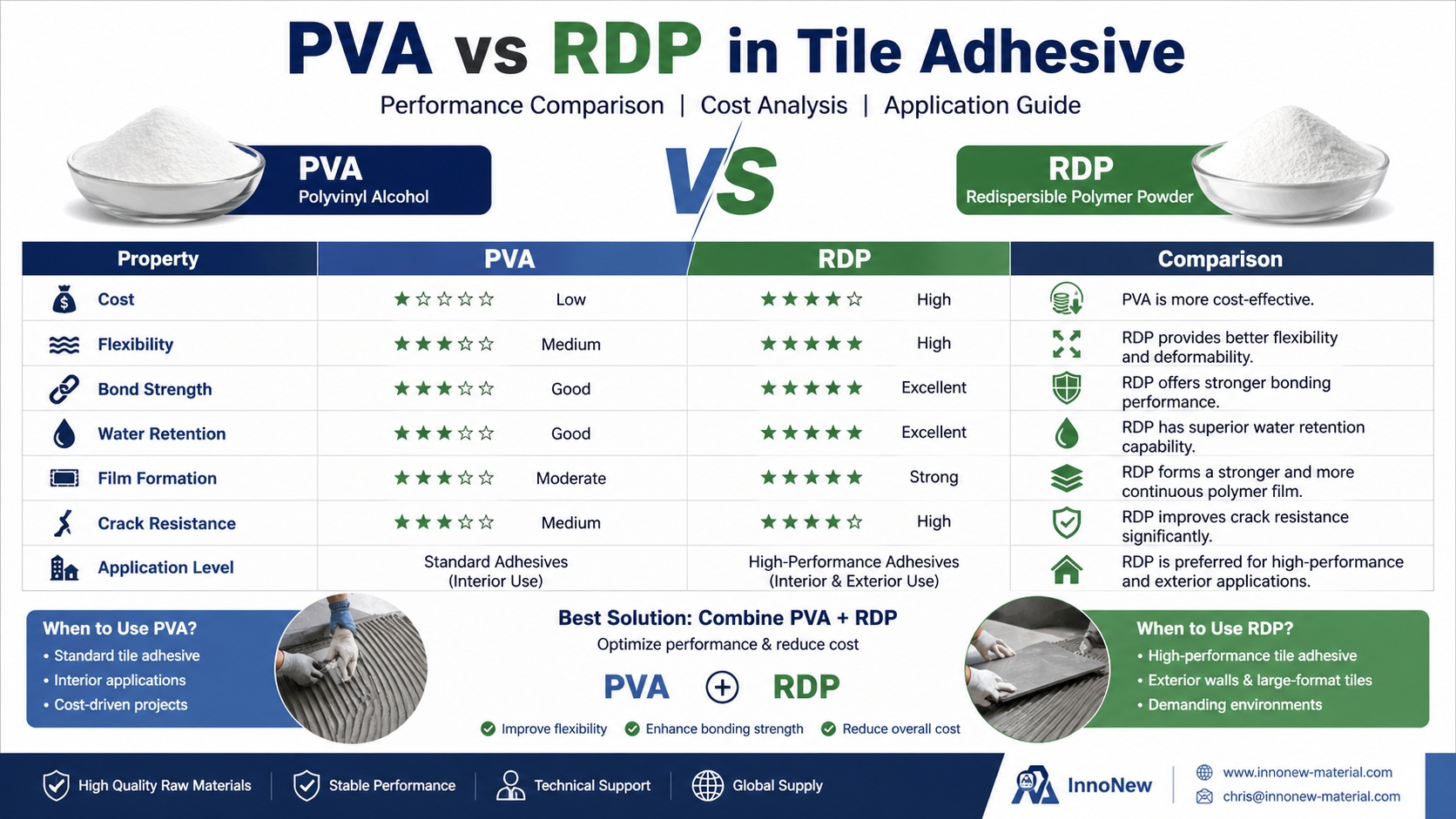
In modern tile adhesive formulations, both Polyvinyl Alcohol (PVA) and Redispersible Polymer Powder (RDP) are widely used to improve performance.
However, many manufacturers face a key question:
👉 Should you use PVA or RDP?
This guide provides a detailed comparison of cost, performance, flexibility, and application, helping you choose the right additive for your formulation.
PVA vs RDP – Key Differences
| Property | PVA | RDP |
|---|---|---|
| Cost | ⭐ Low | ⭐⭐⭐ High |
| Flexibility | Medium | High |
| Bond Strength | Good | Excellent |
| Water Retention | Good | Excellent |
| Film Formation | Moderate | Strong |
| Crack Resistance | Medium | High |
| Application Level | Standard adhesives | High-performance adhesives |
1. Cost Comparison
- PVA: Much lower cost, ideal for budget formulations
- RDP: Higher cost but better overall performance
👉 Conclusion:
PVA is suitable for cost-sensitive markets, while RDP is used in premium systems
2. Flexibility & Crack Resistance
- RDP forms a highly elastic polymer film
- PVA provides moderate flexibility
👉 RDP is better for:
- Large tiles
- Exterior applications
3. Bonding Strength
- PVA improves basic adhesion
- RDP significantly enhances bonding strength
👉 For high bonding requirements → RDP is preferred
4. Workability & Water Retention
Both improve workability, but:
- RDP → better water retention
- PVA → good but slightly lower
Best Solution: Combine PVA + RDP
Instead of choosing one, many manufacturers use:
👉 PVA + RDP combination
Benefits:
- Reduce cost
- Maintain performance
- Optimize formulation
When to Use PVA
- Standard tile adhesive
- Interior applications
- Cost-driven projects
When to Use RDP
- High-performance tile adhesive
- Exterior walls
- Large-format tiles
Recommended Strategy
👉 Use PVA (0.5–1%) + RDP (1–3%)
✔ Balance cost & performance
✔ Improve flexibility and bonding
Typical Applications
- Cement-based tile adhesive
- Wall & floor adhesives
- Thin-set mortar
- EIFS systems
FAQ (Frequently Asked Questions)
Can PVA replace RDP?
PVA can partially replace RDP in low-cost formulations, but not in high-performance systems.
Which is better for tile adhesive?
RDP provides better performance, but PVA offers a more cost-effective solution.
Can I use both PVA and RDP together?
Yes, combining both is the most effective approach for balancing cost and performance.
What is the main difference between PVA and RDP?
The main difference is flexibility and bonding strength—RDP performs better, while PVA is more economical.
Is PVA suitable for exterior tile adhesive?
PVA is generally used for interior applications, while RDP is preferred for exterior use.
Choose the Right Additive for Your Tile Adhesive
Looking for the best solution for your tile adhesive formulation?
👉 We supply high-quality PVA powder for cost-effective systems and support optimized formulations with RDP.
✔ Free samples
✔ Technical guidance
✔ Bulk supply
WhatsApp: +86 17736063980
Email: chris@innonew-material.com