
Why Self-Leveling Mortar Is Not Flowing? 7 Common Problems & Proven Solutions
Self-leveling mortar is designed to flow smoothly and level itself without manual spreading.
But in real production and application, many manufacturers face a frustrating issue:
👉 The mortar does not flow properly,
👉 It becomes thick, uneven, or difficult to spread.
This not only affects surface quality but also increases labor cost and project failure risk.
In this guide, we break down the 7 most common causes and provide practical, formulation-level solutions.
1. Insufficient PCE Dosage
Problem:
Low or ineffective Polycarboxylate Superplasticizer (PCE)
Cause:
- Dosage too low (<0.1%)
- Poor quality PCE
- Incompatibility
Solution:
- Adjust dosage to 0.15%–0.25%
- Use high-performance PCE powder
👉 Without sufficient PCE Superplasticizer, true self-leveling is impossible
2. Incorrect Water-to-Binder Ratio
Problem:
Mortar too thick or too fluid
Cause:
- Water too low → poor flow
- Water too high → segregation
Solution:
- Maintain optimal ratio: 0.24–0.30
- Adjust gradually during testing
3. Poor Particle Size Distribution
Problem:
Flow resistance too high
Cause:
- Too many coarse particles
- Lack of fine fillers
Solution:
- Optimize gradation
- Add fine powders (calcium carbonate)
👉 Good grading = smoother flow
4. Excessive Cellulose Ether (HPMC/MHEC)
Problem:
Mortar becomes sticky and thick
Cause:
- Overdose of viscosity agent
Solution:
- Reduce dosage to 0.02%–0.05%
- Choose low-viscosity grade
5. Lack of Defoamer
Problem:
Air bubbles reduce flowability
Cause:
- Air entrainment
- Foam increases resistance
Solution:
- Add 0.05–0.2% defoamer
- Use high-efficiency type
6. Cement Compatibility Issues
Problem:
Unexpected loss of flow
Cause:
- Cement composition differences
- High C3A content
Solution:
- Test compatibility
- Adjust PCE type
7. Mixing Process Problems
Problem:
Uneven dispersion
Cause:
- Poor mixing sequence
- Insufficient mixing time
Solution:
- Dry mix first
- Add water gradually
- Ensure full dispersion
Quick Diagnosis Table
| Symptom | Possible Cause | Solution |
|---|---|---|
| No flow | Low PCE | Increase dosage |
| Too thick | Low water | Adjust ratio |
| Segregation | Excess water | Reduce water |
| Sticky | Too much HPMC | Reduce dosage |
| Air bubbles | No defoamer | Add defoamer |
Pro Tips for Perfect Flowability
✔ Use high-quality PCE powder
✔ Balance water + additives
✔ Optimize particle grading
✔ Always test formulations
Small adjustments can dramatically improve performance
Related Guide:
Self-Leveling Mortar Formulation Guide
Related Product:
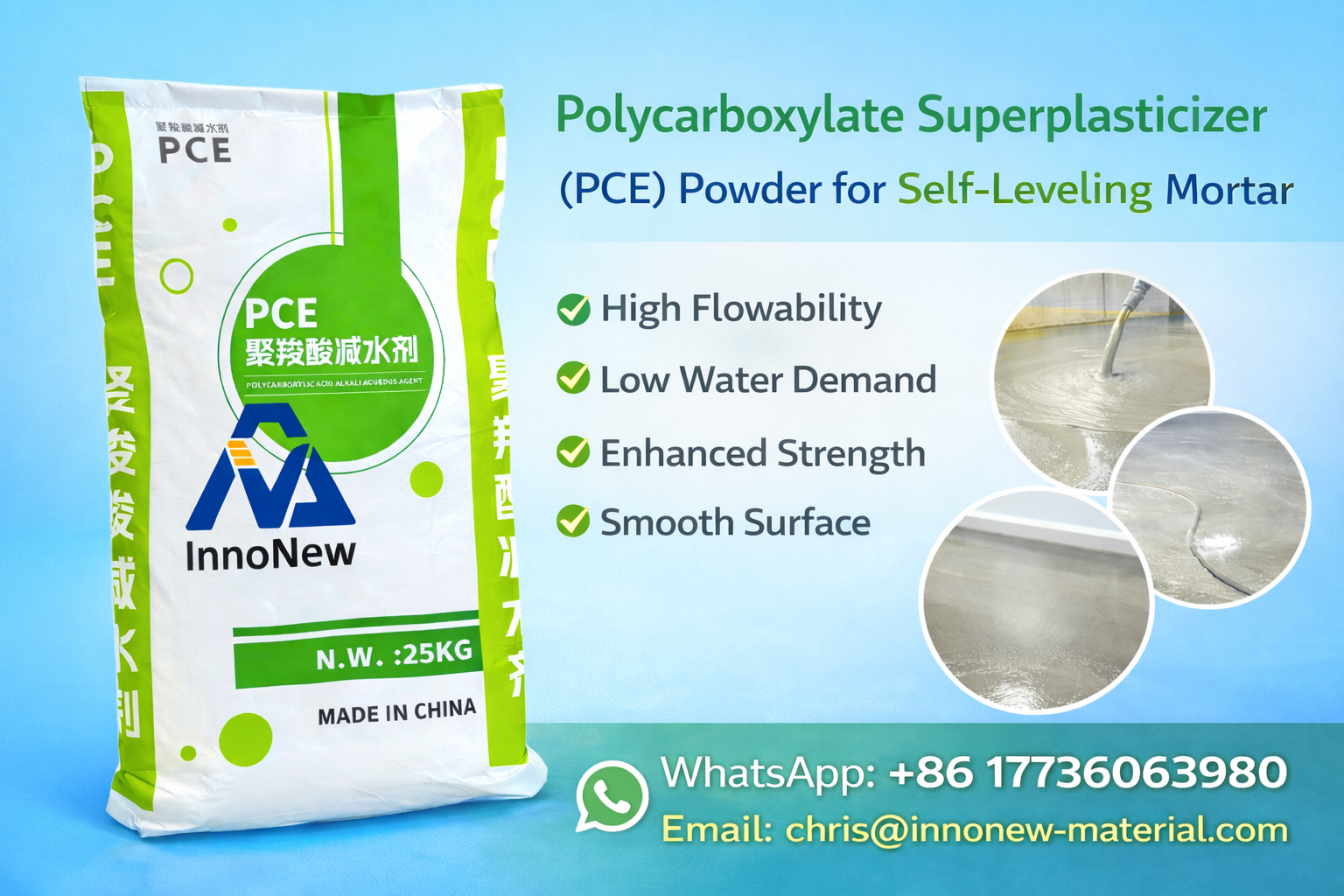
Polycarboxylate Superplasticizer (PCE) Powder
Related Blog:
PCE Powder vs SNF Comparison
FAQ
1. Why is my self-leveling mortar too thick?
Likely due to low PCE dosage or insufficient water.
2. Can I fix flowability without PCE?
No, PCE is essential for proper self-leveling performance.
3. How to improve mortar flow quickly?
- Increase PCE
- Adjust water ratio
- Optimize grading
4. What is the ideal PCE dosage?
Typically 0.15%–0.25%.
5. Why is my mortar not smooth after leveling?
Possible air bubbles or poor dispersion.
Fix Your Mortar Flow Problem Today
Looking for a reliable solution?
✔ High-performance PCE powder
✔ Free formulation optimization
✔ Sample available
✔ Fast global delivery
📩 Contact us now:
Email: chris@innonew-material.com
WhatsApp: +86 17736063980