
How Spun Pile Manufacturers Reduce Steam Curing Time and Improve Mold Turnover Efficiency
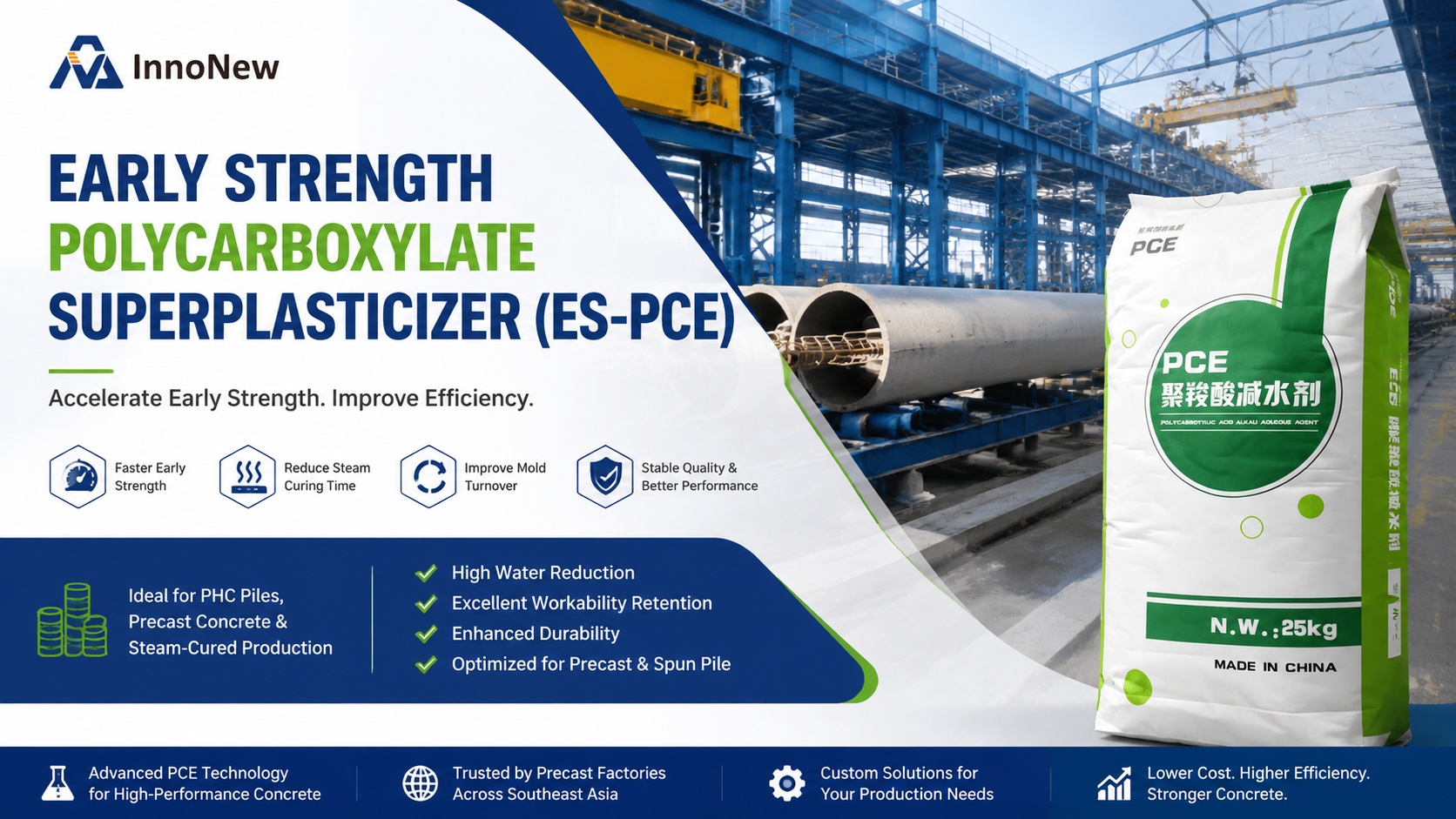
Modern spun pile production is no longer driven solely by concrete strength requirements. Today, production efficiency, steam curing optimization, energy consumption, and mold turnover speed have become critical profitability indicators for precast concrete manufacturers.
For PHC pile and prestressed concrete factories, every additional hour in the curing cycle directly affects:
- Daily production capacity
- Steam consumption
- Labor efficiency
- Mold utilization
- Delivery schedules
As infrastructure projects continue to expand across Southeast Asia, spun pile manufacturers are increasingly searching for ways to accelerate early concrete strength development without sacrificing workability or product quality.
This is why advanced early-strength admixture technology has become an essential part of modern steam-cured concrete production systems.
Why Early Strength Matters in PHC Spun Pile Production
PHC (Prestressed High-strength Concrete) piles are widely used in:
- High-rise building foundations
- Industrial facilities
- Marine engineering
- Bridge construction
- Infrastructure projects
Unlike conventional concrete products, spun piles require:
- High-density concrete structure
- Stable rheology during centrifugal spinning
- Rapid early compressive strength
- Efficient prestress transfer
- Reliable steam curing compatibility
In many factories, insufficient early strength development creates significant production bottlenecks.
When concrete cannot reach transfer strength quickly enough, manufacturers often face:
- Extended steam curing cycles
- Delayed demolding
- Lower mold turnover efficiency
- Increased fuel and energy costs
- Reduced daily production output
For large-scale spun pile factories, these issues directly impact operational profitability.
Common Challenges in Steam-Cured Concrete Production
Although traditional water reducers can improve concrete flowability, many systems are not optimized for high-efficiency steam-cured production environments.
Common issues include:
Slow Early Strength Development
Concrete may achieve acceptable long-term strength but fail to develop sufficient early compressive strength during the first curing stage.
This limits production efficiency and delays prestress transfer operations.
High Steam Consumption
Longer curing cycles require additional steam energy, increasing operational costs significantly.
In tropical Southeast Asian environments where factories operate continuously, steam efficiency becomes especially important.
Unstable Workability During Spinning
In spun pile production, concrete undergoes centrifugal compaction at high rotational speeds.
Poor rheology control can result in:
- Segregation
- Surface defects
- Inconsistent density
- Reduced structural uniformity
Reduced Mold Turnover Efficiency
Mold turnover speed is one of the most important productivity metrics in precast concrete manufacturing.
When demolding cycles become longer, factories may require:
- Additional molds
- More storage space
- Higher labor input
All of these increase production costs.
How Modern Admixture Technology Improves Production Efficiency
Advanced polycarboxylate-based admixture systems are increasingly used in high-performance precast concrete production because they improve both concrete rheology and hydration efficiency.
Compared with conventional admixture systems, modern early-strength technologies help manufacturers achieve:
- Faster early strength development
- Lower water-cement ratio
- Improved cement particle dispersion
- Better steam curing compatibility
- More stable concrete performance during spinning
These systems are particularly effective in:
- Steam-cured concrete
- PHC piles
- Prestressed concrete
- High-strength precast components
By accelerating early hydration kinetics, manufacturers can reduce curing time while maintaining concrete durability and structural performance.
Case Study: Improving Production Efficiency in Thailand Spun Pile Manufacturing
A Southeast Asian spun pile manufacturer operating in Thailand experienced several production challenges related to steam-cured PHC pile manufacturing.
The factory required a more efficient admixture solution capable of improving early concrete strength while maintaining stable spinning performance under continuous production conditions.
After evaluating the production system, a customized early-strength admixture optimization program was introduced to improve:
- Early compressive strength development
- Steam curing efficiency
- Mold turnover speed
- Concrete rheology stability
- Production consistency
The project was associated with spun pile operations linked to ICP Piles Thailand Operations, a regional manufacturer involved in prestressed spun pile production for infrastructure and foundation applications.
Results Achieved After Admixture Optimization
Following the optimization process, the factory achieved measurable improvements in overall production efficiency.
Faster Early Strength Development
Concrete reached target transfer strength earlier during the curing cycle, improving production scheduling flexibility.
Reduced Steam Curing Time
The optimized admixture system helped shorten steam curing duration, reducing:
- Fuel consumption
- Steam energy usage
- Overall curing cost
Improved Mold Turnover Efficiency
Faster demolding allowed the factory to increase daily production capacity without expanding mold inventory.
This significantly improved operational efficiency.
Better Spinning Stability
Improved rheology control during centrifugal spinning resulted in:
- More uniform pile structure
- Better surface finish
- Reduced segregation risk
- More stable product quality
Enhanced Production Consistency
The optimized concrete system provided more reliable batching and production performance across varying ambient temperatures and production conditions.
Why Southeast Asian Precast Factories Are Focusing on Production Optimization
The Southeast Asian construction sector continues to expand rapidly due to increasing demand for:
- Infrastructure development
- Industrial parks
- Transportation systems
- High-rise construction
- Marine engineering
As competition increases, precast and spun pile manufacturers are under growing pressure to improve:
- Production efficiency
- Energy utilization
- Concrete quality consistency
- Factory automation
- Cost control
This is driving widespread adoption of advanced concrete admixture technologies designed specifically for steam-cured and high-turnover production systems.
In tropical climates, optimized early-strength concrete systems also help factories maintain stable production performance despite high temperature and humidity conditions.
Key Benefits of Optimized Early-Strength Concrete Systems
Modern production-oriented admixture systems can provide several advantages for precast manufacturers:
| Production Objective | Benefit |
|---|---|
| Faster demolding | Higher mold turnover efficiency |
| Reduced steam curing | Lower energy consumption |
| Lower water demand | Improved concrete density |
| Stable spinning rheology | Better pile uniformity |
| Faster early strength | Improved production scheduling |
| More efficient hydration | Better cement utilization |
Future Trends in Steam-Cured Concrete Manufacturing
The global precast concrete industry is rapidly evolving toward:
- Automated production systems
- Faster curing cycles
- Energy-efficient manufacturing
- Low-carbon concrete technologies
- High-performance admixture optimization
In this transition, admixture technology is no longer viewed simply as a “water reducer.”
Instead, it has become a critical production-efficiency tool for modern concrete manufacturing.
Factories that can optimize early strength development, steam curing efficiency, and mold turnover will achieve significant long-term competitive advantages.
Conclusion
For modern spun pile and precast concrete manufacturers, production efficiency has become just as important as concrete strength itself.
Optimizing early concrete strength development can help factories:
- Reduce steam curing time
- Improve mold turnover
- Lower production costs
- Increase daily output
- Enhance product consistency
The Thailand spun pile production optimization project associated with ICP Piles Thailand Operations demonstrates how advanced early-strength concrete technologies can successfully solve real production bottlenecks in steam-cured PHC pile manufacturing.
As Southeast Asia’s infrastructure sector continues to grow, efficient concrete production systems will play an increasingly important role in maintaining competitiveness within the precast concrete industry.
FAQ
Why is early strength Polycarboxylate Superplasticizer PCE important in spun pile production?
How does steam curing affect production efficiency?
Efficient steam curing helps accelerate strength development and increase daily production capacity while reducing operational delays.
What causes low mold turnover efficiency in precast factories?
Slow early strength development, extended curing cycles, and unstable concrete performance are among the most common causes.
Why is rheology stability important during spinning?
Stable rheology helps prevent segregation and improves concrete density uniformity during centrifugal compaction.
Are advanced admixture systems suitable for tropical climates?
Yes. Properly optimized admixture systems can maintain stable concrete performance under high temperature and humidity conditions common in Southeast Asia.