
PCE 2025 Bangkok: Top Concrete Challenges and Next-Generation PCE Solutions for Low-Carbon Construction
The global concrete industry is entering a new era of low-carbon construction. As cement producers reduce clinker content and increase the use of supplementary cementitious materials (SCMs), traditional concrete admixture systems are facing unprecedented technical challenges.
At the 6th International Conference on Polycarboxylate Superplasticizers (PCE 2025) in Bangkok, researchers, admixture manufacturers, and concrete experts discussed how next-generation PCE technologies must evolve to support sustainable construction and green cement systems. According to the conference agenda and technical discussions, major focus areas included SCM compatibility, slump retention, rheology optimization, clay tolerance, and low-carbon binder performance.
For ready-mix producers and construction companies across Southeast Asia and global emerging markets, these challenges are no longer theoretical research topics — they directly affect concrete workability, pumping performance, strength development, and construction efficiency.
This article explores the top concrete challenges highlighted at PCE 2025 Bangkok and explains how advanced PCE powder technologies are becoming critical solutions for low-carbon construction.
Why Low-Carbon Concrete Is Creating New Challenges
The transition toward sustainable construction is fundamentally changing cement chemistry.
Modern low-carbon concrete systems increasingly contain:
- Fly ash
- Ground granulated blast furnace slag (GGBFS)
- Calcined clay
- Limestone powder
- Industrial by-products
- Alternative binders
While these materials help reduce carbon emissions, they also introduce complex interactions with conventional polycarboxylate ether (PCE) superplasticizers.
Compared with ordinary Portland cement systems, low-carbon binders often show:
- Faster slump loss
- Higher adsorption competition
- Increased stickiness
- Poor rheology stability
- Reduced workability consistency
These issues were repeatedly discussed during PCE 2025 Bangkok, highlighting the growing importance of customized molecular design in future superplasticizer development.
Challenge 1: Severe Slump Loss in Tropical Climates
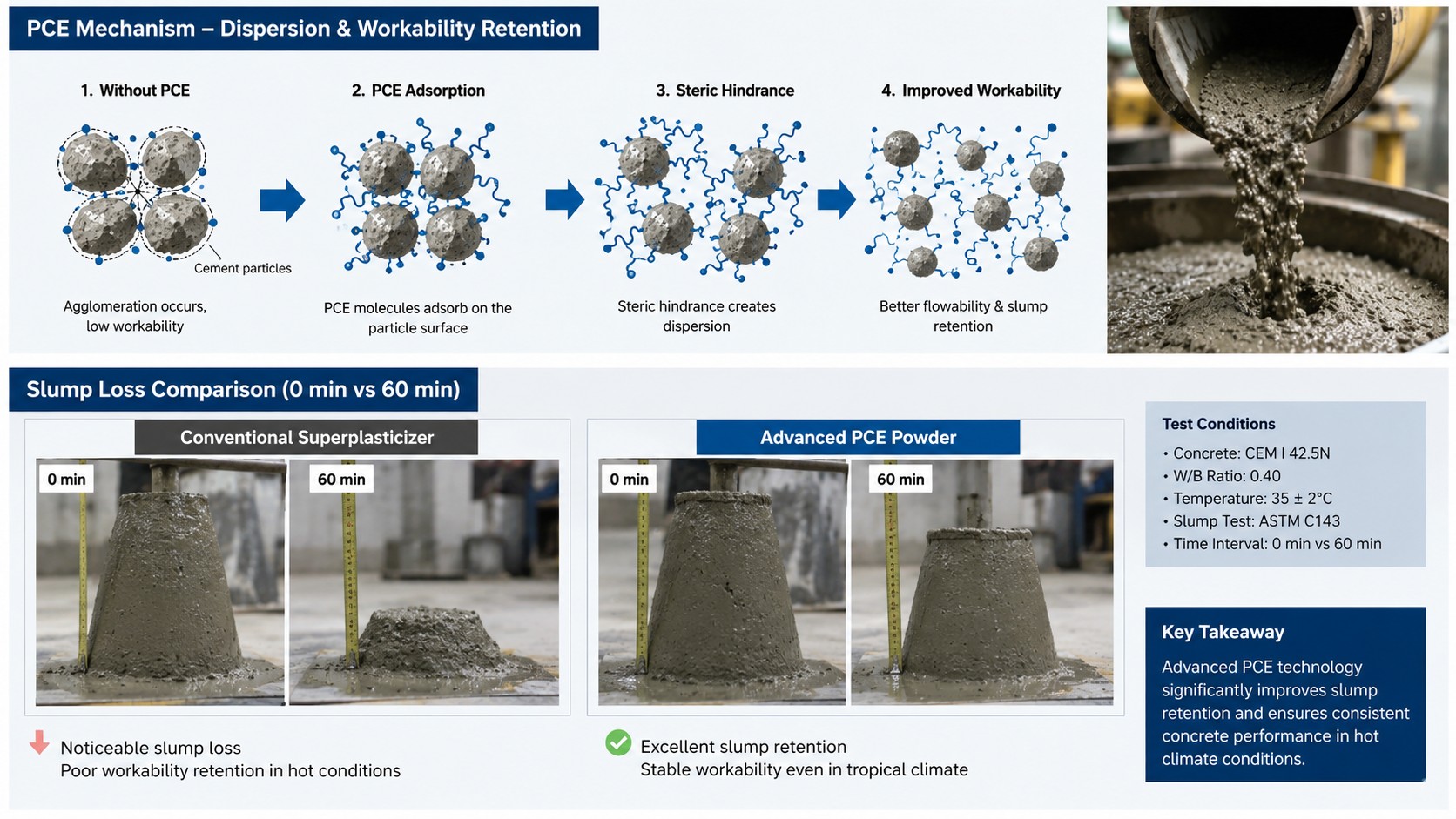
In Southeast Asia, high ambient temperatures significantly accelerate cement hydration and water evaporation. Combined with low water-binder ratio concrete, this creates rapid slump loss during transportation and placement.
Concrete producers frequently encounter:
- Reduced workability after 30–60 minutes
- Difficult pumping performance
- Increased water demand on-site
- Poor finishing quality
The problem becomes even more severe when SCM-rich cement systems are used.
At PCE 2025 Bangkok, several discussions focused on advanced slump-retaining superplasticizers designed for low-carbon and tropical concrete applications. Researchers emphasized the importance of molecular structure optimization and delayed adsorption mechanisms for maintaining long-term workability.
Next-Generation PCE Solution
Modern high-performance PCE powder technologies are increasingly designed with:
- Long side-chain molecular architecture
- Controlled adsorption behavior
- Delayed dispersion release
- Improved rheology stability
- Enhanced slump retention capacity
For ready-mix concrete plants operating in hot climates, selecting a PCE system optimized for extended workability is becoming essential.
Challenge 2: Poor Compatibility with SCM-Based Cement Systems
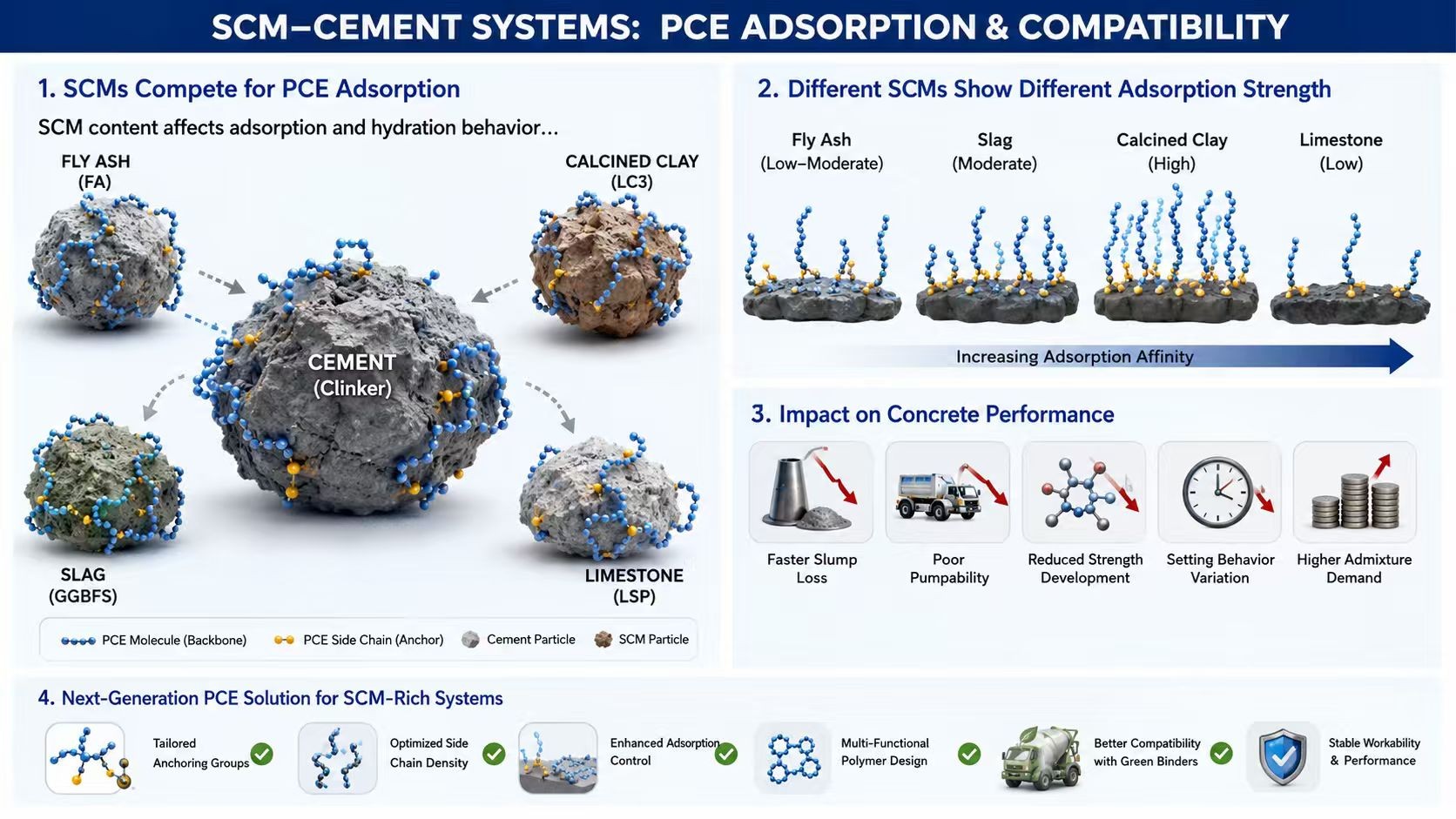
As cement manufacturers reduce clinker content, compatibility between PCE superplasticizers and SCM-rich cement systems has become one of the industry’s biggest technical concerns.
Different SCMs may strongly affect:
- Adsorption efficiency
- Hydration kinetics
- Dispersion performance
- Setting behavior
- Air entrainment
For example, calcined clay and certain industrial by-products may consume or deactivate conventional PCE molecules, resulting in unstable concrete performance.
SCM compatibility was identified as a major discussion topic at PCE 2025 Bangkok, especially in relation to future low-carbon binder systems.
Next-Generation PCE Solution
To address these issues, advanced PCE technologies are evolving toward:
- Tailored anchoring groups
- Optimized side-chain density
- Enhanced adsorption control
- Multi-functional polymer structures
- SCM-adaptive molecular design
High-performance PCE powder systems with improved compatibility can significantly enhance workability stability in blended cement applications.
Challenge 3: High Stickiness in Low Water-Binder Concrete
Ultra-low water-binder ratio concrete is increasingly used in high-strength and high-performance construction projects. However, these systems often suffer from excessive viscosity and poor flowability.
Common problems include:
- Sticky concrete mixtures
- Difficult vibration and compaction
- Reduced pumping efficiency
- Poor surface finishing
At PCE 2025 Bangkok, rheology optimization and viscosity reduction technologies were widely discussed as critical research directions for next-generation superplasticizers.
Next-Generation PCE Solution
Advanced rheology-optimized PCE formulations can help improve:
- Concrete flowability
- Lubrication effect
- Pumpability
- Particle dispersion
- Workability balance
Modern PCE powder products are increasingly engineered not only for water reduction, but also for comprehensive rheological control.
Challenge 4: Clay Contamination in Aggregates
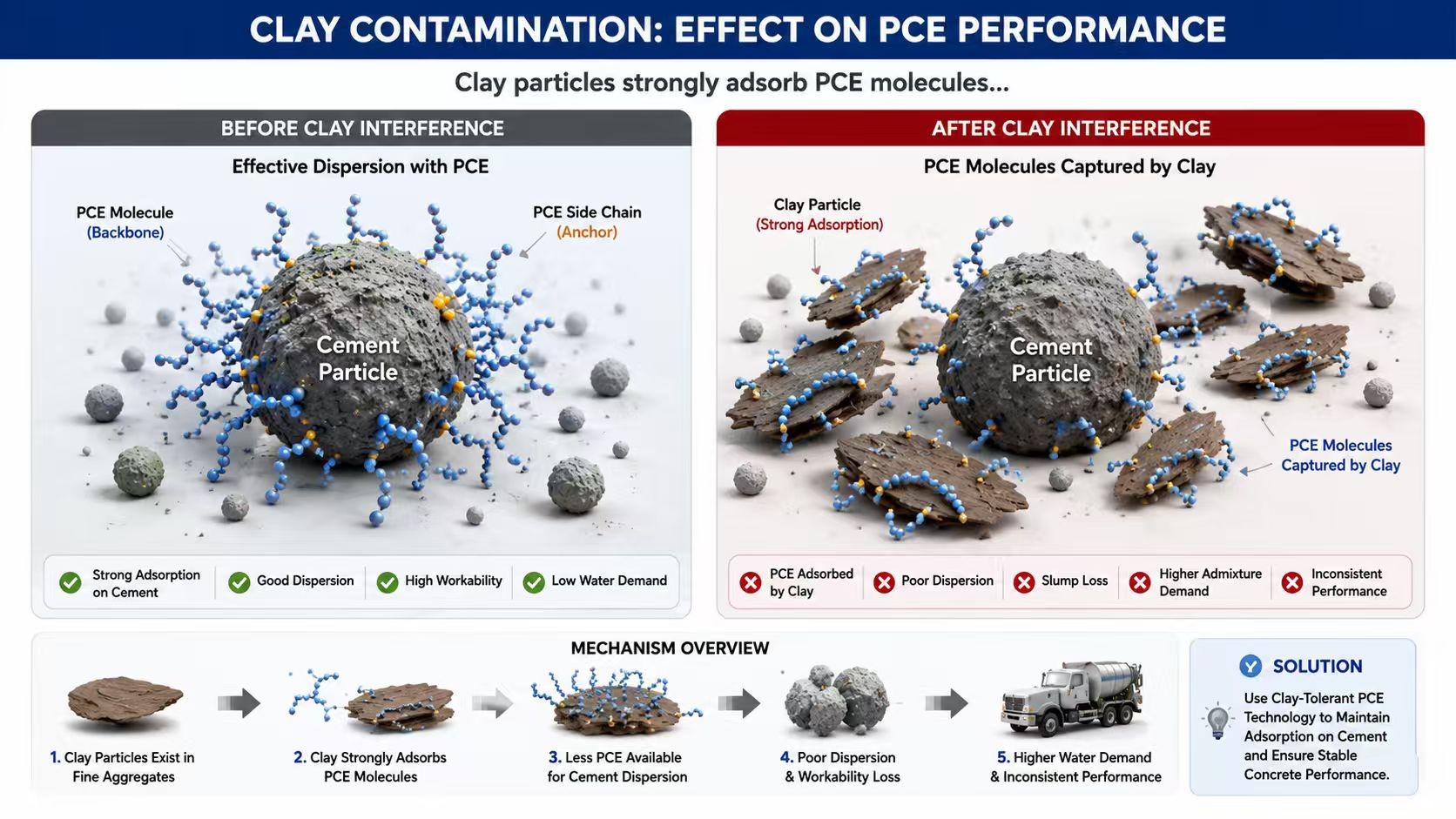
Poor-quality aggregates containing clay and fine impurities remain a major challenge in many developing construction markets.
Clay particles can strongly adsorb conventional PCE molecules, dramatically reducing superplasticizer efficiency.
As a result, concrete producers may experience:
- Unexpected slump loss
- Increased dosage demand
- Inconsistent performance
- Higher production cost
At PCE 2025 Bangkok, clay-tolerant PCE technology was identified as one of the future directions of advanced admixture development.
Next-Generation PCE Solution
Clay-tolerant PCE systems are designed to maintain dispersion efficiency even in difficult aggregate conditions.
Key features include:
- Improved molecular selectivity
- Enhanced clay resistance
- Stable adsorption behavior
- Better tolerance to fines and impurities
For construction markets with variable raw material quality, clay-tolerant PCE powder technologies are becoming increasingly important.
Challenge 5: Higher Admixture Demand in Green Cement Systems
Low-carbon cement systems often require higher superplasticizer dosage to achieve equivalent workability compared with traditional Portland cement.
This creates several challenges:
- Higher admixture consumption
- Increased production cost
- Workability instability
- Greater sensitivity to material variation
As discussed during PCE 2025 Bangkok, future admixture technologies must deliver higher efficiency while supporting sustainable cement chemistry.
Next-Generation PCE Solution
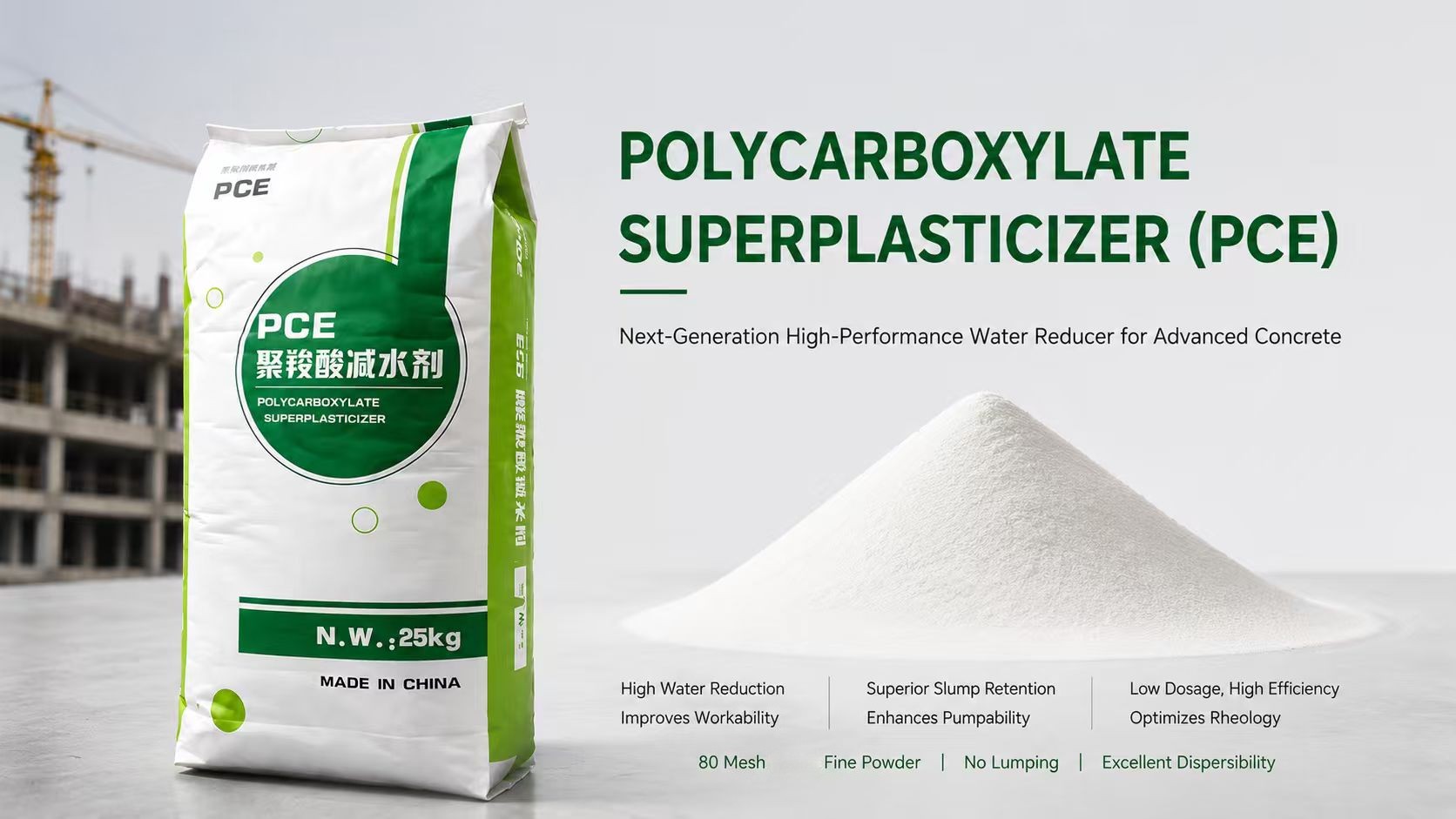
Next-generation high-performance PCE powder systems are increasingly focused on:
- Higher water reduction efficiency
- Lower dosage requirements
- Better compatibility with green binders
- Improved long-term stability
- Sustainable molecular design
These technologies are expected to play a central role in the future of low-carbon construction.
What Concrete Producers Should Look for in Modern PCE Technologies
As concrete systems continue evolving, traditional superplasticizer selection methods are no longer sufficient.
Modern concrete producers should evaluate PCE technologies based on:
- SCM compatibility
- Slump retention performance
- Clay tolerance
- Rheology optimization
- Hot climate stability
- Low dosage efficiency
- Air entrainment control
- Sustainability potential
The future of concrete admixtures will increasingly depend on customized molecular engineering rather than conventional water reduction performance alone.
The Future of PCE Technology After PCE 2025 Bangkok
PCE 2025 Bangkok clearly demonstrated that the future of concrete admixtures is closely linked to the global transition toward sustainable construction.
As low-carbon concrete becomes the industry standard, next-generation PCE powder technologies will need to deliver:
- Better compatibility with green cement systems
- Enhanced rheology control
- Improved durability performance
- Lower environmental impact
- Greater adaptability to regional construction conditions
For concrete producers, contractors, and admixture manufacturers, investing in advanced PCE technologies is no longer simply a performance upgrade — it is becoming a necessary step toward the future of low-carbon construction.
FAQ (PCE 2025 & Low-Carbon Concrete Technology)
1. What is the main role of PCE in modern concrete technology?
Polycarboxylate Ether (PCE) superplasticizers are high-range water-reducing admixtures used to improve concrete flowability while reducing water demand. In modern construction, especially low-carbon cement systems, PCE plays a critical role in maintaining workability, strength development, and rheological stability under reduced clinker conditions.
2. Why is slump loss a major issue in tropical construction environments?
Slump loss is more severe in hot climates due to accelerated cement hydration, higher evaporation rates, and faster adsorption of PCE molecules on cement particles. In regions like Southeast Asia, this leads to reduced workability during transportation and placement, making slump retention a key performance requirement for modern superplasticizers.
3. How does low-carbon cement affect PCE performance?
Low-carbon cement systems typically contain higher amounts of supplementary cementitious materials (SCMs) such as fly ash, slag, and calcined clay. These materials change the surface chemistry of cement particles and increase adsorption competition, often reducing the efficiency and consistency of conventional PCE systems.
4. What is clay-tolerant PCE technology and why is it important?
Clay-tolerant PCE technology refers to advanced molecular designs that reduce the negative impact of clay impurities in aggregates. Clay particles can strongly adsorb PCE molecules, leading to unexpected slump loss and higher admixture dosage. Clay-resistant formulations help stabilize concrete performance even when raw material quality is inconsistent.
5. What were the key technical directions discussed at PCE 2025 Bangkok?
Key research directions highlighted at PCE 2025 included improved SCM compatibility, enhanced slump retention systems, rheology optimization for low water-binder ratio concrete, and next-generation molecular design of PCE to support low-carbon cement systems and sustainable construction practices.
6. Why is rheology control becoming more important in concrete admixtures?
As concrete mixtures become more complex due to low water content and high SCM usage, traditional water reduction is no longer sufficient. Rheology control ensures proper flow behavior, pumpability, and workability balance, reducing issues such as stickiness, segregation, and poor finishing quality.
7. What should be considered when selecting PCE for low-carbon construction projects?
Selection should focus on performance under real construction conditions, including slump retention time, compatibility with SCM-rich cement systems, resistance to raw material variability, dosage efficiency, and stability in high-temperature environments. These factors are becoming more important than simple water reduction capability alone.