
Textile Printing Thickener: The Complete Industry Guide
Introduction
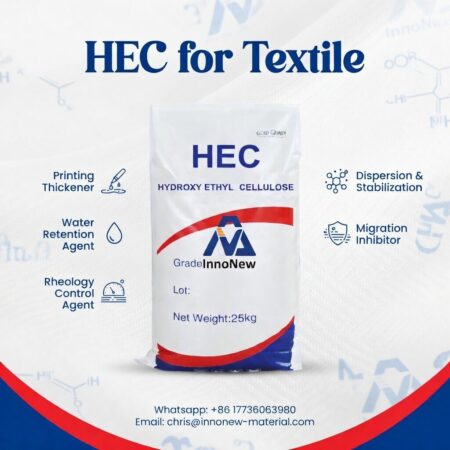
In textile printing, achieving sharp patterns, uniform color distribution, and stable production performance depends heavily on one critical component: the textile printing thickener.
A well-selected thickener ensures:
- Controlled viscosity
- Proper dye fixation
- Clean pattern edges
- Stable processing under industrial conditions
However, with multiple options available—HEC, PVA, sodium alginate, CMC—choosing the right thickener can significantly impact both product quality and production cost.
This guide provides a technical, application-driven comparison to help textile manufacturers and chemical buyers make the optimal decision.
What is a Textile Printing Thickener?
A textile printing thickener is a rheology modifier used to:
- Increase viscosity of printing paste
- Prevent dye migration
- Control flow behavior during printing
Core Functions
- Maintain paste consistency
- Prevent bleeding of dyes
- Ensure sharp pattern outlines
- Improve color yield
Without proper thickening:
- Prints become blurred
- Dye spreads uncontrollably
- Production consistency drops
Types of Textile Printing Thickeners
1. Cellulose-Based Thickeners (HEC, CMC)
Hydroxyethyl Cellulose (HEC)
Key Features:
- Non-ionic polymer
- Excellent electrolyte resistance
- Stable viscosity in reactive systems
Best For:
- Reactive dye printing
- Pigment printing
- High-salt systems
Carboxymethyl Cellulose (CMC)
Key Features:
- Anionic polymer
- Good water solubility
- Lower cost option
Limitations:
- Sensitive to electrolytes
- Less stable than HEC
2. Natural Thickeners (Sodium Alginate)
Sodium Alginate
Key Features:
- Extracted from seaweed
- High viscosity
- Good compatibility with reactive dyes
Advantages:
- Excellent print clarity
- Biodegradable
Disadvantages:
- High cost
- Supply instability
- Susceptible to microbial degradation
3. Synthetic Polymers (PVA)
Polyvinyl Alcohol (PVA)
Key Features:
- Strong film-forming ability
- Good adhesion
- Moderate thickening
Best Use:
- Binder in pigment printing
- Yarn sizing
Learn more about Polyvinyl Alcohol PVA for Textile Application
HEC vs PVA vs Alginate vs CMC (Critical Comparison)
| Property | HEC | PVA | Alginate | CMC |
|---|---|---|---|---|
| Thickening Efficiency | High | Medium | Very High | Medium |
| Electrolyte Resistance | Excellent | Poor | Moderate | Poor |
| Print Definition | Excellent | Moderate | Excellent | Fair |
| Cost Efficiency | High | Medium | Low | High |
| Stability | Excellent | Moderate | Low | Moderate |
| Biodegradability | Good | Moderate | Excellent | Good |
Why HEC is Becoming the Preferred Textile Printing Thickener
1. Superior Electrolyte Stability
Modern textile printing uses:
- Reactive dyes
- High salt concentrations
HEC maintains viscosity even under these conditions, unlike PVA and CMC.
2. Consistent Rheology Behavior
HEC provides:
- Shear-thinning properties
- Stable viscosity during printing
This ensures:
- Smooth application
- No viscosity breakdown
3. Cost vs Performance Balance
Compared to alginate:
- Lower cost
- Better supply stability
- Comparable performance in many systems
4. Compatibility with Multiple Systems
HEC works well with:
- Reactive dyes
- Pigments
- Disperse systems
How to Choose the Best Textile Printing Thickener
Step 1: Identify Dye System
| Dye Type | Recommended Thickener |
|---|---|
| Reactive | HEC / Alginate |
| Pigment | HEC + PVA |
| Disperse | HEC |
Step 2: Evaluate Process Conditions
- High salt → choose HEC
- High viscosity requirement → alginate
- Film strength needed → PVA
Step 3: Consider Cost Optimization
- Replace alginate partially with HEC
- Use hybrid systems (HEC + PVA)
Formulation Optimization Tips
1. Avoid Over-Thickening
Too high viscosity leads to:
- Poor penetration
- Uneven printing
2. Control Hydration Process
For HEC:
- Add slowly into water
- Ensure full dispersion
3. Combine Polymers for Best Performance
Example:
Common Problems & Solutions
Problem 1: Blurred Printing
Cause: Low viscosity
Solution: Increase HEC dosage
Problem 2: Paste Instability
Cause: Electrolyte sensitivity
Solution: Replace CMC with HEC
Problem 3: High Cost
Cause: Excess alginate usage
Solution: Partial replacement with HEC
Problem 4: Poor Adhesion
Cause: Lack of binder
Solution: Add PVA
Future Trends in Textile Printing Thickeners
1. Shift Toward Synthetic Cellulose (HEC)
- More stable
- Cost-effective
- Scalable
2. Hybrid Formulations
- HEC + PVA
- HEC + modified polymers
3. Sustainable Alternatives
- Biodegradable polymers
- Reduced environmental impact
Why Choose InnoNew Textile Printing Thickeners?
1. Customized Formulations
- Tailored viscosity
- Application-specific grades
2. Stable Supply Chain
- Industrial-scale production
- Consistent quality
3. Technical Support
- Formulation optimization
- On-site guidance
FAQ – Textile Printing Thickener
Q1: What is the best thickener for reactive printing?
HEC and alginate are the most effective, with HEC offering better cost-performance.
Q2: Can HEC replace alginate?
Partially or fully in many systems, depending on quality requirements.
Q3: Why is PVA not ideal as a thickener?
Because it primarily acts as a film-forming binder, not a rheology modifier.
Q4: How to improve printing sharpness?
Optimize viscosity and use HEC for stable rheology.
Q5: What is the most cost-effective thickener?
HEC offers the best balance between cost and performance.
Call to Action
Looking for the best textile printing thickener solution?
We provide:
- High-quality HEC & PVA
- Customized formulations
- Free samples & technical support
WhatsApp: +86 17736063980
Email: chris@innonew-material.com