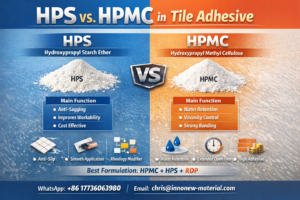
HPS vs HPMC in Tile Adhesive

HPS vs HPMC in Tile Adhesive: Key Differences, Performance & How to Choose

HPS vs HPMC in Tile Adhesive: What’s the Difference and Which One Should You Use? In modern dry mix mortar systems, choosing the right additives is critical for achieving optimal performance. Two of the most widely used construction chemicals in tile adhesive formulations are Hydroxypropyl Starch Ether (HPS) and Hydroxypropyl Methyl Cellulose (HPMC). While both […]

HPS vs HPMC in Tile Adhesive: Key Differences, Performance & How to Choose Read More »
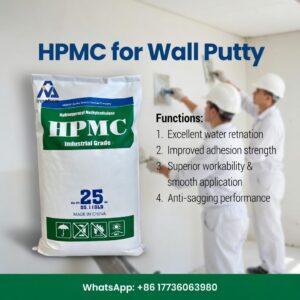
HPMC for wall putty improving workability and wate retention

How HPMC Improves Wall Putty Performance | Complete Technical Guide 2026

In modern dry mix construction materials, HPMC for wall putty has become an essential additive for achieving consistent performance, superior workability, and high-quality surface finishing. As a widely used hydroxypropyl methyl cellulose for wall putty, HPMC plays a multifunctional role in both cement-based and gypsum-based formulations. As a leading HPMC manufacturer, Hebei InnoNew Material Technology

How HPMC Improves Wall Putty Performance | Complete Technical Guide 2026 Read More »

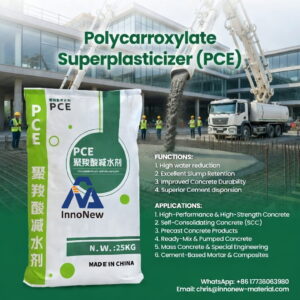
Concrete Admixture PCE Superplasticizer Powder

Top 7 Construction Chemicals Used in Concrete | Functions & Applications Guide

PCE superplasticizer is a high-performance water-reducing agent that provides excellent slump retention, high fluidity, and strong strength enhancement. It reduces water consumption, improves workability, prevents segregation, and helps produce high-strength, durable, and self-compacting concrete with lower cement content.

Top 7 Construction Chemicals Used in Concrete | Functions & Applications Guide Read More »

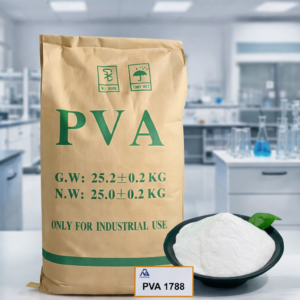
Polyvinyl Alcohol PVA 1788 powder for textile sizing and construction applications

What Are Construction Chemicals? Complete Guide to Types, Functions and Applications

What Are Construction Chemicals? A Complete Industry Guide Construction chemicals are specialized materials used to improve the performance, durability, and workability of construction systems such as concrete, mortar, and building materials. With the rapid development of modern construction technology, these chemicals have become essential for achieving high strength, long-term durability, and efficient construction processes. At

What Are Construction Chemicals? Complete Guide to Types, Functions and Applications Read More »

Best PVA for textile warp sizing

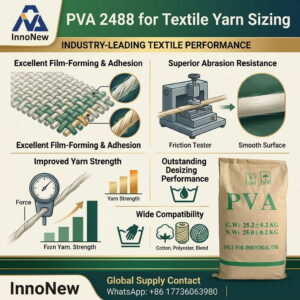
PVA for Textile Warp Yarn Sizing – Manufacturer’s Professional Guide | InnoNew

Textile warp yarn sizing is the most critical process to ensure weaving efficiency, reduce breakage, and improve fabric quality. Among all sizing agents, PVA for textile warp yarn sizing stands out as the industrial standard for modern high-speed looms, offering unmatched film strength, adhesion, water solubility, and stability. As a professional manufacturer of industrial polymers

PVA for Textile Warp Yarn Sizing – Manufacturer’s Professional Guide | InnoNew Read More »

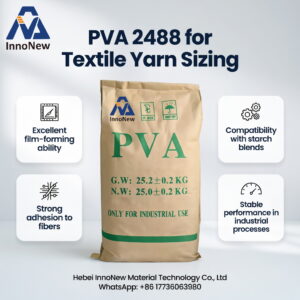
Best PVA for textile yarn sizing 2026, high-performance polyvinyl alcohol warp sizing agent

Best PVA for Textile Yarn Sizing in 2026: Top Grades, Performance & Buying Guide

In the modern textile weaving industry, yarn sizing is a critical process that directly determines weaving efficiency, yarn breakage rate, and final fabric quality. As one of the most widely used sizing agents, polyvinyl alcohol (PVA) stands out for its exceptional film-forming ability, strong adhesion, good fluidity, and easy desizing performance. With the upgrading of

Best PVA for Textile Yarn Sizing in 2026: Top Grades, Performance & Buying Guide Read More »

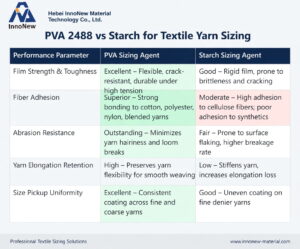
PVA vs Starch for textile yarn sizing

PVA vs Starch for Textile Yarn Sizing: Full Comparison, Pros & Cons

PVA vs Starch for Textile Yarn Sizing In textile manufacturing, yarn sizing is the critical preparatory step that boosts warp yarn strength, reduces hairiness, cuts loom breakage rates, and ensures stable high-speed weaving. Two of the most widely used sizing agents globally are PVA (polyvinyl alcohol) and starch. Choosing between PVA vs starch for textile

PVA vs Starch for Textile Yarn Sizing: Full Comparison, Pros & Cons Read More »

Hydroxyethyl Cellulose HEC for Oil drilling fluid

HEC vs PAC in Drilling Fluids – Complete Comparison Guide for Oilfield Applications

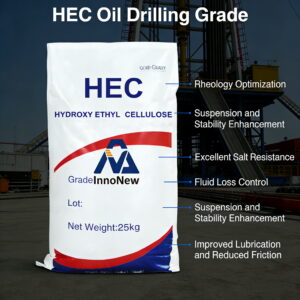
HEC vs PAC in Drilling Fluid: Which Additive is Better? In oilfield drilling operations, selecting the right drilling fluid additive is critical for achieving optimal performance, reducing operational risks, and controlling overall costs. Among the most widely used additives in water-based drilling fluids are HEC (Hydroxyethyl Cellulose) and PAC (Polyanionic Cellulose). Both materials play essential

HEC vs PAC in Drilling Fluids – Complete Comparison Guide for Oilfield Applications Read More »

HEC for oil drilling fluid viscosity and fluid loss control

How HEC Enhances Drilling Fluid Efficiency and Stability

How HEC Enhances Drilling Fluid Efficiency and Stability In oilfield drilling operations, the performance of drilling fluids directly influences operational safety, drilling speed, and cost efficiency. As drilling conditions become more complex, the demand for high-performance additives continues to increase. Among these, HEC for oil drilling has emerged as a reliable and efficient solution for

How HEC Enhances Drilling Fluid Efficiency and Stability Read More »

HPMC for concrete improving workability and water retention

How HPMC Improves Concrete Workability (Complete Technical Guide)

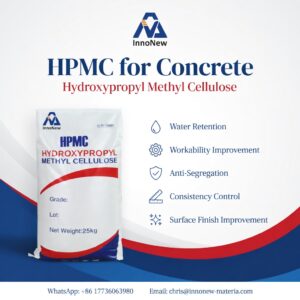
How HPMC Improves Concrete Workability In modern construction, achieving optimal concrete workability is essential for ensuring efficient placement, uniform structure, and long-term durability. One of the most effective additives used today is HPMC for concrete, a versatile cellulose ether that significantly enhances fresh mix performance. At Hebei InnoNew Material Technology Co., Ltd., we provide high-quality HPMC

How HPMC Improves Concrete Workability (Complete Technical Guide) Read More »

Scroll to Top