
Ceramic Binder Formulation Guide: Optimize Strength, Stability & Sintering Performance
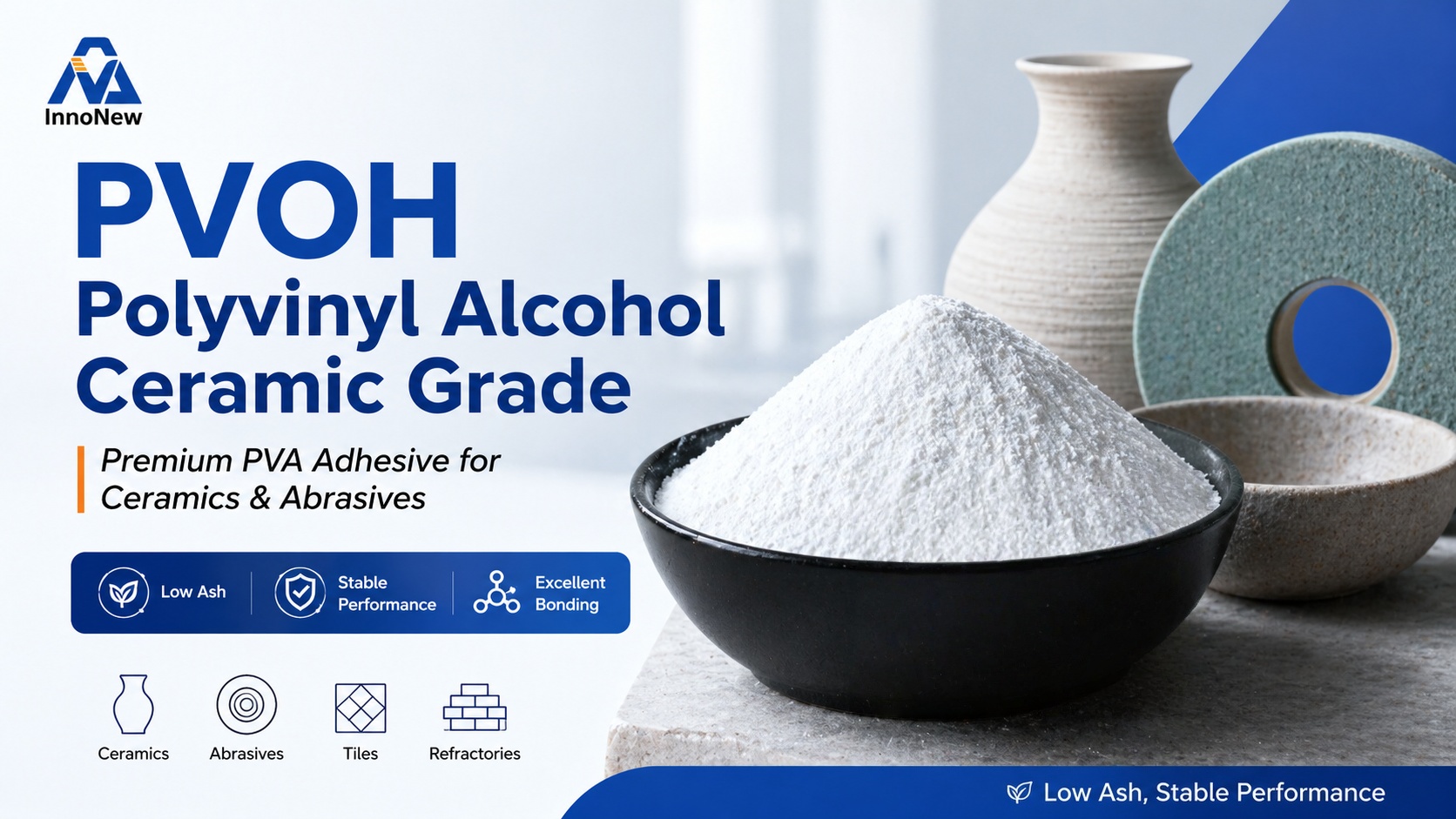
In modern ceramic manufacturing, ceramic binder formulation plays a decisive role in determining product quality, shaping performance, and sintering success. Whether in technical ceramics, structural ceramics, or abrasive materials, selecting the right binder system directly affects green strength, particle bonding, and defect control.
Among various binder options, PVOH (Polyvinyl Alcohol) stands out as one of the most effective water-soluble binders for ceramic powder processing, widely used in pressing, extrusion, and granulation.
This guide provides a complete, practical, and industrial-grade breakdown of ceramic binder formulation strategies to help manufacturers achieve consistent quality and production efficiency.
What is a Ceramic Binder System?
A ceramic binder system is a combination of organic additives used to:
- Bind ceramic particles together
- Improve powder flowability
- Enhance green body strength
- Reduce cracking and defects during drying
Typical Binder Components:
- Primary Binder: PVOH (PVA)
- Secondary Binder: CMC
- Plasticizer: PEG / Glycerol
- Dispersant: Optional additives
Why PVOH Binder is Critical in Ceramic Formulation
PVOH binder for ceramics is widely adopted due to its unique performance advantages:
✔ High Green Strength
Forms strong hydrogen bonding between particles
✔ Excellent Film Formation
Ensures uniform particle distribution
✔ Clean Thermal Decomposition
Leaves minimal residue during sintering
✔ Water-Based Processing
Eco-friendly and easy to handle
👉 This makes PVOH binder the preferred choice in high-performance ceramic systems.
Ceramic Binder Formulation (Recommended Recipe)
Standard Reference Formulation
| Component | Function | Dosage (%) |
|---|---|---|
| PVOH | Main binder | 1.0 – 3.0 |
| CMC | Thickener | 0.2 – 0.8 |
| PEG | Plasticizer | 0.3 – 1.0 |
| Water | Solvent | Balance |
Key Formulation Logic
- Increase PVOH → higher strength, but may reduce flowability
- Add CMC → improves suspension stability
- Use PEG → enhances flexibility, reduces cracking
- Optimize water ratio → ensures process consistency
Process Flow: How to Apply Binder in Ceramic Production
Step-by-Step Process
- Dissolve PVOH in hot water (80–90°C)
- Add CMC slowly under stirring
- Introduce PEG as plasticizer
- Mix with ceramic powder uniformly
- Proceed to:
- Spray drying
- Granulation
- प्रेसing / extrusion
Optimization Strategies
For Powder Pressing
- Use higher PVOH content (2–3%)
- Aim for maximum green strength
For Spray Drying
- Control viscosity strictly
- Avoid nozzle clogging
For Extrusion
- Increase plasticizer ratio
- Improve flexibility and reduce cracks
Common Problems & Solutions
❌ Low Green Strength
✔ Increase PVOH dosage
✔ Improve mixing uniformity
❌ Cracking During Drying
✔ Add PEG or plasticizer
✔ Reduce drying speed
❌ Poor Flowability
✔ Reduce binder viscosity
✔ Optimize particle size distribution
PVOH vs Other Ceramic Binders
| Binder | Strength | Solubility | Residue | Cost Performance |
|---|---|---|---|---|
| PVOH | ⭐⭐⭐⭐⭐ | Excellent | Low | High |
| CMC | ⭐⭐⭐ | Good | Medium | Medium |
| PEG | ⭐⭐ | Excellent | Low | Medium |
👉 Conclusion: PVOH binder remains the most balanced solution
Industry Applications
- Advanced ceramics (Alumina, Zirconia)
- Ceramic tiles & sanitary ware
- Electronic ceramics
- Abrasive tools
WHY CHOOSE OUR PVOH
- Stable viscosity & hydrolysis degree
- Consistent batch quality
- Strong bonding performance
- Technical formulation support
- Factory-direct supply
FAQ
What binder is used in ceramics?
The most commonly used binder is PVOH, due to its strength and clean burnout.
How to improve ceramic green strength?
Increase PVOH binder content and optimize particle distribution.
What is PVOH in ceramics?
PVOH is a water-soluble polymer binder used to enhance bonding and shaping.
How to choose ceramic binder?
Select based on process type, strength requirements, and sintering behavior.
Conclusion
A well-designed ceramic binder formulation is essential for achieving high-quality ceramic products with minimal defects. Among all options, PVOH binder for ceramics offers the best combination of strength, stability, and clean processing, making it the industry standard.
CONTACT US
Looking for a reliable ceramic binder supplier?
👉 Get custom formulation support
👉 Request free samples
👉 Access factory-direct pricing
Contact now:
- 📧 chris@innonew-material.com
- 📱 WhatsApp: +86 17736063980