
Hebei InnoNew Material PCE Solutions for Concrete Spun Pile Production: Reduce Segregation, Accelerate Demolding & Lower Energy Cost
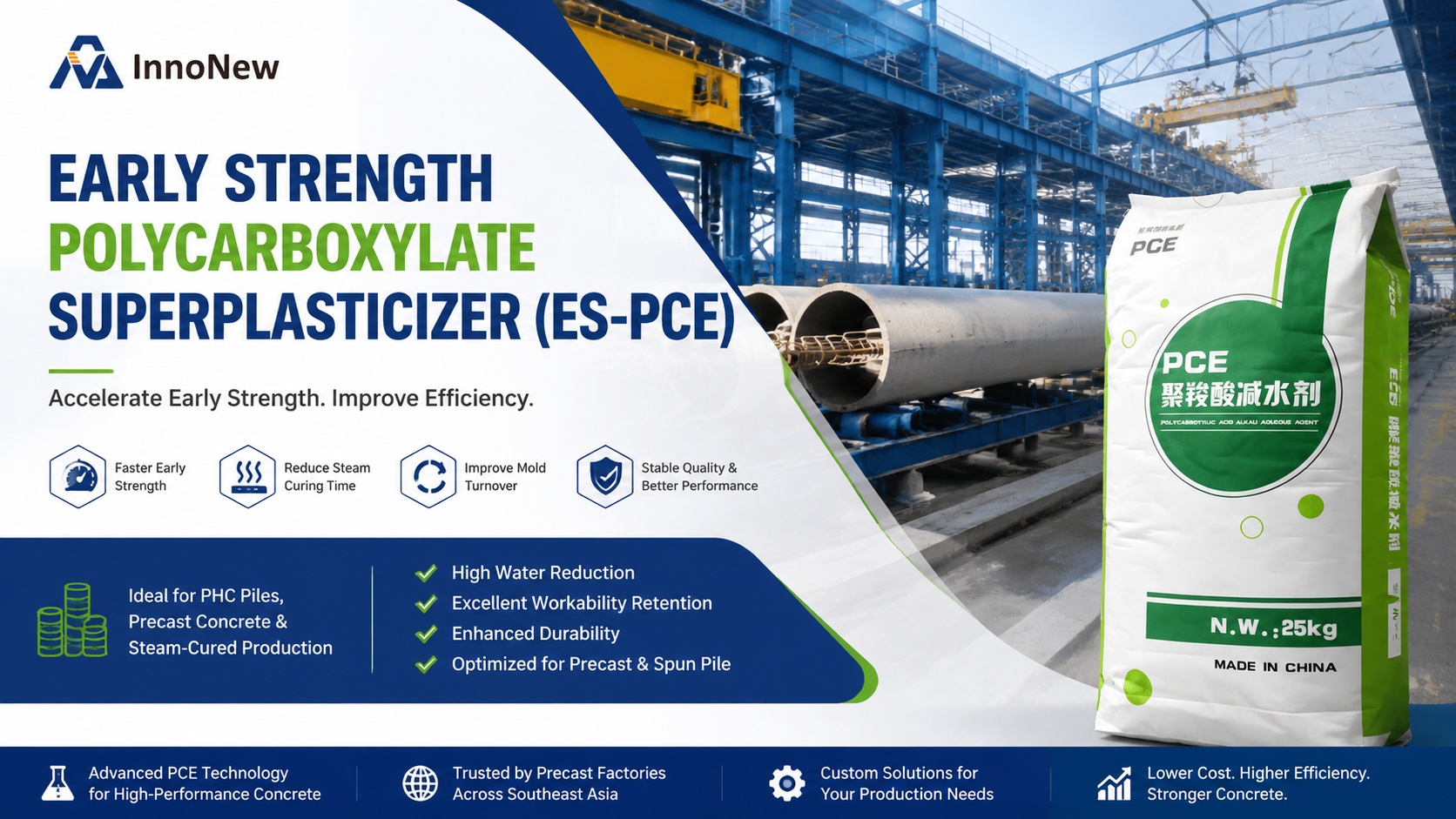
Concrete spun piles are widely used in bridges, ports, highways, industrial foundations, and large-scale infrastructure projects due to their high bearing capacity, excellent durability, and efficient industrialized production process.
However, modern centrifugal concrete pile manufacturing faces increasingly complex challenges:
- Severe segregation during high-speed spinning
- Slow early strength development
- High steam curing energy consumption
- Rapid slump loss in hot workshops
- Poor compatibility with machine-made sand
- Durability reduction after steam curing
For many manufacturers, conventional polycarboxylate superplasticizers (PCEs) can no longer meet the technical requirements of modern spun pile production.
As a professional Concrete Admixture manufacturer, Hebei InnoNew Material Technology Co., Ltd. provides specialized high-performance Polycarboxylate PCE Superplasticizer solutions designed specifically for centrifugal concrete pile production systems.
Our customized admixture technology helps pile manufacturers:
- Reduce segregation and bleeding
- Improve spinning stability
- Accelerate demolding
- Lower steam curing cost
- Improve machine-made sand adaptability
- Enhance long-term durability
- Increase overall production efficiency
Why Concrete Spun Pile Production Requires Specialized PCE Technology
Concrete spun pile manufacturing is fundamentally different from ordinary ready-mix concrete applications.
The process combines:
- Low water-binder ratios
- High-speed centrifugal force
- Dense reinforcement cages
- Rapid strength development requirements
- Steam or autoclave curing systems
- Strict dimensional accuracy standards
Under centrifugal spinning conditions, concrete experiences strong radial acceleration.
Due to density differences inside the mixture:
- Coarse aggregates move outward
- Free water and cement slurry migrate inward
- Particle packing stability decreases
- Internal stress concentration increases
If the PCE system cannot maintain proper particle suspension and rheological stability, severe segregation and structural defects occur rapidly.
This is why ordinary superplasticizers often fail in pipe pile production lines.
Common Problems in Concrete Spun Pile Manufacturing
1. Segregation, Bleeding & Aggregate Settlement During Centrifugal Spinning
This is one of the most critical pain points in centrifugal concrete production.
During high-speed spinning:
- Cement paste separates from aggregates
- Bleeding increases rapidly
- Coarse aggregates sink outward
- Inner wall slurry accumulates excessively
As a result, manufacturers often face:
- Uneven pile wall thickness
- Honeycombing
- Rough inner surfaces
- Internal voids
- Poor structural consistency
- Increased rejection rates
Why Ordinary PCE Cannot Solve This Problem
Traditional PCE products are mainly designed for standard ready-mix flowability rather than centrifugal stability.
Many conventional water reducers:
- Provide excessive dispersion
- Lack particle suspension capability
- Lose rheological stability during spinning
- Cannot maintain cohesion under low water-binder systems
InnoNew Anti-Segregation PCE Technology for Spun Piles
Our specialized spun pile PCE systems are engineered with optimized molecular architecture for centrifugal concrete applications.
The technology combines:
- Controlled dispersion
- Stable viscosity balance
- Low bleeding characteristics
- Enhanced aggregate suspension capability
- Strong rheological stability
This allows concrete to maintain both:
- High water reduction efficiency
- Excellent spinning stability
Key Benefits
- Reduced bleeding during spinning
- Improved aggregate distribution
- More uniform wall thickness
- Lower honeycomb defect rate
- Smoother pile surface quality
- More stable compressive strength
For centrifugal concrete production, stable rheology is often more important than simply achieving high initial slump.
2. Slow Early Strength, Delayed Demolding & High Steam Curing Cost
Many pipe pile factories still depend heavily on high-temperature steam or autoclave curing systems.
However, this creates major operational burdens:
- High electricity or fuel consumption
- Increased carbon emissions
- Long curing cycles
- Slow mold turnover
- Reduced production capacity
In many cases, conventional PCE systems cannot provide sufficient early hydration acceleration under low water-binder conditions.
As a result:
- 12–18 hour strength remains insufficient
- Demolding efficiency decreases
- Production scheduling becomes unstable
InnoNew High Early Strength PCE Solutions
Our high early strength PCE powder technology is specifically designed for precast and spun pile production systems requiring rapid strength development.
Compared with ordinary superplasticizers, it provides:
- Faster cement hydration activation
- Higher early compressive strength
- Improved low-temperature curing efficiency
- Reduced steam curing dependence
Typical Performance Advantages
Depending on local cement systems and curing conditions, manufacturers may achieve:
- Faster demolding cycles
- Earlier mold turnover
- Reduced steam curing intensity
- Improved production efficiency
- Lower overall energy cost
In optimized systems, workable demolding strength can often be achieved within 12–18 hours under controlled curing conditions.
This is highly valuable for high-capacity pile factories seeking faster production turnover.
3. Rapid Slump Loss & Poor Workability in High-Temperature Workshops
Concrete spun pile plants frequently operate under high-temperature production environments, especially in Southeast Asia, the Middle East, and tropical regions.
Additional process delays between batching and spinning further increase workability instability.
Common problems include:
- Rapid slump loss
- Increased viscosity over time
- Difficult mold filling
- Poor concrete distribution during spinning
- Reduced production consistency
Low Slump Loss PCE Technology for Long Workability Retention
InnoNew low-slump-loss PCE systems are designed to maintain stable rheology throughout the production cycle.
The technology provides:
- Stable slump retention
- Excellent flowability over time
- Improved pumping performance
- Better casting consistency
Typical Benefits
- Reduced operator adjustments
- Improved production stability
- More uniform pile quality
- Lower defective product risk
Under tropical production conditions, workable slump retention can often remain stable for 60–120 minutes depending on the mix design system.
4. Poor Compatibility with Machine-Made Sand & High-Mud Aggregates
Many pile manufacturers increasingly rely on local machine-made sand to reduce raw material cost.
However, these aggregates often contain:
- High clay content
- Excessive stone powder
- Unstable fine particle distribution
Ordinary PCE molecules are easily adsorbed by clay minerals, causing:
- Severe slump collapse
- Increased admixture dosage
- Poor fluidity stability
- Inconsistent strength performance
Anti-Mud PCE Solutions for Difficult Aggregate Systems
InnoNew anti-mud PCE technology is specifically optimized for local aggregate adaptability.
Our molecular design improves resistance to:
- Clay adsorption
- Fine powder interference
- Variable aggregate quality
Advantages for Pipe Pile Factories
- Better compatibility with machine-made sand
- More stable fluidity performance
- Lower dosage fluctuation
- Improved batch consistency
- Reduced sensitivity to raw material variation
This is especially important in regions where natural river sand resources are limited.
5. Durability Reduction, Shrinkage Cracking & Long-Term Strength Loss
Excessive steam curing and unstable internal concrete structure can lead to:
- Internal microcracks
- Increased shrinkage stress
- Reduced later-age strength growth
- Poor impermeability
- Lower freeze-thaw durability
For infrastructure projects with long service-life requirements, durability performance is critical.
Low Shrinkage & Durable Concrete Performance
InnoNew specialized PCE systems help optimize concrete microstructure through:
- Lower water demand
- Improved particle packing
- Better cement dispersion
- Reduced pore connectivity
Long-Term Performance Benefits
- Improved crack resistance
- Better later-age strength development
- Enhanced impermeability
- Improved durability stability
- Longer service life potential
This helps manufacturers produce higher-performance spun piles suitable for demanding infrastructure environments.
Comparison: Ordinary PCE vs Specialized Spun Pile PCE
| Performance Item | Ordinary PCE | InnoNew Spun Pile PCE |
|---|---|---|
| Anti-segregation ability | Weak | Excellent |
| Early strength development | Moderate | High |
| Demolding efficiency | Slow | Fast |
| Steam curing dependence | High | Reduced |
| Slump retention | Limited | Stable |
| Machine-made sand adaptability | Poor | Strong |
| Production stability | Unstable | Consistent |
| Durability performance | Standard | Improved |
Typical Challenges in Spun Pile Concrete Mix Design
| Component | Common Problem |
|---|---|
| Cement | Rapid hydration fluctuation |
| Machine-made sand | High clay adsorption |
| Crushed stone | Poor grading stability |
| Water reducer | Slump collapse |
| Steam curing | Shrinkage cracking |
| Low water-binder ratio | Poor workability |
A specialized PCE system must balance:
- Water reduction
- Cohesion
- Slump retention
- Early strength
- Aggregate adaptability
- Durability performance
This is why customized admixture design is essential for modern spun pile production.
Recommended InnoNew Solutions for Concrete Spun Pile Production
Recommended internal links can naturally point to:
- high early strength PCE powder
- polycarboxylate superplasticizer category
- anti-mud PCE products
- low slump loss PCE solutions
- precast concrete admixture applications
Suggested anchor text:
- high early strength PCE powder
- anti-segregation superplasticizer
- spun pile concrete admixture
- low slump loss PCE solution
- machine-made sand compatible PCE
Frequently Asked Questions (FAQ)
What causes segregation in concrete spun pile production?
Segregation is mainly caused by density differences under high-speed centrifugal force. Coarse aggregates move outward while water and cement slurry migrate inward, resulting in non-uniform concrete structure.
Why does ordinary PCE fail in centrifugal concrete applications?
Most conventional PCE products are designed for standard ready-mix concrete rather than high-speed spinning environments. They often lack sufficient anti-segregation and rheological stability.
How can pile factories reduce steam curing energy consumption?
By improving early strength development through specialized high early strength PCE systems, manufacturers can reduce curing intensity and accelerate demolding efficiency.
Why is machine-made sand difficult for ordinary superplasticizers?
Machine-made sand often contains clay and excessive fine particles that adsorb conventional PCE molecules, reducing fluidity and workability stability.
What is the benefit of low slump loss PCE in spun pile production?
Stable slump retention helps maintain consistent workability between batching and centrifugal spinning, especially in high-temperature workshops.
Why is durability important for concrete pipe piles?
Concrete piles are frequently exposed to underground moisture, chloride environments, and long-term structural loading. Poor durability can reduce service life and increase cracking risk.
What properties should a spun pile PCE have?
An ideal spun pile PCE should provide:
- High water reduction
- Anti-segregation capability
- Fast early strength
- Stable slump retention
- Anti-mud adaptability
- Low shrinkage performance
Conclusion
Modern concrete spun pile production requires far more than standard water reduction performance.
Manufacturers need specialized admixture systems capable of balancing:
- Spinning stability
- Early strength development
- Workability retention
- Aggregate adaptability
- Energy efficiency
- Long-term durability
Hebei InnoNew Material provides customized PCE solutions specifically engineered for centrifugal concrete pile manufacturing.
Our advanced high early strength PCE technology combines:
- Low viscosity
- Anti-mud adaptability
- High water reduction
- Excellent slump retention
- Fast demolding performance
- Low shrinkage characteristics
The result is a more stable, efficient, and cost-effective spun pile production process.
For modern concrete spun pile manufacturers, admixture selection is no longer only about water reduction performance.
It is about balancing:
- centrifugal stability
- early strength development
- energy efficiency
- aggregate adaptability
- long-term durability
- production consistency
Hebei InnoNew Material Technology Co., Ltd. continues to work closely with global precast and pipe pile producers to develop customized PCE solutions tailored to local raw materials, curing systems, and production processes.
Through formulation optimization and application-focused technical support, we help manufacturers improve operational efficiency, reduce production risk, and achieve more stable concrete performance in demanding centrifugal pile applications.