
PAC vs CMC in Drilling Fluid: Key Differences, Applications & Performance Guide
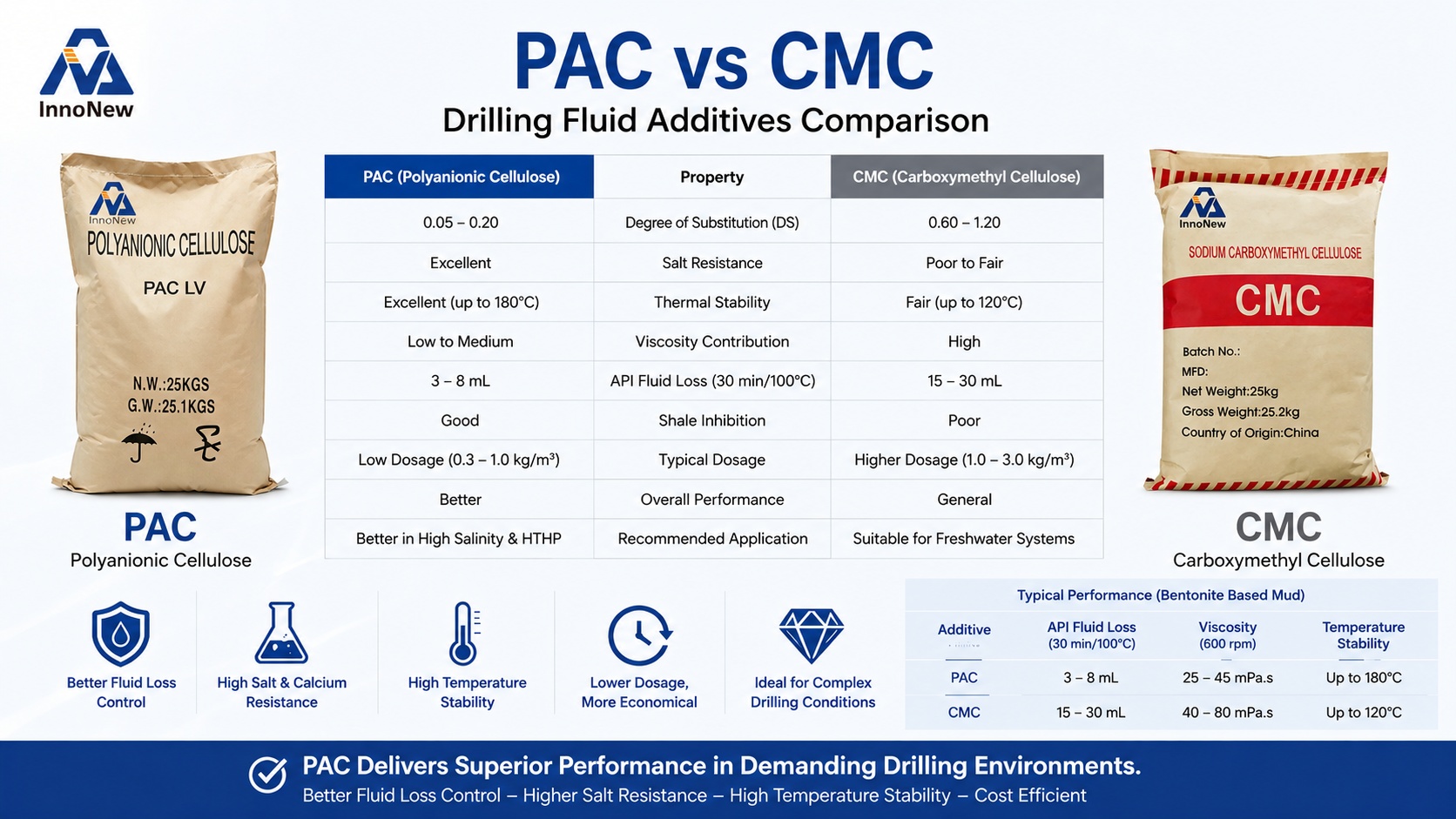
PAC vs CMC: Which One is Better for Oil Drilling?
In modern drilling fluid systems, selecting the correct filtration control polymer directly affects:
- Wellbore stability
- Drilling efficiency
- ROP (Rate of Penetration)
- Mud rheology
- Formation protection
- Operational cost
- Non-productive time (NPT)
Among all cellulose-based drilling fluid additives, PAC (Polyanionic Cellulose) and CMC (Carboxymethyl Cellulose) are the two most commonly used polymers.
However, many drilling contractors still misunderstand the performance gap between PAC and conventional CMC.
Although both products are cellulose derivatives, their molecular structure, substitution degree, salt tolerance, thermal stability, and drilling performance are significantly different.
In modern high-performance water-based mud systems, PAC is generally considered the premium drilling fluid polymer due to its superior:
- API fluid loss reduction
- High temperature stability
- Salt resistance
- Shale inhibition support
- Rheology stability
- Borehole stabilization capability
This technical guide explains the real drilling-fluid performance differences between PAC and CMC using:
- Laboratory parameters
- API drilling standards
- Field application logic
- Mud system recommendations
- Real drilling case studies
- Cost-performance analysis
Chemical Structure Difference Between PAC and CMC
PAC Molecular Characteristics
PAC is a highly modified polyanionic cellulose polymer with:
- Higher Degree of Substitution (DS)
- Better molecular uniformity
- Stronger hydration capability
- Higher purity cellulose backbone
- Better anionic charge distribution
Typical PAC characteristics:
| Property | PAC Typical Value |
|---|---|
| Degree of Substitution (DS) | 0.90 – 1.20 |
| Purity | ≥ 95% |
| Moisture | ≤ 10% |
| pH Value | 6.5 – 8.5 |
| API Filtrate Reduction | Excellent |
The higher substitution degree gives PAC stronger hydration and superior filtration control under demanding drilling conditions.
CMC Molecular Characteristics
CMC is also a cellulose ether polymer, but typically has:
- Lower substitution degree
- Lower polymer uniformity
- Weaker salt resistance
- Lower thermal resistance
- Reduced polymer stability
Typical industrial drilling-grade CMC:
| Property | CMC Typical Value |
|---|---|
| Degree of Substitution (DS) | 0.65 – 0.90 |
| Purity | 55% – 85% |
| Moisture | ≤ 12% |
| Salt Resistance | Moderate |
| Thermal Stability | Moderate |
Because of its lower molecular stability, CMC performance often decreases rapidly in high salinity and high temperature drilling systems.
PAC vs CMC Technical Performance Comparison
Comprehensive Performance Table
| Technical Property | PAC LV | PAC HV | CMC LV | CMC HV |
|---|---|---|---|---|
| Apparent Viscosity (2% Solution) | ≤ 40 mPa.s | ≥ 50 mPa.s | 20–40 mPa.s | 50-80 mPa.s |
| API Fluid Loss | ≤ 16 mL | ≤ 20 mL | 20–35 mL | 25–40 mL |
| Salt Resistance | Excellent | Excellent | Moderate | Moderate |
| Temperature Resistance | Up to 180°C | Up to 180°C | Usually <120°C | Usually <120°C |
| Suspension Stability | Excellent | Excellent | Medium | Medium |
| Borehole Stability | Excellent | Excellent | Moderate | Moderate |
| Polymer Stability | High | High | Medium | Medium |
| Offshore Drilling Suitability | Excellent | Excellent | Limited | Limited |
| Deep Well Suitability | Excellent | Excellent | Limited | Limited |
API Fluid Loss Comparison
One of the most critical indicators in drilling fluid performance is API filtration control.
Typical API Fluid Loss Results
Under standard API testing conditions:
| Additive | Dosage | API Fluid Loss |
|---|---|---|
| PAC LV | 1.0% | 8–15 mL |
| PAC HV | 1.0% | 10–18 mL |
| CMC LV | 1.0% | 18–30 mL |
| CMC HV | 1.0% | 20–35 mL |
PAC typically reduces filtrate invasion by 30–60% more effectively than conventional CMC.
This directly improves:
- Formation protection
- Wellbore stability
- Differential sticking prevention
- Mud cake quality
- Drilling efficiency
PAC vs CMC Under High Salinity Conditions
Salt contamination is one of the biggest challenges in water-based drilling fluids.
In saturated brine systems or seawater drilling:
- CMC molecules tend to collapse
- Viscosity decreases rapidly
- Filtration performance deteriorates
- Polymer hydration weakens
PAC performs significantly better because of its stronger anionic structure.
Salt Resistance Comparison
| Condition | PAC Performance | CMC Performance |
|---|---|---|
| Fresh Water Mud | Excellent | Good |
| Seawater Mud | Excellent | Moderate |
| Saturated Salt Mud | Good | Poor |
| High Calcium Environment | Stable | Unstable |
This is why PAC is widely preferred in:
- Offshore drilling
- Marine drilling
- Salt formation drilling
- High-mineralization formations
PAC vs CMC Thermal Stability
Modern deep-well drilling frequently exceeds:
- 120°C
- 150°C
- 180°C bottom-hole temperature
Under these conditions, polymer degradation becomes critical.
PAC High Temperature Performance
High-quality PAC can maintain:
- Stable rheology
- Fluid loss control
- Polymer structure
- Suspension performance
under temperatures up to: 180°C
with proper mud system design.
CMC High Temperature Limitation
Conventional CMC often experiences:
- Chain degradation
- Viscosity loss
- Filtration increase
- Reduced suspension performance
above: 120°C
This makes CMC less suitable for:
- HPHT wells
- Deep drilling
- Ultra-deep drilling
- High geothermal environments
PAC vs CMC Cost Analysis
Many buyers initially choose CMC because of lower product cost.
However, real drilling economics depend on:
- Total mud maintenance cost
- Dilution requirement
- Polymer consumption
- Wellbore stability
- Drilling downtime
- Fluid replacement frequency
Actual Cost Performance Logic
| Factor | PAC | CMC |
|---|---|---|
| Initial Product Price | Higher | Lower |
| Dosage Efficiency | Better | Lower |
| Mud Stability | Excellent | Medium |
| Maintenance Frequency | Lower | Higher |
| Operational Risk | Lower | Higher |
| Total Drilling Cost | Often Lower | Often Higher |
In many modern drilling projects, PAC delivers lower total operational cost despite higher unit price.
Field Case Study: Offshore Drilling Project
Project Background
Location:
Middle East Offshore Drilling Project
Mud System:
Seawater-Based Mud System
Formation:
High salinity sandstone formation
Bottom Hole Temperature:
165°C
Initial Problem Using CMC
The drilling contractor initially used conventional CMC.
Problems encountered:
- Rapid viscosity reduction
- API fluid loss exceeded 32 mL
- Poor filter cake quality
- Borehole instability
- Increased torque and drag
- Frequent mud treatment adjustments
Solution: Replacement with PAC LV + PAC HV
The mud engineer replaced the system with:
- PAC LV for fluid loss control
- PAC HV for rheology enhancement
Dosage:
- PAC LV: 1.2%
- PAC HV: 0.5%
Final Results
| Parameter | Before (CMC) | After (PAC) |
|---|---|---|
| API Fluid Loss | 32 mL | 11 mL |
| Apparent Viscosity | Unstable | Stable |
| Borehole Stability | Poor | Excellent |
| Mud Maintenance Frequency | High | Reduced |
| Drilling Efficiency | Medium | Improved |
| Non-productive Time | Increased | Reduced |
The operator achieved:
- Improved drilling stability
- Lower mud maintenance cost
- Reduced downtime
- Better drilling efficiency
PAC LV vs PAC HV Detailed Comparison
PAC LV (Low Viscosity)
PAC LV is mainly designed for:
- API fluid loss control
- Minimal rheology increase
- High-density drilling mud
- Completion fluid systems
Typical parameters:
| Property | PAC LV |
|---|---|
| Viscosity | Low |
| API Fluid Loss | Very Low |
| Rheology Impact | Minimal |
| Main Function | Filtration control |
Recommended applications:
- Deep wells
- Completion fluids
- High-density mud systems
- Low solids mud
PAC HV (High Viscosity)
PAC HV is designed for:
- Viscosity building
- Hole cleaning
- Cuttings transport
- Suspension enhancement
Typical parameters:
| Property | PAC HV |
|---|---|
| Viscosity | High |
| Suspension Performance | Excellent |
| Carrying Capacity | Strong |
| Main Function | Rheology enhancement |
Recommended applications:
- HDD drilling
- Large hole sections
- Poor hole cleaning conditions
- Extended reach drilling
PAC Applications in Advanced Drilling Systems
Offshore Drilling
PAC is highly suitable for offshore drilling because of:
- Excellent seawater compatibility
- Salt resistance
- Stable filtration control
- Better borehole integrity
HDD Drilling
In Horizontal Directional Drilling (HDD), PAC improves:
- Borehole lubrication
- Hole stability
- Suspension capacity
- Cuttings transport
HPHT Drilling
For high-pressure high-temperature wells:
PAC provides:
- Better polymer stability
- Reduced fluid loss
- Improved rheology retention
- Lower drilling risk
PAC vs CMC: Which One Should You Choose?
Choose PAC If:
- Drilling conditions are complex
- High temperature exists
- Salinity is high
- Offshore drilling is involved
- Deep well stability is critical
- Premium mud performance is required
Choose CMC If:
- Drilling environment is mild
- Cost is the main priority
- Wells are shallow
- Mud system requirements are simple
FAQ
Is PAC better than CMC?
In most modern drilling applications, yes. PAC provides significantly better fluid loss control, salt resistance, and thermal stability.
Why is PAC more expensive than CMC?
PAC has:
- Higher purity
- Better molecular stability
- More advanced production requirements
- Stronger drilling performance
However, PAC often reduces total drilling cost due to better operational efficiency.
Can PAC replace CMC completely?
In premium drilling systems, PAC can completely replace CMC. However, CMC is still widely used in low-cost conventional drilling operations.
Which is better for offshore drilling?
PAC is strongly recommended for offshore drilling because of its superior seawater and salt resistance.
What is the best dosage for PAC?
Typical PAC dosage:
- PAC LV: 0.5% – 1.5%
- PAC HV: 0.2% – 1.0%
Actual dosage depends on:
- Mud density
- Formation condition
- Temperature
- Salinity
- Desired rheology
Why Choose InnoNew PAC?
InnoNew supplies high-performance drilling-grade PAC products for demanding oilfield applications.
Advantages include:
- Stable industrial production
- Excellent API fluid loss reduction
- Strong salt resistance
- Reliable high-temperature performance
- Consistent rheology control
- Professional drilling application support
Applications include:
- Oil drilling
- Gas drilling
- HDD drilling
- Offshore drilling
- Water well drilling
- Industrial drilling fluids
Conclusion
Although PAC and CMC are both cellulose-based drilling fluid additives, their real-world drilling performance differs significantly.
PAC delivers superior:
- Filtration control
- High-temperature stability
- Salt resistance
- Borehole stabilization
- Rheology retention
- Operational efficiency
For modern high-performance water-based mud systems, PAC has become the preferred drilling fluid polymer in offshore drilling, deep wells, HPHT environments, and complex formations.
As drilling technology advances and operating environments become more challenging, premium PAC products continue to replace conventional CMC in advanced drilling applications.
Both PAC and CMC are important drilling fluid additives, but PAC offers significantly better performance in modern drilling environments.
For operators seeking:
- Better wellbore stability
- Lower fluid loss
- Improved drilling efficiency
- High salinity resistance
- Stable high-temperature performance
PAC is generally the preferred drilling fluid additive.
As drilling conditions become increasingly complex, high-performance PAC products continue to play a critical role in advanced water-based mud systems.