
Dry Mix Mortar Additives – Technical Performance System Guide
Dry mix mortar is a pre-engineered powder system composed of cementitious binders, graded aggregates, and functional chemical additives. Compared with site-mixed mortar, its core advantage lies in formulation precision, performance stability, and industrial reproducibility.
In modern construction chemistry, dry mix mortar performance is no longer determined only by cement strength, but by a multi-component additive system that governs rheology, hydration kinetics, adhesion formation, and long-term durability.
Without properly designed additives, dry mix mortar typically exhibits:
- Premature water loss → incomplete cement hydration
- Poor workability → high application resistance
- Sagging on vertical surfaces
- Weak bonding strength and interfacial failure
- Shrinkage cracking and durability loss
Therefore, performance additives are not optional modifiers—they are functional control systems of mortar engineering.
Functional Additive System Architecture
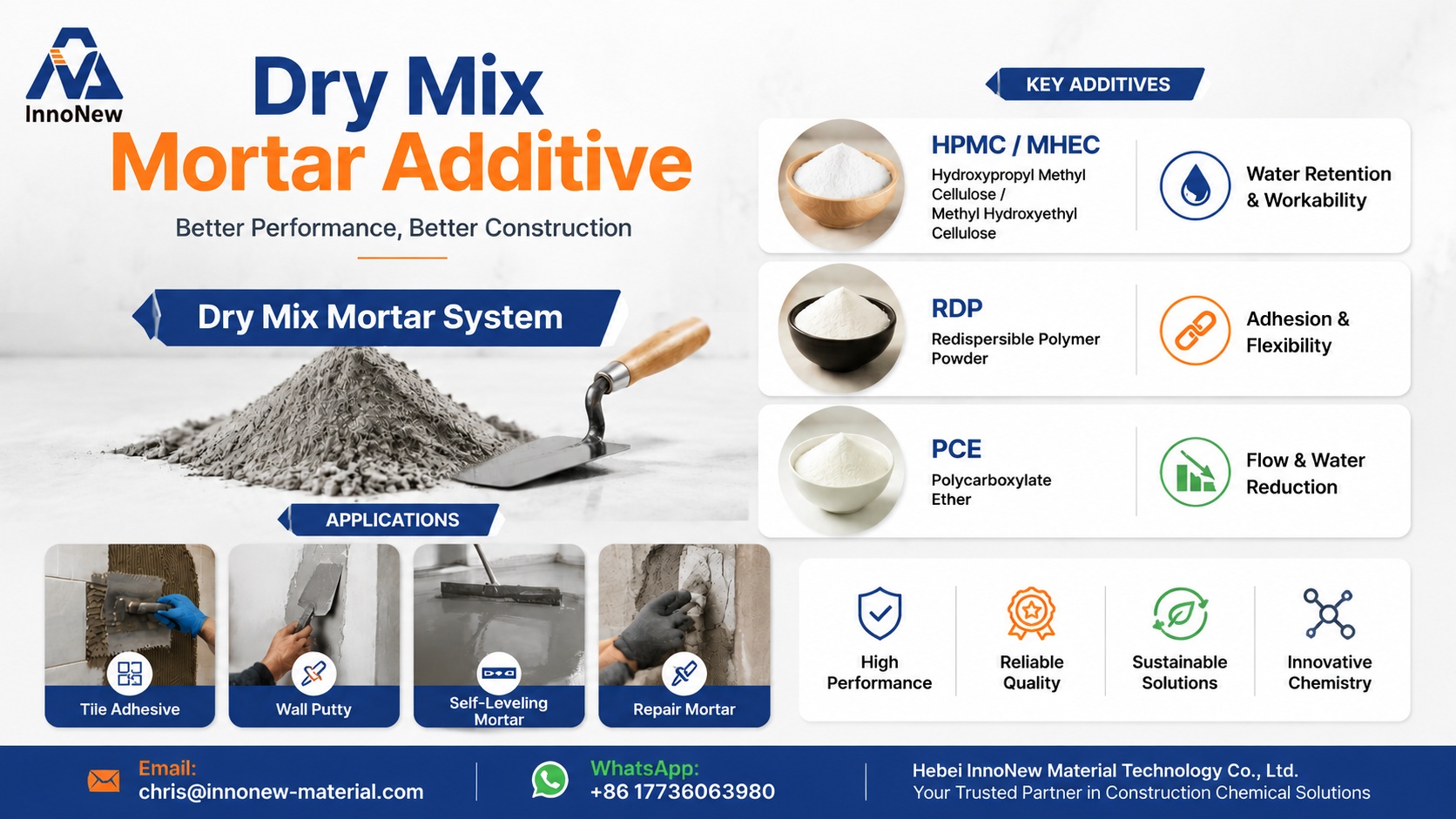
Modern dry mix mortar systems rely on a synergistic combination of four major additive families:
- Cellulose Ether System (HPMC / MHEC / HEC)
- Starch Ether System (HPS)
- Polymer Binder System (RDP / VAE powder)
- Superplasticizer System (PCE Powder)
Each system controls a different stage of mortar behavior:
| System | Primary Function | Controlled Performance Stage |
|---|---|---|
| Cellulose Ether (HPMC/MHEC) | Water retention, viscosity, open time | Fresh state / workability |
| Starch Ether (HPS) | Anti-sag, rheology stability | Application stage |
| RDP Polymer | Adhesion, flexibility, durability | Hardened state |
| PCE Superplasticizer powder | Water reduction, dispersion | Mixing & hydration |
This structure defines a full lifecycle performance control model for dry mix mortar.
Top 3 Essential Additives
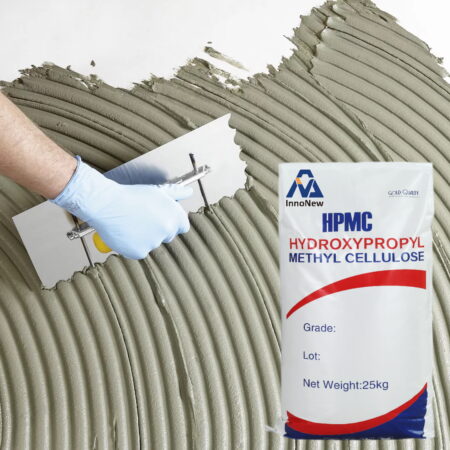
1. Cellulose Ether (HPMC / MHEC) – Water Retention & Rheology Core
Cellulose ether is the primary functional backbone in dry mix mortar systems.
Functional Mechanism
Hydroxypropyl Methyl Cellulose (HPMC) forms a three-dimensional hydrated polymer network in water, increasing viscosity and controlling water mobility. This reduces capillary water loss into porous substrates.
Engineering Functions
- High-efficiency water retention (≥96–99%)
- Controlled cement hydration rate
- Extended open time for application
- Improved troweling and spreadability
- Anti-sag resistance for vertical applications
Technical Significance
Water retention is not simply moisture control—it directly determines:
- Cement hydration completeness
- Interfacial bond formation
- Microstructure density
- Final compressive strength
Insufficient cellulose ether dosage leads to hydration interruption and weak interfacial bonding failure.
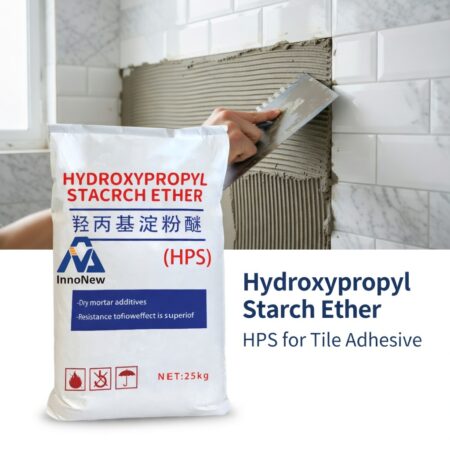
2.Starch Ether (HPS) – Rheology Stabilization & Anti-Sag System
HPS (Hydroxypropyl Starch Ether) functions as a rheological modifier and structural stabilizer.
Mechanism of Action
HPS enhances thixotropy, meaning the material behaves as:
- High viscosity at rest (prevents sagging)
- Lower viscosity under shear (easy application)
Engineering Benefits
- Anti-slip performance on vertical surfaces
- Improved trowel feel and application smoothness
- Reduced deformation under gravity load
- Synergistic viscosity balance with HPMC
- Partial substitution to optimize cost-performance ratio
System Role
HPS does not replace cellulose ether; it refines rheological response behavior, especially in tile adhesives and wall systems.
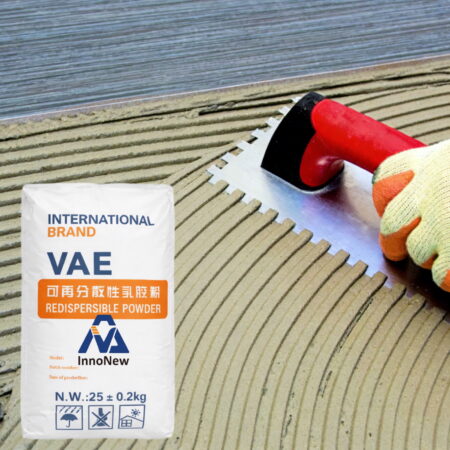
3.Redispersible Polymer Powder (RDP / VAE) – Adhesion & Flexibility Matrix
RDP is a polymer binder system that activates during hydration.
Formation Mechanism
When water is added:
- RDP particles redisperse into latex emulsion
- Polymer film forms during curing
- Continuous flexible network is created inside cement matrix
Engineering Functions
- Strong adhesion to inorganic substrates (tile, concrete, gypsum)
- Flexural strength improvement
- Crack bridging and stress dispersion
- Water resistance enhancement
- Freeze-thaw durability improvement
Structural Role
RDP transforms brittle cement matrix into a:
“cement + polymer composite material system”
This is the key reason modern tile adhesives outperform traditional mortar systems.
4. Polycarboxylate Ether (PCE Powder) – Dispersion & Water Reduction System
PCE is the high-efficiency dispersion and water reduction core in modern dry-mix systems.
Molecular Mechanism
PCE molecules provide:
- Electrostatic repulsion
- Steric hindrance effect
This disperses cement particles and prevents flocculation.
Performance Contributions
- Water reduction: 25–40%
- Improved flowability and leveling
- Increased early and final strength
- Reduced porosity and capillary voids
- Enhanced pumpability in self-leveling systems
Engineering Importance
PCE allows:
Lower water-cement ratio without sacrificing workability
This is essential for high-performance mortar systems such as:
- Self-leveling compounds
- Repair mortars
- High-strength tile adhesives
Synergistic Additive Interaction System
Modern dry mix mortar performance is not additive-based, but interaction-based.
Key Synergy Model:
- HPMC + HPS → Rheology balance (stability + workability)
- HPMC + RDP → Water retention + adhesion synergy
- RDP + PCE → Strength + dispersion optimization
- PCE + HPMC → Workability under low water ratio system
System Engineering Concept:
Each additive compensates for a different physical limitation of cement hydration systems:
- HPMC → Controls water movement
- HPS → Controls deformation
- RDP → Controls bonding failure
- PCE → Controls particle dispersion
Advanced Additive System
✔ Ideal formulation:
- HPMC: 0.2–0.5%
- HPS: 0.02–0.1%
- RDP: 1–5%
- PCE: 0.2-0.3%
Application-Specific Optimization
Tile Adhesive System
- High adhesion + anti-slip + open time stability
- Key: HPMC + RDP + HPS + PCE balance
Wall Putty System
- Smooth finish + crack resistance
- Key: HPMC + RDP synergy
Self-Leveling Mortar
- High flow + low water ratio
- Key: PCE + HPMC system
Repair Mortar
-
- High bonding + durability
- Key: RDP + PCE + HPMC
Conclusion
Dry mix mortar is a multi-phase engineered material system, where performance is controlled by chemical additives rather than raw cement alone.
The modern formulation philosophy is:
“Rheology is controlled by cellulose ether, structure by starch ether, durability by polymer powder, and efficiency by superplasticizer.”
A properly designed additive system ensures:
- Stable construction performance
- Predictable field behavior
- Long-term mechanical durability
- Industrial batch consistency
This is the foundation of modern dry mix mortar engineering.
FAQ:
HPMC mainly provides water retention and workability, while HPS focuses on anti-sagging and thixotropy to improve construction performance.
RDP improves flexibility, bond strength and crack resistance, reducing mortar brittleness and shrinkage.
Excessive HPMC may slow down curing, increase viscosity excessively and affect final strength development.
HPS is recommended for vertical mortars to enhance anti-sagging, anti-dripping and troweling performance.
Use HPMC for water retention, HPS for anti-sag, and RDP for adhesion; adjust ratios based on application requirements.
Contact Us
Hebei InnoNew Material Technology Co., Ltd. delivers premium PCE, HPMC, HPS & RDP additives tailored for dry mix mortar—solving sagging, boosting water retention, adhesion & durability, with third-party tested quality & global supplyHebei InnoNew Material Technology Co., Ltd..
Get your custom formulation & free sample today →
Contact us: chris@innonew-material.com | WhatsApp: +86 17736063980