
High-Performance Mortar Protective Layer for EPS Decorative Lines: HPMC and RDP Synergistic Application
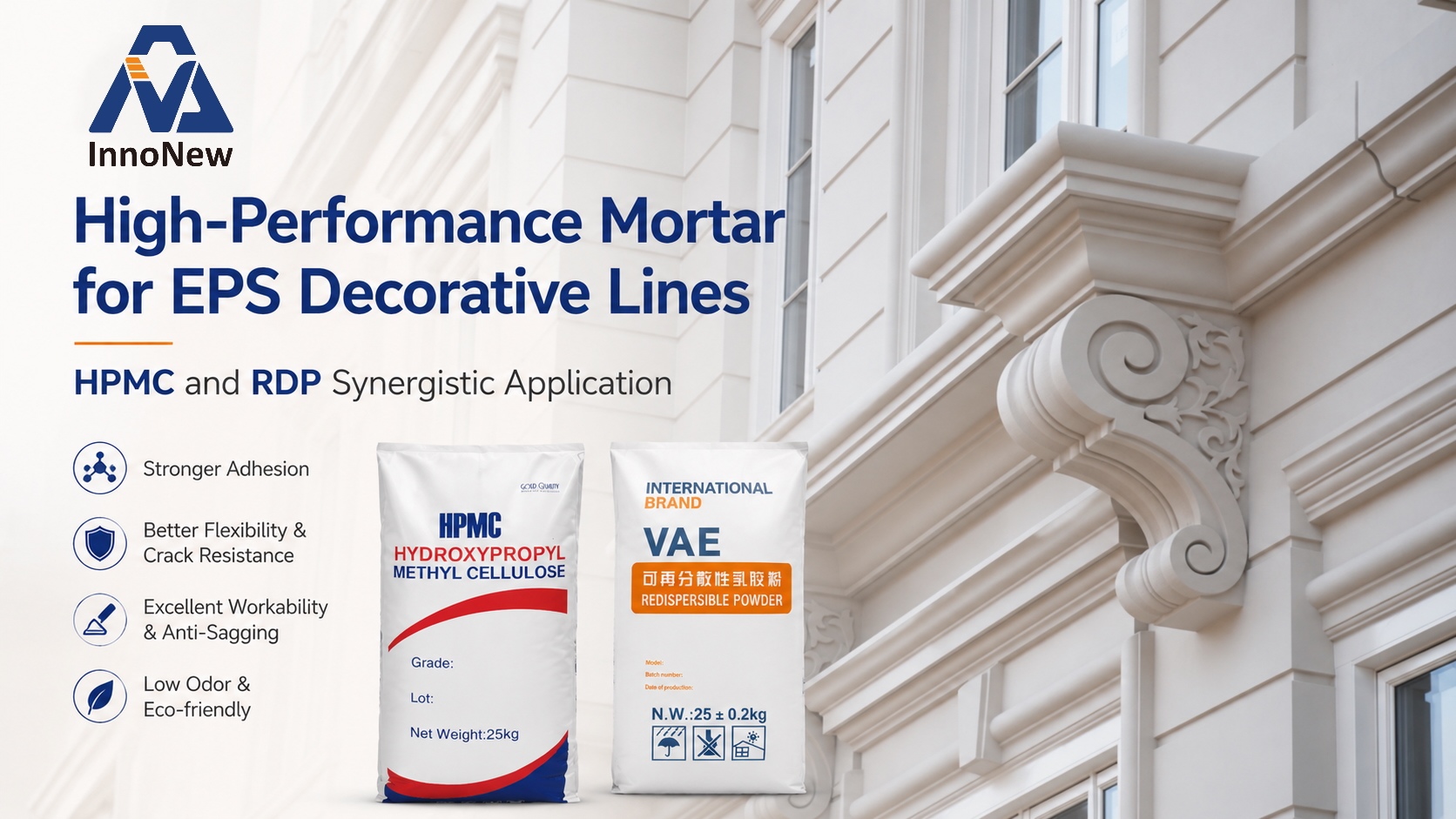
EPS decorative lines are widely used for exterior architectural decoration, including cornices, window surrounds, columns, arches, and other customized profiles. Their lightweight structure and design flexibility make EPS an attractive alternative to traditional heavy decorative materials.
However, the EPS substrate itself requires a properly engineered protective layer to achieve adequate surface strength, adhesion, flexibility, crack resistance, and weather durability.
For cementitious protective mortar, the combination of Hydroxypropyl Methylcellulose (HPMC) and Redispersible Polymer Powder (RDP) can provide an effective balance between fresh-mortar workability and hardened-mortar performance.
1. Why HPMC and RDP Are Important for EPS Decorative Mortar
EPS is lightweight and relatively deformable compared with rigid mineral substrates. A mortar that is too rigid can therefore develop cracks or lose adhesion when the EPS profile experiences thermal or mechanical movement.
The formulation should balance:
Adhesion + Flexibility + Crack Resistance + Workability + Surface Strength
HPMC and RDP contribute to different parts of this system.
| Material | Main Function in EPS Mortar |
|---|---|
| HPMC | Water retention, rheology, workability, anti-sagging |
| RDP | Adhesion, flexibility, cohesion, crack resistance |
| Cement | Primary hydraulic binder |
| Quartz sand | Structural skeleton |
| Mineral filler | Particle packing and surface finish |
| PP fiber | Microcrack control |
In simple terms:
HPMC controls how the mortar behaves during application, while RDP helps modify the mortar after curing.
2. Recommended Starting Formulation
The following is a practical starting point for laboratory development of EPS decorative-line protective mortar.
EPS Protective Mortar Formulation
| Raw Material | Recommended Dosage |
|---|---|
| Portland cement | 34–36% |
| Quartz sand | 40–45% |
| Fine mineral filler | 18–21% |
| RDP | 1.5–2.5% |
| HPMC | 0.20–0.30% |
| PP fiber | 0.05–0.15% |
| Hydrophobic additive | 0.10–0.20% |
| Defoamer & minor additives | Balance |
Recommended Starting Point
For a first laboratory trial:
HPMC: 0.25%
RDP: 2.0%
For a 1,000 kg dry-mix batch, this corresponds approximately to:
- HPMC: 2.5 kg
- RDP: 20 kg
The actual formulation should be adjusted according to cement type, aggregate grading, EPS surface, coating thickness, water demand, and the selected HPMC/RDP grades.
3. How to Optimize HPMC
A practical development range for HPMC is approximately:
0.20–0.30%
HPMC helps improve:
- Water retention
- Trowelability
- Consistency
- Vertical application
- Sag resistance
- Open time
- Surface finishing
However, higher HPMC dosage does not necessarily mean better performance.
Excessive HPMC may cause excessive viscosity, stickiness, air entrainment, and reduced spreading efficiency.
Therefore, HPMC should be selected based on actual mortar performance, rather than viscosity alone.
4. How to Optimize RDP
For EPS protective mortar, an initial RDP range of:
1.5–2.5%
is suitable for formulation screening.
RDP can improve:
- Adhesion to the substrate
- Flexibility
- Cohesion
- Crack resistance
- Impact resistance
- Durability
A higher RDP dosage should only be used when the performance requirement justifies the additional polymer content and cost.
The polymer type is also important. A flexible RDP and a relatively rigid RDP can produce significantly different mortar behavior even at the same dosage.
5. Thailand EPS Manufacturer Application Case
Customer Profile
A Thailand-based EPS Design & Manufacturer producing architectural EPS decorative profiles approached us for technical support in improving its protective mortar system.
The customer’s products included decorative EPS profiles designed for exterior architectural applications.
The main formulation challenges were:
- Improving mortar workability
- Maintaining good adhesion to the EPS system
- Reducing surface cracking
- Improving consistency during vertical application
- Achieving a better balance between surface hardness and flexibility
These requirements are consistent with the broader technical demands of EPS decorative products in Thailand, where manufacturers use reinforced and polymer/mineral surface systems for exterior decorative applications.
Our Technical Approach
Instead of simply increasing the cement or polymer dosage, we optimized the complete formulation.
The main variables were:
HPMC → fresh-mortar rheology
RDP → polymer modification and adhesion
Aggregate → packing and mechanical structure
Water → workability and shrinkage control
A representative starting formulation used approximately:
- HPMC: 2.5 kg/t
- RDP: 20 kg/t
The customer then conducted application trials on its EPS decorative profiles.
Result
The optimized formulation provided a more balanced mortar system with:
- More stable application consistency
- Improved vertical workability
- Better substrate adhesion
- Improved flexibility
- Better resistance to surface cracking
The key lesson from the project was that HPMC and RDP should be optimized as part of the complete mortar formulation rather than treated as isolated additives.
Note: Customer-specific laboratory values and production data are not publicly disclosed. Numerical performance claims should only be published when supported by the customer’s actual test records.
6. Common Problems and Formulation Solutions
| Problem | Possible Cause | Optimization Direction |
|---|---|---|
| Mortar cracks | High shrinkage, low flexibility | Optimize RDP, water and aggregate |
| Mortar sags | Low viscosity or excessive water | Optimize HPMC and water |
| Poor EPS adhesion | Insufficient polymer modification | Evaluate RDP type and dosage |
| Mortar too sticky | Excessive HPMC | Reduce/replace HPMC grade |
| Surface too soft | Excessive flexible polymer | Adjust RDP type/dosage |
| Poor finishing | Poor particle grading | Optimize sand/filler distribution |
The important principle is:
Do not solve every problem by simply increasing additive dosage.
The cement, aggregate, polymer, cellulose ether, water and coating thickness must be considered together.
7. Recommended Quality-Control Tests
Before commercial production, the optimized mortar should be evaluated for:
- Workability
- Sag resistance
- Adhesion
- Flexural strength
- Compressive strength
- Crack resistance
- Water absorption
- Impact resistance
- Thermal cycling
- Freeze-thaw resistance where applicable
For exterior EPS decorative systems, the complete system should ideally be evaluated:
EPS substrate → protective mortar → finishing coat
rather than testing the mortar alone.
Conclusion
High-performance EPS decorative-line mortar requires more than high compressive strength.
The protective layer must provide a controlled balance of:
adhesion, flexibility, crack resistance, workability and surface durability.
HPMC and RDP provide complementary functions.
HPMC improves water retention, rheology, workability and sag resistance.
RDP improves polymer modification, adhesion, flexibility and crack resistance.
A practical starting point is:
HPMC: 0.20–0.30%
RDP: 1.5–2.5%
with 2.5 kg/t HPMC + 20 kg/t RDP as a useful initial laboratory combination.
The Thailand EPS manufacturer project demonstrates the value of a formulation-development approach: the goal is not simply to supply HPMC or RDP, but to help EPS manufacturers develop a more stable, durable and application-optimized protective mortar system.
FAQ:
1. What is the recommended HPMC dosage for EPS decorative mortar?
A practical starting range is 0.20–0.30%, or approximately 2.0–3.0 kg per ton of dry mortar. The optimum dosage depends on HPMC grade, cement, aggregate, water content and application requirements.
2. How much RDP is recommended for EPS protective mortar?
A typical development range is 1.5–2.5%, equivalent to approximately 15–25 kg per ton. The optimum dosage depends on the required adhesion, flexibility and crack resistance.
3. What does HPMC do in EPS mortar?
HPMC mainly improves water retention, rheology, workability, open time and sag resistance. It is particularly useful when mortar is applied to vertical or detailed EPS profiles.
4. What does RDP do in EPS mortar?
RDP provides polymer modification and can improve adhesion, flexibility, cohesion, crack resistance and impact resistance after curing.
5. Can HPMC and RDP be used together?
Yes. They are complementary. HPMC primarily improves the fresh mortar, while RDP contributes strongly to the hardened polymer-modified matrix.
6. Why does EPS decorative mortar crack?
Cracking can result from excessive cement content, excessive water, insufficient polymer modification, poor aggregate grading, excessive coating thickness, inadequate curing, or movement between the EPS substrate and mortar.
7. How can EPS manufacturers optimize protective mortar?
The most reliable approach is to optimize cement, aggregate, HPMC, RDP, water and reinforcement together, followed by laboratory and production trials. The final formulation should be validated under the actual climate and application conditions.