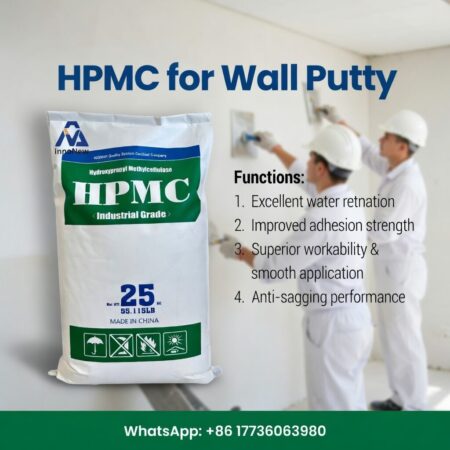
In modern dry mix construction materials, HPMC for wall putty has become an essential additive for achieving consistent performance, superior workability, and high-quality surface finishing. As a widely used hydroxypropyl methyl cellulose for wall putty, HPMC plays a multifunctional role in both cement-based and gypsum-based formulations.
As a leading HPMC manufacturer, Hebei InnoNew Material Technology Co., Ltd. specializes in producing industrial-grade, high-purity HPMC tailored for construction mortar and putty powder. In this complete guide, we break down the core mechanisms of how HPMC optimizes wall putty performance, key application benefits, dosage tips, and selection criteria to help manufacturers, contractors, and construction teams produce top-tier wall putty and deliver flawless wall finishes. Ordinary wall putty often suffers from premature drying, cracking, sagging, poor adhesion, and uneven finishing, directly affecting construction efficiency and long-term wall quality. Hydroxypropyl Methyl Cellulose (HPMC), a premium non-ionic cellulose ether additive, has become the core raw material for high-grade wall putty formulations. This guide provides a detailed technical explanation of how HPMC enhances wall putty performance and why it is indispensable in high-performance formulations.
1. Water Retention Mechanism of HPMC
One of the most important functions of HPMC for wall putty is its exceptional water retention capability.
HPMC forms a protective colloidal film within the mortar matrix, slowing down water evaporation. This ensures:
- Proper hydration of cement particles
- Reduced risk of shrinkage and cracking
- Improved mechanical strength development
Without adequate water retention, wall putty can dry too quickly, leading to poor bonding and surface defects. By incorporating hydroxypropyl methyl cellulose for wall putty, manufacturers can significantly improve curing conditions and final product quality.
2. Workability and Application Performance
Another critical advantage of HPMC in wall putty is its ability to enhance workability.
HPMC modifies the rheology of the mixture, resulting in:
- Smooth and creamy texture
- Improved spreadability
- Reduced application resistance
This is particularly important for large-scale construction projects where consistent application is required. The lubricating effect of HPMC allows workers to apply putty more efficiently, reducing labor costs and improving productivity.
3. Crack Resistance and Durability Enhancement
Cracking is one of the most common issues in wall putty applications. HPMC for wall putty helps mitigate this problem through moisture control and internal stress reduction.
Key benefits include:
- Uniform drying process
- Reduced internal tension
- Enhanced flexibility of the coating layer
By improving the overall structure of the hardened putty, hydroxypropyl methyl cellulose for wall putty contributes to long-term durability and stability.
4. Open Time Control and Application Flexibility
Open time refers to the duration during which the applied material remains workable. HPMC in wall putty significantly extends open time, providing:
- More time for leveling and finishing
- Reduced material waste
- Better surface uniformity
This feature is especially beneficial in hot or dry climates where rapid water loss can negatively impact performance.
5. Anti-Sagging and Thickness Control
For vertical applications, sagging can be a major concern. HPMC improves the structural stability of the wet mixture by increasing viscosity and yield stress.
As a result:
- Putty stays in place on vertical surfaces
- Thickness can be controlled more accurately
- Surface defects are minimized
This makes HPMC for wall putty ideal for both interior and exterior wall applications.
6. Recommended Dosage and Formulation
The performance of hydroxypropyl methyl cellulose for wall putty depends on proper dosage and formulation.
Typical dosage:
- 0.3% – 0.5% of total dry mix
Example formulation:
- White cement: 30–50%
- Calcium carbonate: 50–70%
- HPMC: 0.3–0.5%
Adjustments can be made depending on performance requirements such as viscosity, open time, and environmental conditions.
7. Choosing the Right HPMC Grade
Selecting the appropriate viscosity grade is essential for optimizing performance.
| Viscosity Grade | Recommended Application |
|---|---|
| 40,000 cps | Interior wall putty |
| 60,000 cps | Standard applications |
| 100,000 cps | High-end or exterior putty |
Higher viscosity grades provide better water retention and anti-sagging properties, while lower grades improve flowability.
Conclusion
In summary, HPMC for wall putty is a multifunctional additive that significantly enhances water retention, workability, crack resistance, and overall application performance. Its role in modern construction materials is indispensable, particularly for manufacturers aiming to produce high-quality, consistent wall finishing products.
By using high-quality hydroxypropyl methyl cellulose for wall putty, companies can achieve superior performance, reduce defects, and improve customer satisfaction.