
HPMC for Wall Putty | Excellent Water Retention & Thickening
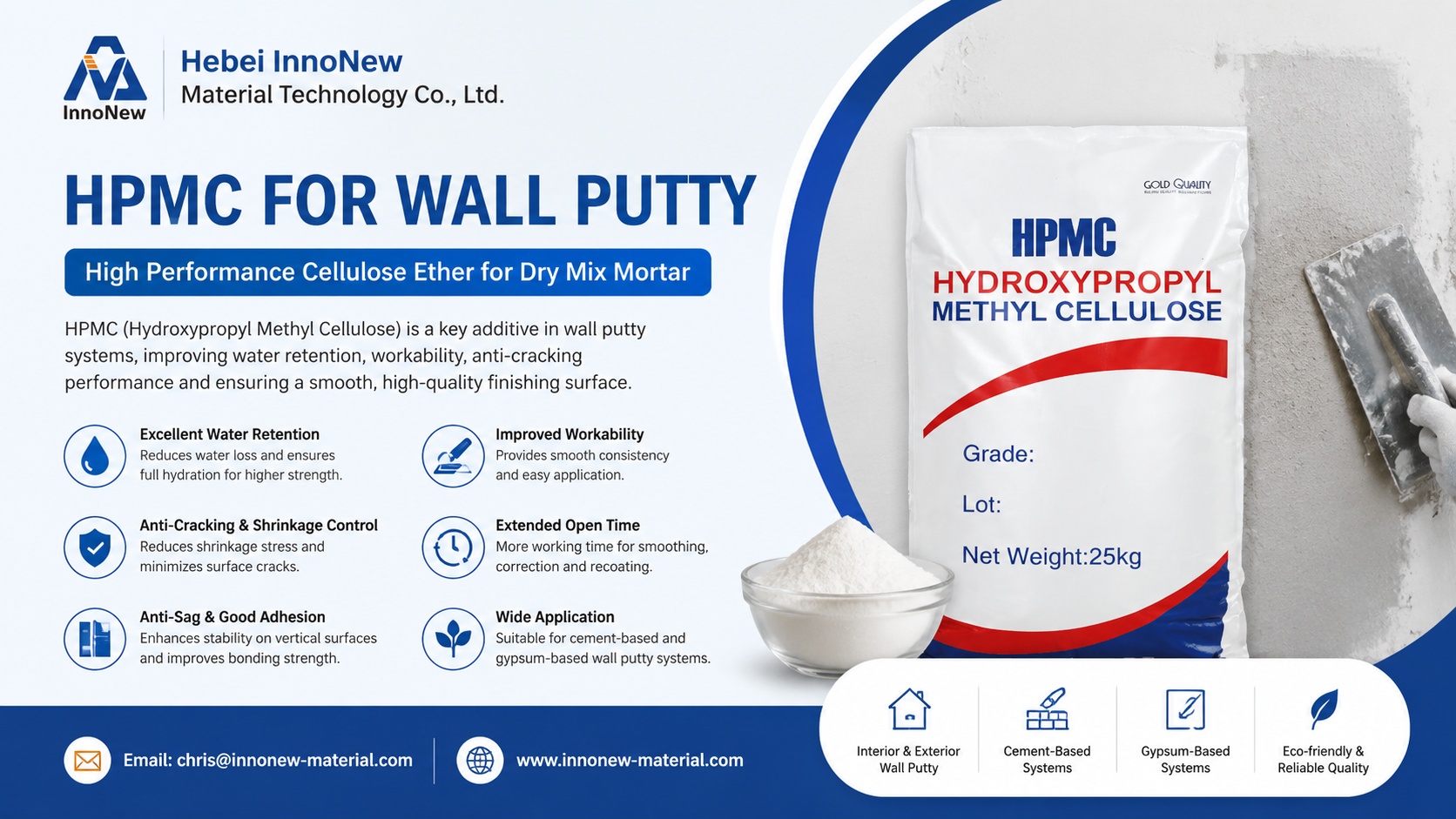
HPMC for wall putty (Hydroxypropyl Methyl Cellulose) is a key functional additive in modern dry-mix mortar systems, specifically designed to improve water retention, rheology control, workability, and anti-cracking performance in cement-based and gypsum-based wall putty formulations.
In wall putty systems, HPMC acts as a multi-functional performance regulator, ensuring stable application behavior, extended open time, and a smooth, defect-free finishing surface. It is widely used in interior and exterior wall leveling compounds, skim coats, and decorative finishing systems.
As a critical Cellulose Ether for wall putty, HPMC improves workability, enhances adhesion, and ensures a smooth, crack-free surface—making it an essential additive in modern dry mix formulations. Hebei InnoNew Material Technology Co., Ltd. is a professional manufacturer and supplier specializing in high-performance construction chemical additives, integrating R&D, production and sales. We are committed to providing stable, high-quality raw material solutions for dry-mix mortar, wall putty, tile adhesive, waterproof coatings and other building material industries. Our core product lines cover Hydroxypropyl Methyl Cellulose (HPMC), Redispersible Polymer Powder (RDP), Polyvinyl Alcohol (PVA) and other functional additives, which are widely recognized by global customers for reliable performance, consistent quality and cost-effective advantages.
What is HPMC in Wall Putty?
Wall putty is a fine powder coating material composed of white cement, calcium carbonate, and performance additives, applied to walls before painting to create a smooth and uniform surface.
In this system, HPMC serves as a rheology modifier + water retention agent + workability enhancer, ensuring:
- Stable hydration of cementitious binder
- Controlled drying rate
- Improved troweling performance
- Reduced shrinkage cracking
- Enhanced surface smoothness
Without HPMC, wall putty tends to suffer from:
- Rapid water loss
- Poor adhesion to substrate
- Powdering and cracking
- Uneven finishing surface
Technical Functions of HPMC in Wall Putty
HPMC provides multi-dimensional performance improvements through physical colloid behavior rather than chemical reaction.
1. Excellent Water Retention Mechanism
HPMC forms a protective hydrophilic network in the mortar system, reducing water evaporation and ensuring sufficient cement hydration.
This leads to:
- Higher bonding strength
- Reduced shrinkage stress
- Improved curing stability
2. Improved Workability & Smooth Application
HPMC significantly optimizes rheology, creating a creamy and smooth consistency that improves:
- Spreading efficiency
- Trowel resistance control
- Operator comfort during application
This is especially important for large-area wall finishing and machine spraying systems.
3. Anti-Sagging & Rheology Stability
HPMC increases viscosity stability and structural cohesion, preventing:
- Slumping on vertical walls
- Material separation
- Uneven thickness distribution
4. Crack Resistance & Shrinkage Control
By controlling moisture migration, HPMC reduces internal stress during drying, significantly lowering:
- Hairline cracks
- Surface shrinkage defects
- Powdering after drying
5. Extended Open Time
HPMC delays surface water loss, allowing installers more working time for:
- Smoothing
- Recoating
- Surface correction
Key Benefits of HPMC for Wall Putty
1. Excellent Water Retention
HPMC significantly improves water retention in wall putty, preventing rapid moisture loss. This ensures proper cement hydration and reduces shrinkage cracks.
2. Superior Workability & Smooth Application
- Enhances spreadability
- Provides creamy texture
- Improves troweling performance
This makes hydroxypropyl methyl cellulose for wall putty ideal for both manual and machine application.
3. Improved Adhesion Strength
HPMC increases bonding between putty and substrate, ensuring long-lasting durability and reduced delamination.
4. Anti-Sagging Performance
Optimized rheology control prevents sagging on vertical surfaces, making application easier and more efficient.
5. Crack Resistance & Surface Finish
- Reduces surface cracking
- Enhances smoothness
- Improves final decorative appearance
Technical Functions in Wall Putty
| Function | Performance Impact |
|---|---|
| Water Retention | Prevents premature drying |
| Thickening | Controls viscosity and consistency |
| Lubrication | Improves workability |
| Film Formation | Enhances surface smoothness |
| Open Time Control | Allows longer application time |
Recommended Dosage
Typical dosage of HPMC for wall putty:
- 0.2% – 0.5% of total dry mix
(depending on formulation and performance requirements)
Applications of HPMC in Wall Putty
1. Interior Wall Putty
- Smooth finishing
- Easy sanding
- Excellent whiteness
2. Exterior Wall Putty
- Improved weather resistance
- Crack prevention
- Enhanced durability
3. Cement-Based Putty
HPMC ensures stable hydration and consistent performance.
4. Gypsum-Based Putty
Provides excellent rheology and application control.
Learn more about our HPMC construction grade.
Why Choose InnoNew HPMC for Wall Putty
Hebei InnoNew Material Technology Co., Ltd. provides industrial-grade HPMC optimized for dry-mix mortar systems.
Key advantages:
- Stable viscosity consistency across batches
- Optimized dissolution speed for construction conditions
- Excellent compatibility with RDP, starch ether, and cement systems
- Designed for Asian, Middle East, and tropical climates
- Strong technical support for formulation optimization
Related Products
To maximize performance, combine with:
- Polycarboxylate Superplasticizer (PCE Powder)
- Redispersible Polymer Powder (RDP)
- Hydroxyethyl Cellulose (HEC)
- Powder Defoamer
- Hydroxypropyl Starch Ether (HPS)
FAQ
Q1: What is the main function of HPMC in wall putty?
HPMC acts as a water retention agent, thickener, and rheology modifier, improving workability and preventing cracking.
Q2: How does HPMC improve wall putty performance?
It enhances water retention, increases adhesion, and ensures smooth application and longer open time.
Q3: What viscosity grade is suitable for wall putty?
Typically, 40,000 – 100,000 cps viscosity grades are recommended depending on formulation needs.
Q4: Can HPMC prevent wall putty cracking?
Yes, by controlling moisture evaporation and improving flexibility, HPMC reduces cracking risk.
Q5: Is HPMC suitable for both interior and exterior putty?
Yes, high-quality HPMC works effectively in both applications.
Q6: Why is HPMC essential in wall putty?
HPMC controls water retention and rheology, ensuring proper cement hydration and preventing cracking and powdering.
Q7: What happens if wall putty has no HPMC?
It will dry too quickly, resulting in poor adhesion, cracking, and low workability.