
How Powder Defoamer Improves Quality of Self-Leveling Mortar
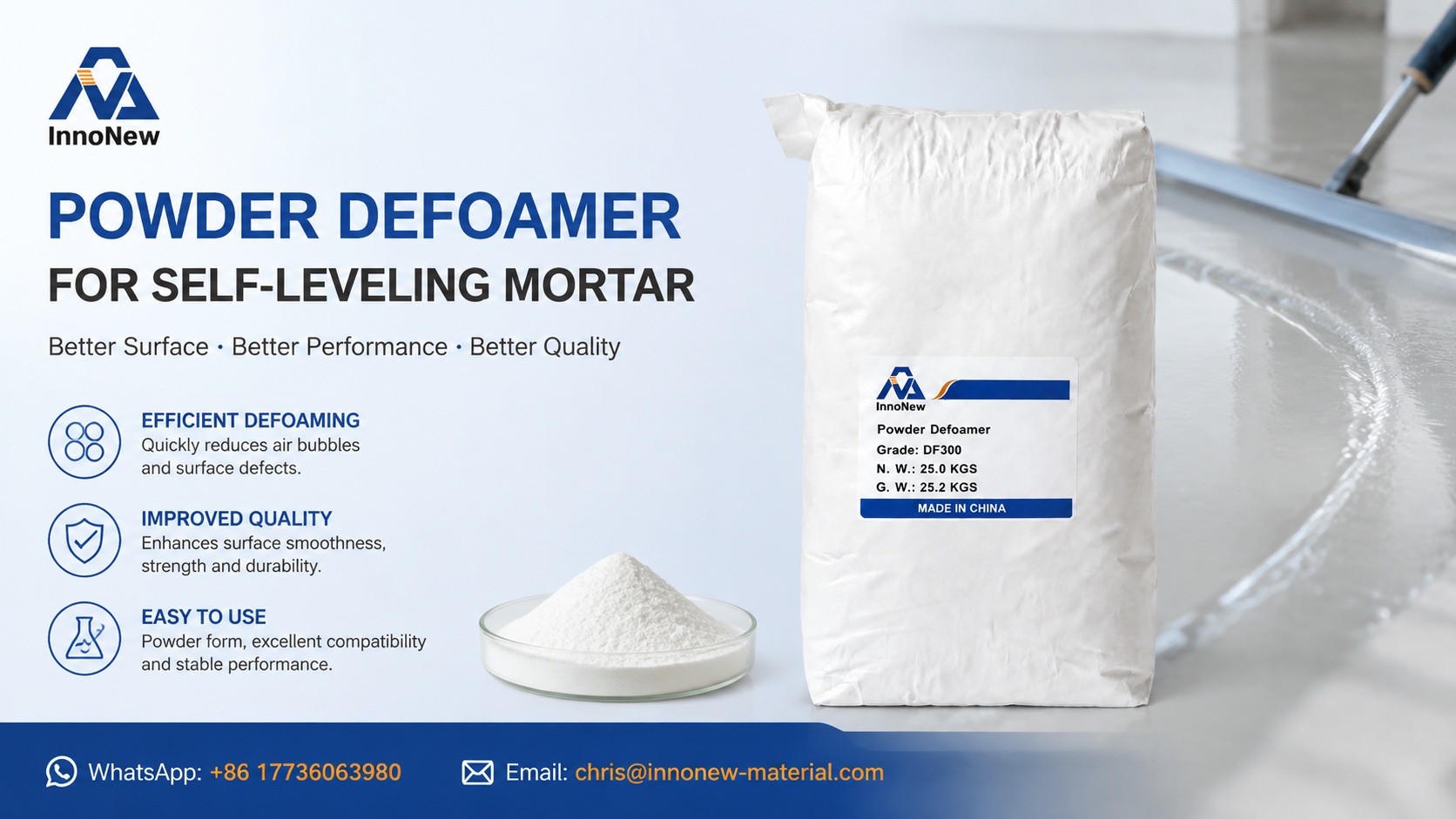
1. Introduction: The Importance of Surface Quality in Self-Leveling Mortar
Self-leveling mortar has become an important material in modern flooring systems due to its excellent flowability, rapid installation capability, and high surface smoothness. It is widely applied in:
- Commercial buildings
- Industrial flooring
- Residential renovation
- Underfloor heating systems
- Vinyl flooring and ceramic tile substrates
Unlike traditional cement mortar, self-leveling mortar requires extremely high requirements for:
- Surface smoothness
- Flow performance
- Dimensional stability
- Mechanical strength
- Decorative appearance
However, during production and application, one of the most common challenges is air entrainment.
Excessive air trapped inside the mortar system may lead to:
- Surface pinholes
- Craters
- Micro-voids
- Uneven appearance
- Reduced density
- Lower mechanical performance
For this reason, Powder Defoamer has become an important functional additive in high-performance self-leveling mortar formulations.
By controlling unwanted foam and releasing entrapped air, powder defoamer helps manufacturers produce smoother, stronger, and more reliable flooring materials.
2. Why Air Bubbles Occur in Self-Leveling Mortar?
Understanding air bubble formation is essential for optimizing self-leveling mortar formulations.
Air problems are usually caused by a combination of physical mixing effects and chemical interactions.
2.1 Air Introduction During Mixing Process
Self-leveling mortar is a complex dry-mix system containing:
- Cement
- Fine aggregates
- Mineral fillers
- Redispersible Polymer Powder (RDP)
- Hydroxypropyl Methyl Cellulose (HPMC)
- PCE Superplasticizers
- Other functional additives
During high-speed mixing with water, air can easily become incorporated into the mortar matrix.
Small air bubbles may remain suspended because of:
- High viscosity
- Surfactant components
- Polymer additives
- Stabilizing effects from cellulose ethers
Without effective defoaming control, these bubbles migrate to the surface and create visible defects after curing.
2.2 Chemical Additives Can Stabilize Foam
Many additives used in modern self-leveling mortar improve workability but may also influence foam behavior.
For example:
Cellulose Ether
Provides:
- Water retention
- Improved consistency
- Better construction performance
However, excessive dosage may increase air retention.
Polymer Powder (RDP)
Improves:
- Adhesion
- Flexibility
- Crack resistance
But polymer systems may increase foam stability due to surface-active components.
Polycarboxylate Superplasticizers
Improve:
- Flowability
- Water reduction
However, they may also change surface tension and affect bubble stability.
2.3 High Flowability Requires Advanced Air Control
Self-leveling mortar depends on excellent fluidity to spread automatically.
However:
Higher fluidity does not always mean better surface quality.
If air bubbles cannot escape quickly:
- They remain inside the material
- They accumulate near the surface
- They create defects after hardening
Therefore, balancing flowability and air release capability is a key formulation challenge.
3. What is Powder Defoamer?
Powder Defoamer is a specially designed dry additive used to control unwanted foam and air bubbles in cement-based dry mortar systems.
Unlike liquid defoamers, powder defoamer is developed specifically for:
- Dry mixing production
- Bagged mortar systems
- Factory-produced construction materials
Typical powder defoamer compositions include:
- Modified mineral carriers
- Silicone-based defoaming components
- Organic active defoaming agents
The product is engineered to provide:
Excellent Dry Mixing Compatibility
Powder defoamer can be directly blended with other dry ingredients, ensuring:
- Uniform dispersion
- Stable performance
- Easy production operation
Superior Storage Stability
Compared with liquid additives, powder defoamer provides:
- Longer shelf life
- Easier transportation
- Lower packaging requirements
This makes it especially suitable for modern dry mortar factories.
4. Working Mechanism of Powder Defoamer in Self-Leveling Mortar
Powder defoamer improves self-leveling mortar quality through several mechanisms.
4.1 Reducing Entrapped Air
The main function of powder defoamer is controlling air bubbles by reducing surface tension within the mortar system.
It helps:
- Break unstable bubbles
- Prevent excessive foam formation
- Accelerate air release
As a result:
- Internal porosity decreases
- Mortar density improves
- Surface defects are minimized
4.2 Improving Surface Appearance
Surface appearance is one of the most important quality indicators for self-leveling flooring materials.
Without proper defoaming control:
Common defects include:
- Pinholes
- Small craters
- Foam marks
- Uneven texture
After adding powder defoamer:
Manufacturers can achieve:
- Smoother surface
- Better leveling effect
- More uniform appearance
This is particularly important for decorative flooring systems where final appearance directly affects customer acceptance.
4.3 Enhancing Mechanical Properties
Air voids act as weak points inside hardened mortar.
Reducing air content improves:
- Compactness
- Compressive strength
- Flexural strength
- Abrasion resistance
- Long-term durability
Therefore, powder defoamer indirectly contributes to improved mechanical performance by optimizing the internal structure of the mortar.
5. Benefits of Using Powder Defoamer in Self-Leveling Mortar
5.1 Better Surface Finish
A high-quality self-leveling mortar should provide a smooth and defect-free surface.
Powder defoamer helps reduce:
✓ Surface bubbles
✓ Pinholes
✓ Micro defects
✓ Uneven curing appearance
Result:
A cleaner and more professional flooring surface.
5.2 Improved Flow Performance
Powder defoamer does not simply eliminate foam; it helps maintain the balance between:
- Flowability
- Viscosity
- Air release
This allows self-leveling mortar to achieve:
- Better spreading ability
- More stable leveling performance
- Improved construction experience
5.3 Improved Production Stability
For dry mortar manufacturers, formulation stability is critical.
Using powder defoamer can help:
- Reduce batch variation
- Improve product consistency
- Lower rejection rates
- Increase customer satisfaction
5.4 Better Compatibility with Other Additives
High-performance self-leveling mortar contains multiple additives.
Powder defoamer is generally designed to work together with:
- HPMC
- RDP
- PCE Powder
- Calcium Formate
- Retarders
Proper compatibility ensures stable formulation performance.
6. Recommended Dosage of Powder Defoamer in Self-Leveling Mortar
The recommended dosage depends on formulation design and raw material characteristics.
Typical dosage range:
0.1% – 0.5% based on total dry mortar weightExample:
For 1000 kg self-leveling mortar:
Powder Defoamer dosage:
1 – 5 kgThe optimum dosage depends on:
- Cement type
- Polymer content
- Cellulose ether dosage
- Mixing equipment
- Required surface quality
Excessive dosage should be avoided because it may affect:
- Flow behavior
- Surface properties
- Adhesion performance
Laboratory testing is recommended before commercial production.
7. Powder Defoamer vs Liquid Defoamer for Dry Mortar Applications
| Item | Powder Defoamer | Liquid Defoamer |
|---|---|---|
| Application | Dry mortar systems | Wet formulations |
| Mixing method | Direct dry blending | Additional liquid dosing |
| Storage stability | Excellent | Limited |
| Transportation | Easy | Higher cost |
| Suitable products | Self-leveling mortar, tile adhesive | Coatings, emulsions |
For factory-produced dry mortar products, powder defoamer provides significant advantages in production efficiency and formulation stability.
8. How to Select the Right Powder Defoamer for Self-Leveling Mortar
Selecting the correct defoamer is critical for achieving optimum performance.
8.1 Compatibility
The defoamer should be compatible with:
- Cement systems
- Polymer additives
- Cellulose ethers
- Superplasticizers
8.2 Defoaming Efficiency
A high-performance powder defoamer should provide:
- Rapid bubble breaking
- Long-lasting foam control
- Effective air release
8.3 Low Dosage Performance
Premium products should achieve excellent results at low dosage levels.
Advantages:
- Cost efficiency
- Stable formulation
- Easier production control
9. Application Example: Powder Defoamer in Cement-Based Self-Leveling Compound
A self-leveling mortar manufacturer experienced:
Before optimization:
- Visible surface pinholes
- Poor final appearance
- Customer complaints after installation
After introducing powder defoamer:
Results:
✓ Reduced surface bubbles
✓ Improved surface smoothness
✓ Higher product consistency
✓ Better customer acceptance
This demonstrates the importance of proper foam control in high-performance flooring materials.
10. Conclusion
Powder Defoamer is a key functional additive for improving the quality of modern self-leveling mortar.
By controlling unwanted air bubbles, reducing surface defects, and improving mortar compactness, it enables manufacturers to produce:
- Smoother flooring materials
- More stable dry mortar products
- Better mechanical performance
- Higher customer satisfaction
For self-leveling mortar producers, selecting a suitable powder defoamer is an effective approach to optimize formulation performance and maintain competitive product quality.
FAQ
What is the function of powder defoamer in self-leveling mortar?
Powder defoamer reduces entrapped air and controls foam formation, helping improve surface smoothness and mortar density.
How much powder defoamer should be added to self-leveling mortar?
The typical dosage is around 0.1%-0.5% of total dry mix weight, depending on formulation requirements.
Can powder defoamer improve mortar strength?
Yes. By reducing internal air voids, powder defoamer can improve mortar compactness and contribute to better mechanical properties.
Is powder defoamer compatible with HPMC and RDP?
High-quality powder defoamers are designed to be compatible with common dry mortar additives including HPMC and RDP.
Why does self-leveling mortar need defoaming additives?
Because air bubbles generated during mixing can cause surface defects and reduce final material performance.