
A Technical Guide for Engineers and Construction Professionals on Adhesion, Workability, and Durability Optimization
Introduction
Modern construction increasingly demands high-performance mortars capable of delivering excellent workability, strong adhesion, and long-term durability. Traditional cement-sand mortars often face challenges such as early shrinkage, cracking, and poor substrate bonding.
The combination of InnoNew Hydroxypropyl Methylcellulose (HPMC) and InnoNew Redispersible Polymer Powder (RDP) has emerged as a technically proven solution. HPMC improves workability, water retention, and consistency, while RDP enhances adhesion, flexibility, and durability. Together, they form a synergistic system that meets the stringent requirements of modern construction projects worldwide.
HPMC in Mortars: Enhancing Workability and Water Retention
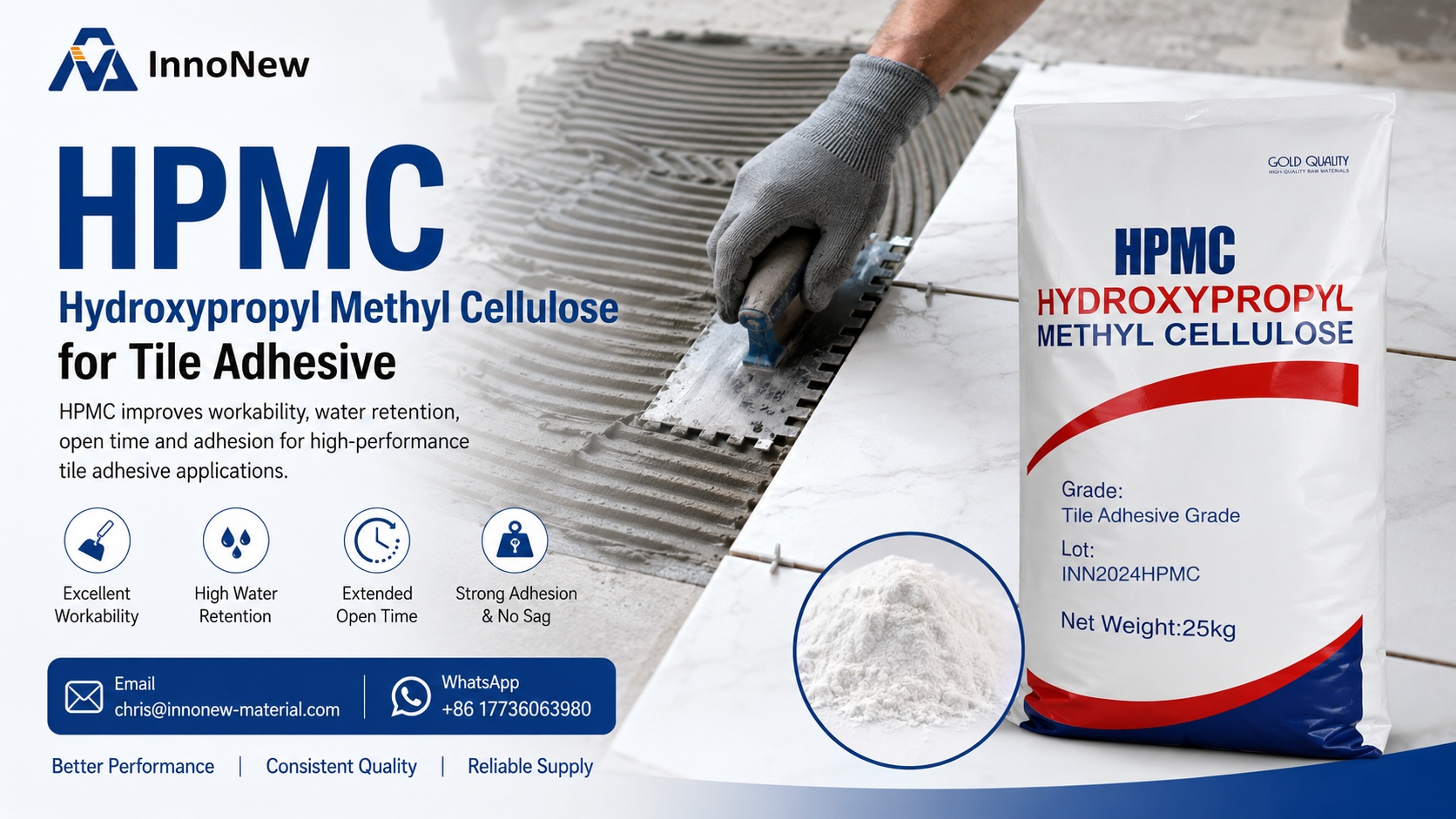
Hydroxypropyl Methylcellulose (HPMC) is a cellulose ether widely used as a viscosity modifier and water retention agent in cementitious mortars. Its key functions include:
- Water Retention: Maintains moisture to ensure complete cement hydration, reducing shrinkage.
- Workability Improvement: Provides smooth flow and easy troweling, especially in vertical applications.
- Mortar Stabilization: Reduces segregation and enhances mix consistency.
Technical Insight: HPMC molecules form a viscous network in the water phase, slowing evaporation and allowing uniform cement hydration. This directly improves early strength and bonding properties.
Applications: Tile adhesives, plastering mortars, self-leveling floors.
RDP in Mortars: Boosting Adhesion and Durability
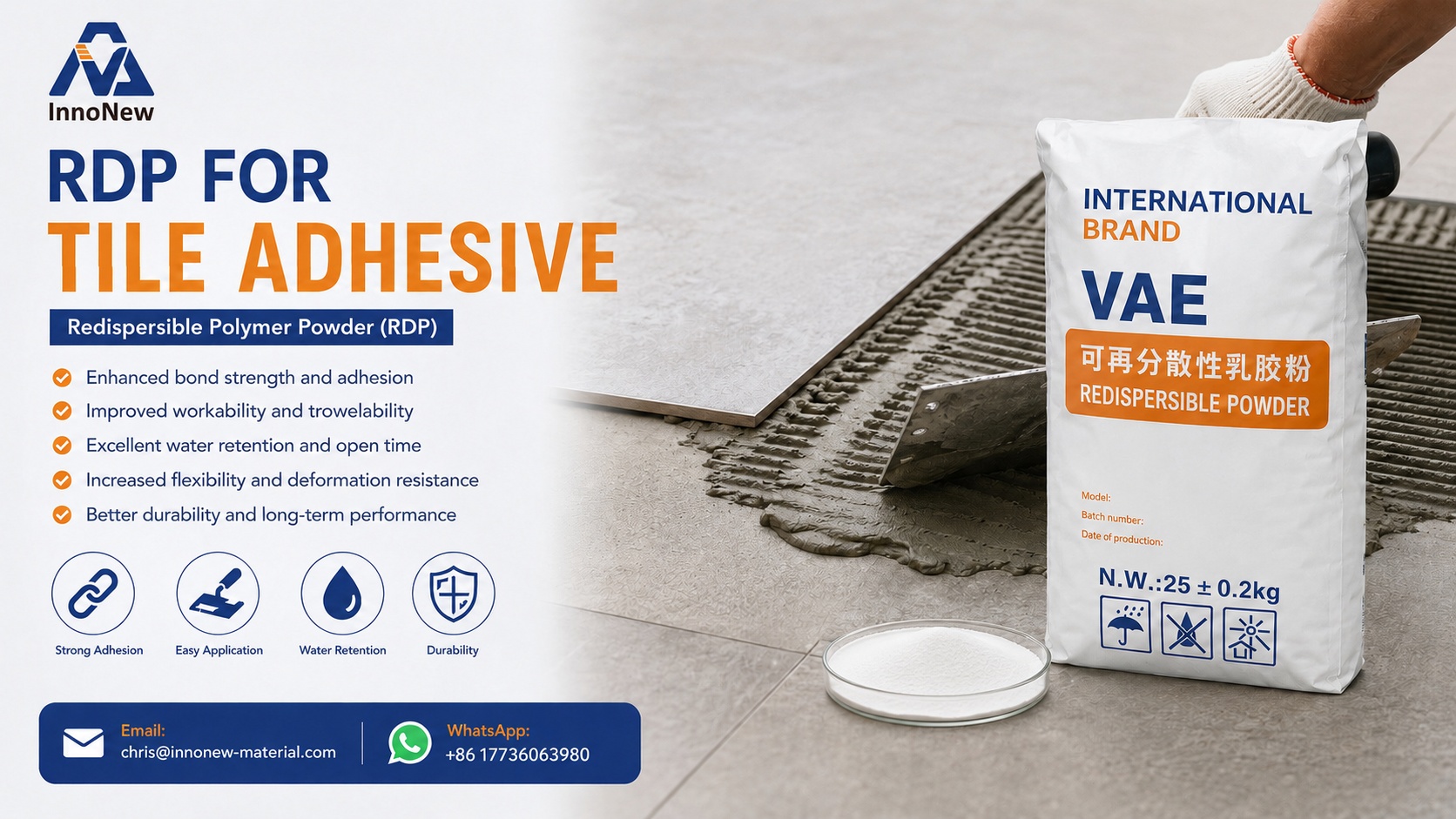
Redispersible Polymer Powder (RDP) is a polymeric additive that, when dispersed in water, enhances the mechanical properties of mortars. Key benefits include:
- Enhanced Adhesion: Forms a polymer film within the cement matrix, increasing bond strength to concrete, tiles, and gypsum boards.
- Crack Resistance: Improves flexibility and reduces shrinkage cracks during curing.
- Long-Term Durability: Increases resistance to environmental stress such as freeze-thaw cycles and moisture ingress.
Technical Insight: RDP particles coalesce during curing to form a continuous polymer network, reinforcing the cement matrix and significantly improving tensile and flexural strength.
Applications: Repair mortars, exterior wall plasters, self-leveling floors.
Synergy Between HPMC and RDP
While HPMC and RDP are effective individually, their combination produces a synergistic effect, enhancing multiple performance parameters simultaneously.
| Property | HPMC | RDP | Combined Effect |
|---|---|---|---|
| Workability | High | Moderate | Optimal consistency and extended open time |
| Water Retention | High | Moderate | Ensures uniform hydration, improves strength |
| Adhesion | Moderate | High | Superior bonding to diverse substrates |
| Flexibility | Low | High | Reduced cracking, improved durability |
| Durability | Moderate | High | Long-term resistance to environmental stress |
Mechanism: HPMC forms a viscous network in the water phase while RDP forms a polymer film within the cement matrix. This combination enhances workability, adhesion, and durability simultaneously.
Practical Applications in Construction
- Tile Adhesives: Improved open time and strong adhesion allow precise tile placement with minimal delamination.
- Self-Leveling Mortars: Smooth flow, reduced shrinkage, and crack resistance create flat, durable surfaces.
- Plasters and Renders: High water retention and adhesion prevent premature drying and improve surface finish.
- Repair Mortars: Flexible polymer-modified mortars withstand mechanical stress and prevent cracking.
Case Example: A commercial construction project in Southeast Asia using HPMC + RDP-modified mortar achieved:
- 25% faster application time
- 30% stronger adhesion to concrete substrates
- Significant reduction in surface cracks after 28 days curing
Recommended Dosage and Mixing Guidelines
| Additive | Typical Dosage | Notes |
|---|---|---|
| HPMC | 0.3–0.6% of dry mortar | Adjust viscosity for application type |
| RDP | 1–5% of dry mortar | Optimal for adhesion and flexibility |
| Water | As per mix design | Ensure proper dispersion of additives |
Tip: Add HPMC to water first, then RDP, to maximize dispersion and performance.
FAQ:
Q1: Does HPMC affect setting time?
A1: Slightly extends open time but does not negatively impact final strength.
Q2: Can RDP be used with all cement types?
A2: Generally yes, but preliminary testing is recommended for specialty cements.
Q3: Can HPMC and RDP be used separately?
A3: Yes, but combined use provides optimal performance.
Q4: Does this combination increase material cost?
A4: While additive costs rise slightly, improved efficiency and performance justify the investment.
Q5: How much does it improve durability?
A5: Depending on formulation, crack formation can decrease by 40–60%, and adhesion improves by 25–30%.
Conclusion
The combination of HPMC and RDP is essential for creating high-performance mortars that meet modern construction standards. By optimizing workability, adhesion, flexibility, and durability, this synergistic system allows contractors to achieve superior construction quality, efficiency, and long-term performance.
This technical approach has proven effective in tile adhesives, self-leveling mortars, plastering, and repair applications, making HPMC + RDP the industry standard for polymer-modified mortars.